A garden room starts out as a nice idea: somewhere quiet to sew, throw pots, pour candles, do nails or cut hair a few steps from the back door. Then the orders pick up, the kettle and the heater are on every day, and the studio quietly becomes a business. That is the point where electricity stops being a household bill and starts being a running cost you need to plan for.
This guide is for readers in the UK, where small business electricity has more than doubled in price since 2019. Here is what has changed, how to work out what your own studio uses, and where the savings usually are.
Home Tariff or Business Tariff?
If your studio runs off the same meter as the house, you are most likely still on your home tariff. If it has its own supply and meter set up for business use, or you work from a small unit or shop, you will be on a business contract instead.
Business contracts work differently from home tariffs. They are not covered by the energy price cap, they are usually fixed for one to three years, and there is usually no cooling-off period once you sign. That makes the price you agree at the start matter a lot more.
What Small Businesses Pay for Electricity Now
Government figures from the Department for Energy Security and Net Zero (DESNZ) track what businesses pay on average. For the smallest business users, the group most garden studios and one-person workshops fall into, the average price was 16.71p per kWh in 2019, including the Climate Change Levy. In the first half of 2026 it was 36.69p, an increase of about 120%.
Slightly larger small businesses saw their average go from 14.89p to 28.67p per kWh over the same period, up about 93% (based on DESNZ Quarterly Energy Prices).
In plain numbers, every 1,000 kWh a very small business used cost about £167 in 2019 and about £367 in 2026. Those are averages, and the price on any one contract depends on when it was signed, how long it runs and how much power you use. Before you agree to a new deal, it is worth taking a few minutes to compare business electricity rates for your own usage rather than relying on the average.
How to Work Out What Your Studio Uses
You do not need a smart meter to get a rough idea. Look for the wattage on each piece of equipment, usually on a label on the back or underneath, and use this simple sum:
– Watts ÷ 1,000 × hours used = kWh
– kWh × your price per kWh = cost
Here is one example. A 2,000-watt (2 kW) heater running for six hours uses 12 kWh. At the 2019 average of 16.71p, that is about £2.00 a day. At the 2026 average of 36.69p, it is about £4.40. Across 100 cold working days, the same heater goes from about £200 to about £440 a season.
Do the same for the things that run longest in your space. In most studios that means heating, lighting, a kettle, and whatever your craft needs, such as a kiln, a sewing machine, a hair dryer or a wax heater. Heating is often the biggest share in a garden building, because it is small, detached and loses warmth quickly.
Simple Ways to Bring the Bill Down
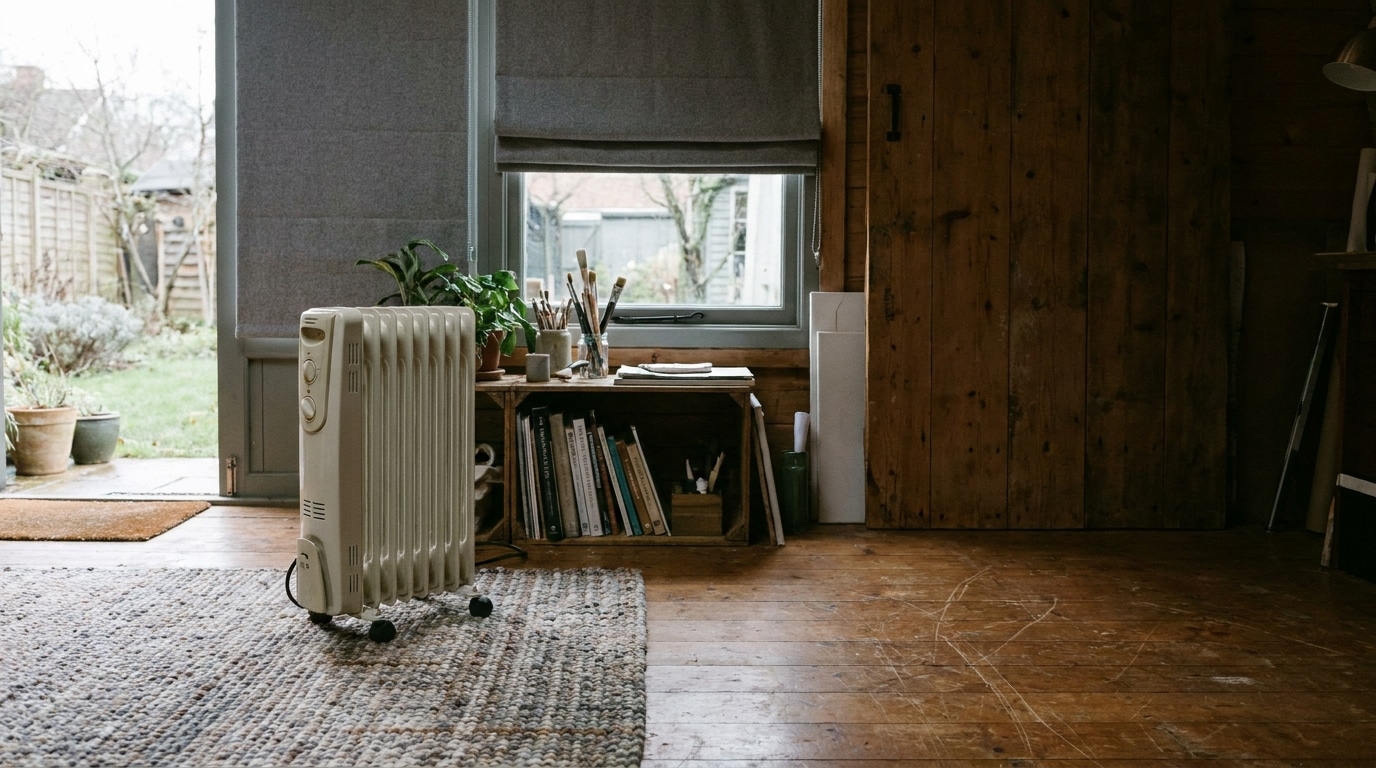
Insulate before you heat. Garden rooms lose heat through thin walls, floors and doors. Draft strips, a rug and thermal blinds are cheap and make the heater work less.
Heat yourself, not the room. A small heater near where you work, on a timer, often does more than a big one heating the whole space all day.
Switch to LED lighting. If you still have older bulbs or tubes, LEDs use far less power for the same light.
Turn equipment off at the wall. Chargers, heaters and machines left on standby add up over a working week.
Batch your power-hungry jobs. If you fire a kiln or run a dryer, do it in fewer, fuller sessions rather than many small ones.
Watch Your Contract End Date
The biggest saving for many small businesses is not a gadget but timing. When a fixed business contract ends, it can roll on to a higher rate if you have not given notice or agreed a new deal. Put the end date and the notice period in your calendar. A month or two before it, take the time to find a better energy deal for your business instead of letting it renew on whatever terms come through the door.
Frequently Asked Questions
Can I Run My Garden Studio Business on My Home Electricity?
Many people do, especially when the studio shares the house supply. Your home insurer, and your landlord if you rent, may want to know you are running a business from the property, so it is worth checking with them.
Why Are Some Small Businesses Paying So Much More Than in 2019?
Business contracts are not covered by the price cap, and many were fixed when wholesale prices peaked in 2022 and 2023. Some of those contracts are still running, which is one reason the 2026 average is still more than double the 2019 one.
How Much Electricity Does a Garden Studio Use?
It depends on the size, how well it is insulated and what you use in it. The sum above, applied to your own equipment and hours, will give you a better answer than any average.
Conclusion
A garden studio can be one of the best ways to start a small business at home, and it is worth keeping it that way. Know what you use, keep the heat where you need it, and treat the contract end date as the one day a year that decides most of your electricity bill.
How the figures were worked out: average prices are from DESNZ Quarterly Energy Prices table 3.4.2 (prices paid by non-domestic consumers, very small and small bands, including the Climate Change Levy), 2019 and the first half of 2026. The heater example uses an assumed 2 kW heater for six hours a day over 100 days and is for illustration only.”