I own nine quarter-zips. No, that’s not a typo, and yes, my closet rod has complained about it. But here’s what nine of them taught me: the quarter-zip is one of the most misused pieces in menswear. Wear it wrong, and you look like you’re heading to a Tuesday budget meeting. Wear it right, and it’s the most versatile layer you’ll own.
You want one garment that works from a cool morning walk to dinner and doesn’t look like a costume either time. Most men own men’s quarter zips and treat them like a uniform shirt, which is exactly why they look office-bound. Below are the layering, fit, and fabric rules I’ve tested across hundreds of outfits, plus the small details that separate a sharp quarter zip from one that just looks borrowed.
Where the Quarter Zip Actually Belongs in Your Rotation
Think of a quarter zip as a bridge layer, not a base and not a coat. It sits between your tee and your jacket, keeping your core warm while leaving your neck open for a collar to peek through. That open neck is the whole point. A full zip hides your shirt collar when it’s closed, and a crewneck flattens everything into one blob. The quarter zip meets in the middle, which is why it plays so well with everything underneath it.
Stylists call this the “second-layer gap” moment. The top quarter of your chest is where the outfit’s punctuation happens, whether it’s a white tee collar or a chambray shirt. According to the Department of Labor, the professional dress codes that dominate American offices have shifted dramatically over the past decade toward business casual. That shift is exactly why one layer has to do more work than it used to.
Under a Jacket, or Over a Shirt? Both Work, if You Follow This Rule
Here’s the rule I use and I’d bet on it every time: match your layer’s weight to your outerwear, not your mood. A lightweight quarter zip slides under a blazer without adding bulk at the shoulders. A heavier one belongs over a shirt with nothing on top, or under a casual bomber.
Three combinations that always look right:
- Blazer + merino quarter zip + dress shirt. The zip sits low so the shirt collar shows. Skip the tie.
- Bomber + performance quarter zip + plain tee. Weekend uniform, no thinking required.
- Over a flannel, no outerwear. Blue-collar texture meets upscale fit, and it works in a way that shouldn’t.
Where guys go wrong is stuffing a heavy fleece under a blazer. The shoulders bunch, the collar sticks up, and you look like you’re wearing two jackets at once. Weigh your layers on a kitchen scale if you’re unsure. If the quarter zip feels like a sweater, it does not go under structured tailoring.
Fabric Is the Real Dividing Line
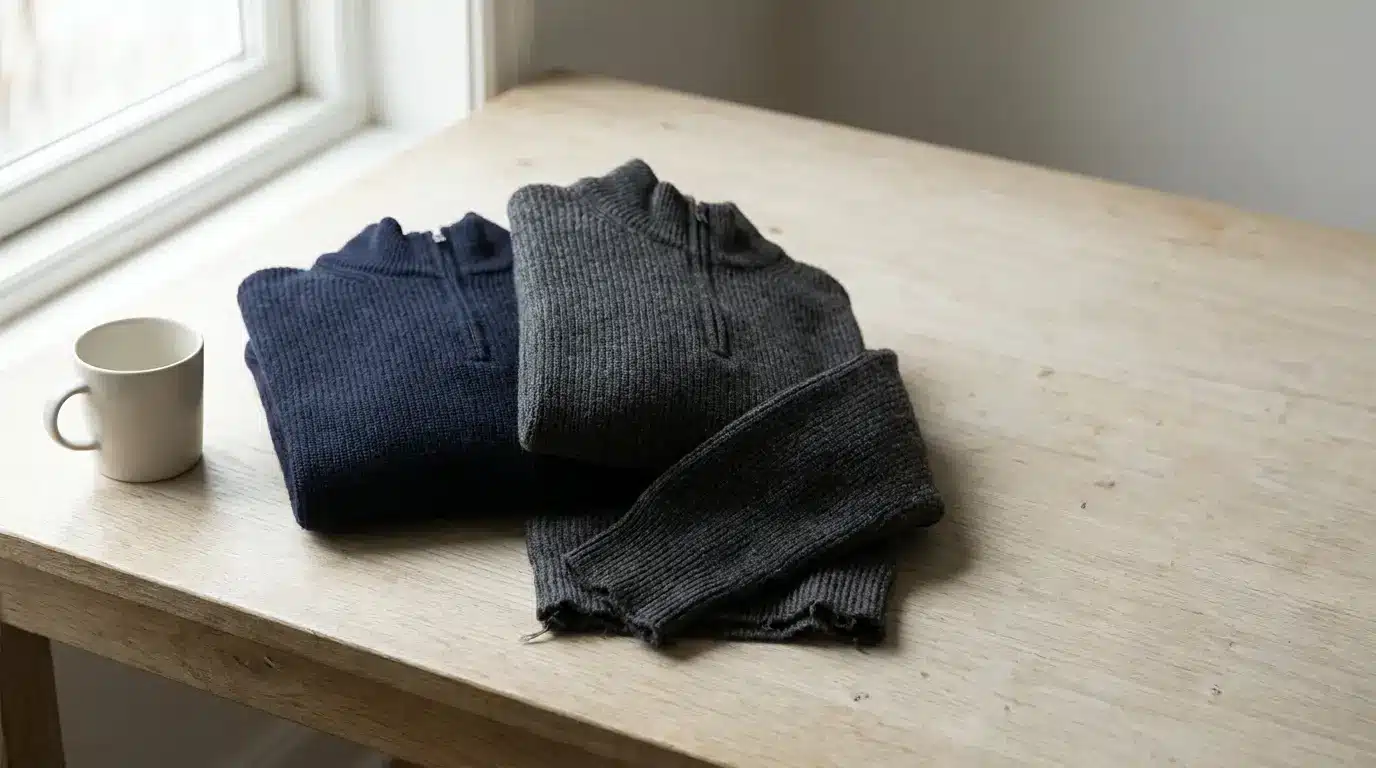
Cotton and merino give you softness and a little drape. Performance knits give you stretch, moisture management, and color that survives fifty washes. At a wardrobe level, that matters more than style, because a quarter zip you have to treat like fine china ends up unworn in a drawer.
Here’s a test: pinch the fabric and see how it springs back. Cotton stays pinched. Performance fabric bounces almost instantly, which is the same reason it moves with you through traffic and a mid-morning walk. The Bureau of Labor Statistics tracks textile, apparel, and furniture manufacturing as a major American industry, and the shift toward technical knits shows up in how those mills invest. For you, the takeaway is simple: technical fabric is the difference between a quarter zip you buy and one you reach for on a Tuesday.
The Fit Details that Decide Everything
Most quarter zips are cut too long, which pulls the hem below your belt and shortens your legs. The fixes are obvious once you see them:
- Hem stops at mid-fly. Not below. Not on your hips.
- Shoulder seam sits at your natural shoulder point, not three inches past it.
- Sleeve ends at your wrist bone, so the cuff doesn’t bunch when you layer
- Chest give: you should be able to slip one hand flat against your chest without straining the fabric
If your current quarter zip fails two of those four, you’re fighting it. Tailor the hem down an inch and you’ll feel the difference immediately on your next mirror check.
Care that Keeps the Color Honest
Quarter zips die in the dryer. Heat shrinks the knit, fades dark dyes, and roughs up the surface. Turn it inside out, wash cold, and hang it flat to dry. Tags come with care instructions for a reason, and the Federal Trade Commission oversees the labeling rules that make those symbols enforceable, so if a garment tells you cold water, it means it.
One more habit: never fold a quarter-zip collar-to-collar in a drawer with a hanger collar pressing on it. The zipper teeth leave marks that look like scratches by the third month. Fold it flat with the zipper closed, or hang it on a wide-shouldered hanger that respects the neckline.
The Collar Question, Finally Answered
Pop the collar or leave it flat? Flat, unless you’re wearing the quarter zip as a single outer layer, in which case a light pop against a stiff collar looks sharp. What you don’t want is a full stand-up with a collar underneath, because now your neck is doing two jobs at once.
Quarter zip dressed up, or quarter zip dressed down? Down, almost every time. Buy one in navy or charcoal, wear it untucked over a plain tee with clean jeans and a white sneaker. If you want one dressed up, go with merino and a crisp white shirt underneath, then close the zipper halfway so the shirt cinches the shape.
Pull every drawer-worthy item, then retire the rest. A closet where every quarter-zip fits well, and every layer earns its spot beats a packed rail of maybes. Pick three that pass the pinch test, fold them right, and see how many mornings they solve before you check the full drawer.