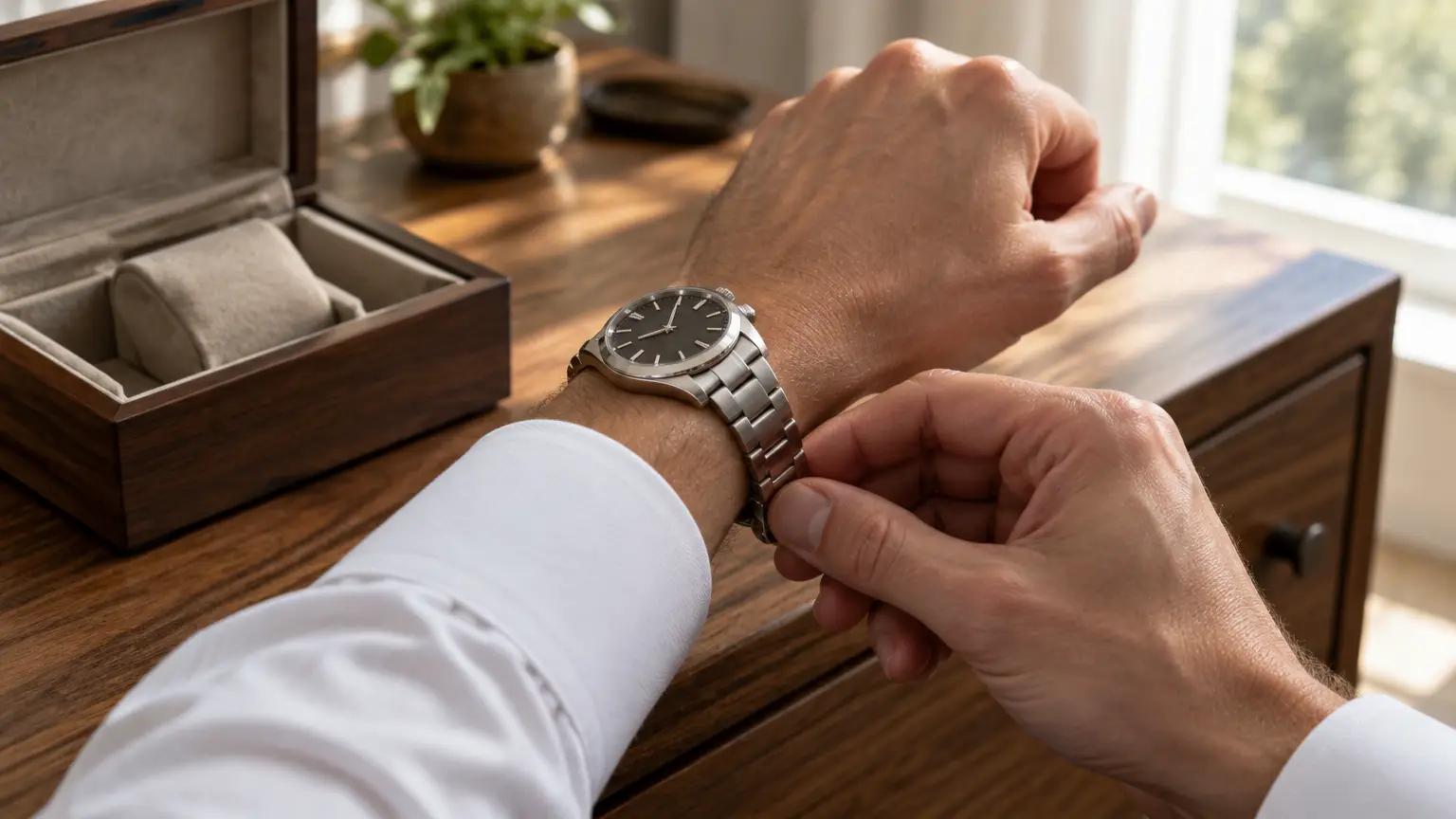
To style an everyday luxury watch, pick a case that fits your wrist, then match its metal and strap to your outfit and the setting. To care for it, keep it away from magnets and hot water, clean it every week, and get it serviced on schedule. Most damage comes from small daily habits, not big accidents.
Get the Fit Right Before Anything Else
The number on the spec sheet can mislead you. A 40mm watch with long lugs can look bigger than a 42mm watch with short, curved ones. Check the lug-to-lug length, which is the distance from the top strap end to the bottom. If the lugs hang past the edges of your wrist, the watch is too big for you, whatever the diameter says.
|
Wrist Circumference |
Comfortable Case Diameter |
|
Under 6.5 in (16.5 cm) |
34mm to 38 mm |
|
6.5 in to 7.25 in (16.5 cm to 18.5 cm) |
38mm to 41 mm |
|
Over 7.25 in (18.5 cm) |
41mm to 44 mm |
If you wear button-cuff shirts, look for a case under about 12mm thick so it slides under the cuff. The watch should sit just above your wrist bone, with room for one finger under the bracelet. If it is loose, it slides around and the case back gets scratched. If it is tight, it leaves marks on your skin by the afternoon.
Most new bracelets need a link or two taken out. A shop that handles luxury watch repair can size the bracelet without scratching the clasp. Keep the spare links, because buyers often ask for them when you resell the watch. Wear the watch on your non-dominant wrist. It takes fewer knocks there, and you can wind or set it with your stronger hand.
Metals and Other Accessories
The old rule was to match your watch to your belt buckle and jewelry. That still looks clean, but you don’t have to follow it strictly anymore. A two-tone watch works as a bridge piece when you wear gold and silver together. If you like layering metals, this guide to styling mixed metals in jewelry shows how to keep the look planned instead of random. One watch can cover most of your week if you swap straps:
- Steel bracelet: Office, travel, and days when you might get caught in the rain.
- Leather: Dinners and formal events. Black is dressier than brown.
- NATO or fabric: Weekends and outdoor plans. It is cheap, washable, and easy to replace.
- Rubber: Swimming, the gym, and hot weather.
Before you buy a strap, check your lug width. It is usually printed on the case back or listed in the manual. A strap that’s 2mm too narrow will slide around and strain the spring bars.
If you wear bracelets on the same wrist, put a soft one, like a leather cord or beads, right next to the watch. Hard metal chains rub against the case and leave fine scratches on polished surfaces within weeks. The same idea applies when you mix and match rings on the same hand: give hard metals a little space from each other.
Daily Habits That Wear Down a Watch
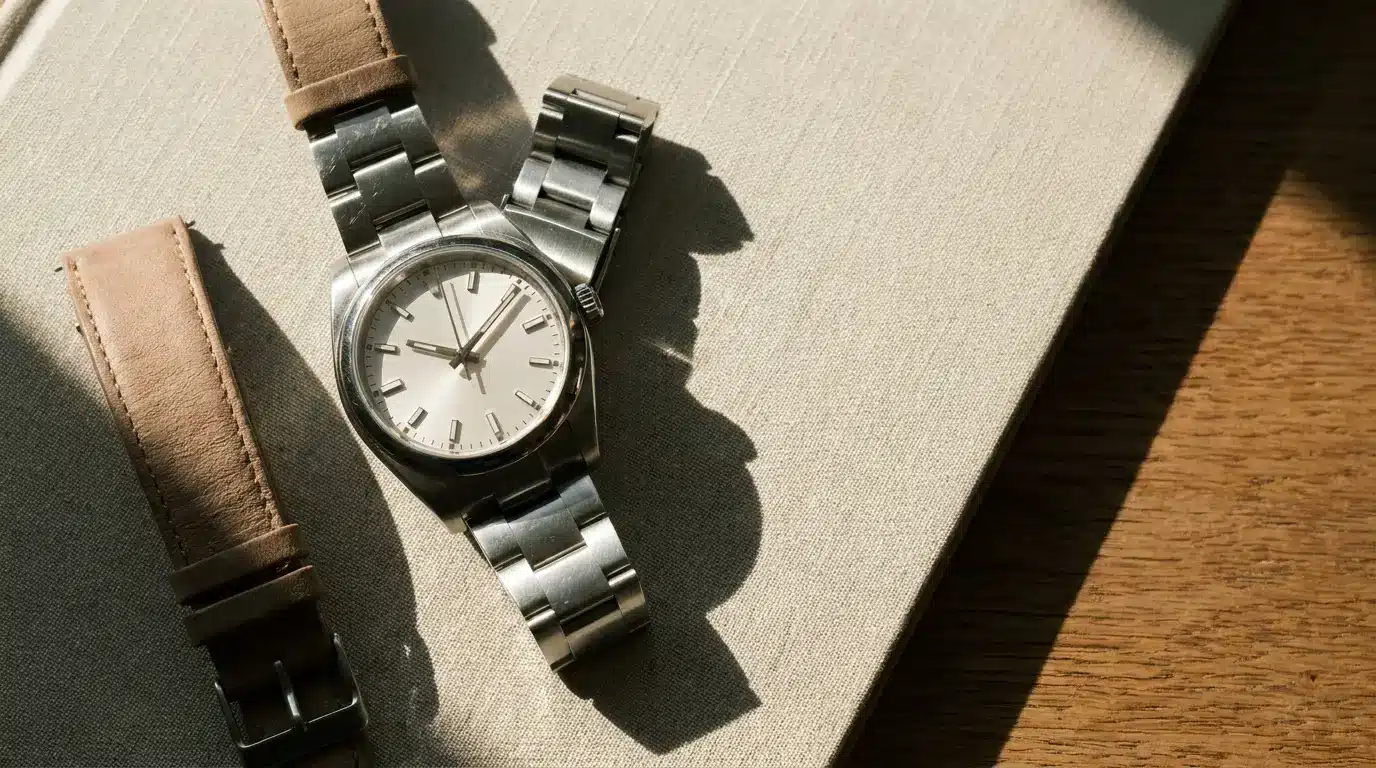
Remember, these habits can wear down your watch, so try to keep an eye on them.
Magnets Are Everywhere
Phone cases with magnetic clasps, laptop lids, handbag snaps, and induction cooktops can all magnetize a mechanical watch. When that happens, the coils of the hairspring stick together, and the watch can start gaining several minutes a day. To check, hold the watch close to a compass app on your phone. If the needle moves, the watch is likely magnetized. A watchmaker can demagnetize it in a few minutes, often for very little.
Water Resistance Ratings Don’t Mean What They Say
A “30m” rating doesn’t mean you can dive to 30 meters. It’s a lab pressure test, and in real life it only covers splashes and rain. Use this as a practical guide:
- 30m: Handwashing and rain
- 50m: Light swimming, if the crown screws down
- 100m and above: Regular swimming and snorkeling
- 200m / ISO 6425 diver: Diving
Never press chronograph pushers or pull out the crown while the watch is wet. Also keep it out of hot showers and saunas. Heat makes the gaskets expand and then shrink, and over time that lets moisture in. If you see fog under the crystal, take the watch to a watchmaker within a day or two.
Don’t Change the Date at Night
On many mechanical watches, the date gear starts moving at around 9 p.m. and stays engaged until roughly 3 a.m. If you use the quick-set date in that window, you can break teeth off the gear. Move the hands to 6 o’clock first, set the date, and then set the time.
Sunscreen, Perfume, and Sweat
Sunscreen and perfume dry out rubber gaskets and stain leather. Put them on first, let them dry, and then put on your watch. Sweat contains salt, which collects in bracelet links and slowly wears them. If you wear leather straps in summer, rotate between two so each one can dry fully.
A Simple Weekly Cleaning Routine
- Check that the crown is pushed in or screwed down all the way.
- Wipe the case and crystal with a damp microfiber cloth.
- Scrub the bracelet links with a soft toothbrush and mild soapy water. Only do this if the watch is rated 50m or higher.
- Rinse with lukewarm water, never hot.
- Pat it dry and leave it face-up for an hour.
Keep leather straps away from water, and hand wash NATO straps on their own.
Storage and Winding
You don’t need a watch winder. If an automatic watch stops, that does no harm. Just wind it with the crown about 20 to 30 turns before you put it on. If you do use a winder, set it to the turns-per-day number the brand recommends, because running it all the time adds wear.
If you won’t wear a quartz watch for a few months, pull the crown out to stop the hands. Replace the battery every two to three years, even if the watch still runs. Old batteries can leak and eat through the circuit board, and that repair often costs more than a full service. Store watches dial-up in a lined box, away from windowsills. Sunlight fades dials and dries out straps.
Service Intervals and Warning Signs
Most mechanical watches need a full service every 5 to 10 years. The oils inside break down over time, even when the watch keeps good time. Get it checked sooner if you notice any of these:
- It gains or loses more than about 20 seconds a day
- The crown feels gritty or loose when you wind it
- The power reserve is shorter than it used to be
- There is moisture or dust under the crystal
- The rotor makes a grinding or scraping sound
For any of these, go to a watchmaker who works on your brand rather than a general jewelry counter. They can pressure-test the case, replace worn gaskets, and use factory parts, which protects both how the watch runs and what it is worth when you sell it. Ask for a pressure test after every battery change too, since opening the case back can disturb the seal.