You can spend twenty minutes getting your makeup just right. The foundation blends beautifully, your concealer stays exactly where it should, and you’ve finally mastered that effortless, barely-there finish.
Then you remember sunscreen.
Or worse, you remember that your foundation already has SPF 30 and wonder whether you’ve been worrying about nothing.
It’s a reasonable question. After all, beauty products have become remarkably multifunctional. We have tinted moisturizers, skin tints, foundations, primers, and powders that promise coverage, hydration, and sun protection in one convenient step.
But there’s a difference between a product containing SPF and actually getting the level of protection printed on its packaging.
And understanding that difference might change how you approach your morning makeup routine.
Your Foundation Has SPF. Isn’t That Enough?
Imagine applying your favorite SPF 30 foundation. You use a small amount on your forehead, a little around your nose, and just enough on your cheeks to even out your complexion.
Your makeup looks great. But have you applied enough product to receive the SPF 30 protection stated on the label?
Probably not.
SPF ratings are determined using standardized application amounts. Most people apply foundation for the coverage they want, not according to the amount required for sunscreen testing.
That distinction matters because applying less product can result in less UV protection than the label suggests.
The American Academy of Dermatology’s sunscreen guidance recommends using a sufficient amount of broad-spectrum sunscreen with SPF 30 or higher and reapplying it approximately every two hours when outdoors.
Makeup with SPF can be a useful addition, but relying on a thin layer of foundation as your only protection may leave you with less coverage than you expect.
The solution isn’t to abandon your favorite foundation. It’s to give sunscreen its own place in your routine.
The Order of Application Actually Matters
Most beauty routines already have a familiar order. Cleanser comes first, followed by skincare products, moisturizer, and makeup.
Sunscreen belongs between skincare and makeup.
According to the American Academy of Dermatology, applying products in the appropriate sequence helps them work as intended. Its recommended routine places moisturizer and sunscreen before makeup.
In practice, that means finishing your skincare routine, applying sunscreen according to its directions, allowing it to settle, and then moving on to foundation or concealer.
You don’t necessarily need a complicated collection of products. If your sunscreen is moisturizing enough for your skin, you may find that you don’t need a separate moisturizer underneath.
What matters is avoiding the temptation to use less sunscreen simply because you’re planning to apply makeup afterward.
A comfortable formula can make that much easier.
Why Some Sunscreens Work Better Under Makeup
We’ve all experienced a product combination that seemed perfectly fine until we started blending.
Your foundation suddenly rolls into tiny flakes. Concealer refuses to sit smoothly. Or the sunscreen underneath feels so rich that everything seems to slide around.
This is often described as pilling, and it can happen when products don’t layer comfortably together.
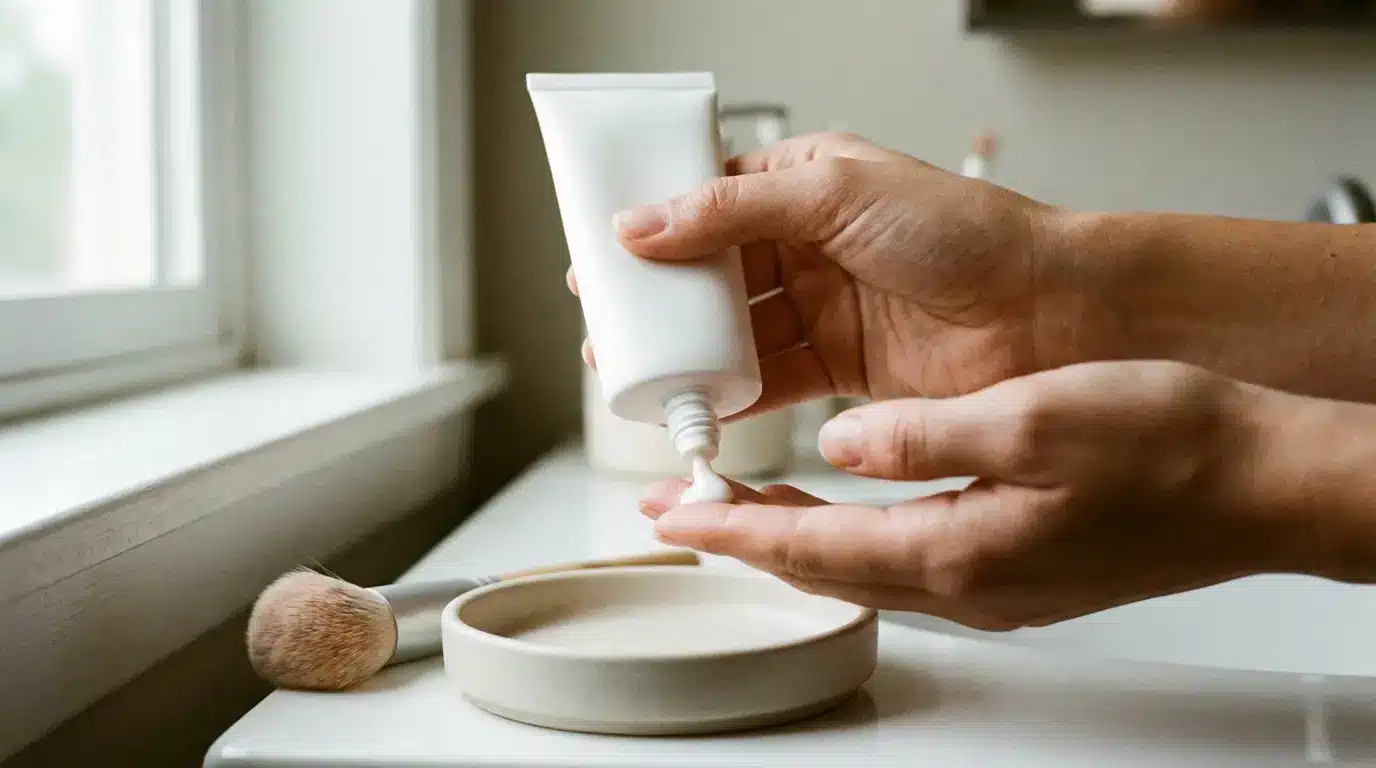
Several factors may contribute, including the textures of the products, the amount applied, and how they’re rubbed or blended.
Sometimes using too many skincare layers makes the problem worse. Other times, allowing each product a little time to settle can help.
Sunscreen formulations themselves also vary considerably.
Some are rich creams, while others are lightweight fluids, gels, or serum-like products. Mineral sunscreens use zinc oxide, titanium dioxide, or both as UV filters, and the surrounding formulation influences their texture and application.
The development of zinc oxide ingredients for mineral sunscreen involves considerations such as dispersion, spreadability, and compatibility with other ingredients. These factors can influence how a finished product feels on the skin.
For someone who wears makeup regularly, that matters. A sunscreen that feels comfortable and layers well is much easier to make part of a daily routine.
The Beauty of a Lightweight Formula
There’s a reason lightweight skincare products have become so popular. Many of us want our skin to feel comfortable without having to choose between sun protection and a polished makeup finish.
A sunscreen that spreads easily, settles comfortably, and doesn’t leave an overly greasy finish can make morning routines more manageable.
And sunscreen doesn’t have to come in just one texture.
Looking at different sunscreen formulation examples shows how sun protection can be incorporated into products such as lightweight creams, tinted moisturizers, and foundations.
Of course, not every product format works equally well for every person. A rich sunscreen may suit someone with dry skin, while a lighter formula may be more comfortable for someone who dislikes heavier textures.
The important thing is to choose a product with appropriate tested protection rather than assuming a lighter texture means weaker SPF.
Texture and SPF are different characteristics. You can look for both comfortable wear and effective sun protection.
What About Tinted Moisturizers and Skin Tints?
Tinted moisturizers occupy an interesting space between skincare and makeup.
They’re often designed to provide hydration, a little color, and sometimes sun protection. For anyone who prefers minimal makeup, that combination can be appealing.
But the same application question applies.
If a tinted moisturizer is labeled SPF 30, that rating applies when the product is used at the tested amount. Applying a tiny dab for sheer coverage may not deliver the protection you expect.
Some tinted sunscreens are specifically developed to provide sun protection alongside cosmetic coverage. These can be practical choices when applied in the appropriate amount.
Tinted products containing iron oxides may offer another benefit. The American Academy of Dermatology notes that iron oxides can help protect against visible light, which can contribute to dark spots.
Still, shade matching matters. A tinted product is only convenient if you’re comfortable wearing enough of it.
If applying the recommended amount leaves the color looking too heavy, consider using a dedicated sunscreen underneath your preferred makeup instead.
The Midday Makeup Problem
Morning sunscreen is one thing. Reapplying it over a full face of makeup is another.
Nobody wants to spend fifteen minutes blending foundation only to feel like they need to start over by lunchtime.
But sunscreen protection needs attention throughout the day, particularly when you’re spending time outdoors.
The American Academy of Dermatology recommends reapplying sunscreen approximately every two hours outdoors and after swimming or sweating.
For makeup wearers, one practical approach is to use a suitable sunscreen that can be gently applied over makeup, working in sections and allowing it to settle before touching up any displaced cosmetics.
You may also encounter SPF setting sprays, sticks, cushions, and powders. These can be convenient formats, but convenience alone doesn’t guarantee adequate protection. You still need to apply the amount required by the product’s directions.
A light dusting of SPF powder shouldn’t automatically be assumed to replace a full sunscreen application.
Shade, hats, and other protective measures can also help reduce exposure when you’re out for extended periods.
The best approach is the one that lets you maintain protection without relying on an unrealistically perfect makeup routine.
Your Makeup Routine Doesn’t Need More Rules
It’s easy for beauty advice to become exhausting.
Use this ingredient. Avoid that texture. Wait a specific number of minutes. Buy another product because the one you already own apparently isn’t good enough.
But a practical sunscreen routine doesn’t need to be complicated.
Choose a broad-spectrum sunscreen with SPF 30 or higher that suits your skin and daily activities. Apply it generously according to the label, before makeup. Then use the foundation, concealer, or tinted moisturizer you actually enjoy wearing.
If your products don’t layer well, experiment with simpler skincare underneath or a different sunscreen texture.
And if you spend substantial time outdoors, plan how you’ll reapply sunscreen rather than assuming your morning foundation will provide protection all day.
That’s really the heart of it.
Good Makeup and Good Sun Protection Can Coexist
Makeup is personal. Some days you want a full face, carefully blended and finished with setting powder. Other days, a little concealer and lip balm feel like more than enough.
Sun protection should be able to fit into either routine.
Your foundation doesn’t need to do every job. Your sunscreen doesn’t need to behave like a primer. And you shouldn’t have to sacrifice the makeup finish you enjoy just to make room for protection.
The most useful beauty routine is one that works in real life, not just in a perfectly lit tutorial.
So keep the foundation you love. Enjoy the tinted moisturizer that makes your mornings easier. Experiment with textures until you find products that feel comfortable together.
Just remember that an SPF number on your makeup doesn’t automatically mean you’re getting that level of protection.
Sometimes the most important beauty step is the one nobody can see.