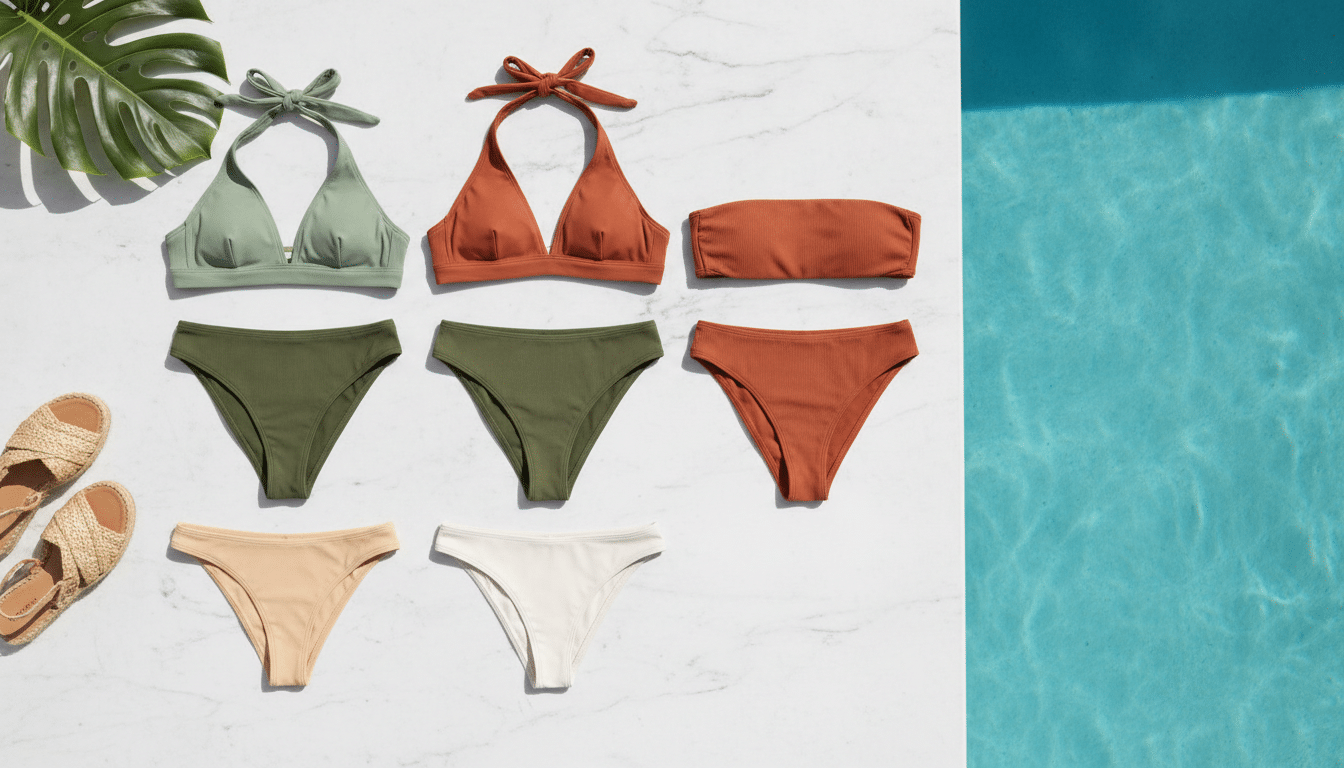
The majority of swimwear tops are sized like bras, with band and cup sizing. The majority of swimwear bottoms are sized like underpants or low-rise jeans, with elastic and approximate size equivalents. Sort these into two categories, then guess that most women aren’t the exact same size on bottom and top. That’s right: it’s time to mix and match.
Why Buying Separates Solves a Fit Problem, Not Just a Style One
The fact about the average bust-to-hip ratio fluctuating enough that a coordinated set intended for one body type doesn’t really flatter the other half of a person makes sense, doesn’t it?
That’s the logic behind suit separates: you purchase the top to suit your ribcage and bust, and the bottom to suit your hips and waist, free from each other. Bra-sized bikini tops make this simpler, since sizing by band and cup (32DD, for example) gets you closer to real support than a universal S/M/L tag ever could.
This simply isn’t a niche preference any longer. According to McKinsey’s State of Fashion report, the worldwide swimwear market is developing at about 6% yearly until 2025, and separates are a noteworthy source of that development as buyers displace from fixed sets. Retailers have risen to the challenge.
Most swim collections now make the tops and bottoms to be shopped freely, with color families and fabric runs made explicitly so pieces from the same collection – or even distinctive ones – can be recombined.
When you stop considering swimwear as “outfits” you purchase ready-to-wear and begin considering it as a closet of swapable parts, the complete category becomes a lot more practical.
Find Your Coverage Formula First
Determine your top-versus-bottom coverage formula before you consider color or fabric. This can be really abstract but an effective shortcut is just looking at photos of yourself and noting if you’ve generally got more skin showing up top (usually denoted by a lower-cut or strappier style) or more showing on the bottom (higher leg-line, maybe more midriff).
The more often you feel great about an outfit is an experiment to see if that proportion is reflective of how you naturally like to dress. If you generally prefer a higher-coverage top and more minimal bottoms in your day-to-day wardrobe, you’re not going to feel great in something that’s cut high right up to the navel.
Conversely, fans of the full-length leg and a skimpy triangle top are going to end up disappointed by a full-midriff cropped top.
Here’s where pairing logic comes in: a high-coverage top, like a halter neck or a full-cup style, gives you room to balance with something cheekier on the bottom half. The structure up top does the visual work of grounding the outfit, so the bottom can be less substantial without the whole look feeling unbalanced.
This is where Thong Bikini Bottoms come in as a genuinely useful pairing option – when they’re set against a structured, supportive top, the combination reads as deliberate and confident rather than mismatched. The opposite direction works too. A skimpy triangle top needs a more substantial bottom underneath it, or the whole silhouette starts to look unfinished rather than intentionally minimal.
Write your coverage formula down if you have to. Something like “structured top, lower coverage bottom” or “minimal top, high-waisted bottom” gives you a filter to run every future purchase through, so you’re not relying on guesswork every time you shop.
Match Fabric Weight, Not Just Color
This is the rule most people skip, and it’s the reason some mix-and-match outfits look expensive while others look accidental.
Swimwear fabric isn’t uniform. A lined, structured top with real bra construction has weight and density to it. A thin, unlined triangle top made from lightweight jersey does not. When you pair a heavy, structured piece with a flimsy, delicate one, the mismatch is visible even if the colors are perfect. Your eye reads the difference in texture before it registers anything else.
The fix is simple: pair substantial with substantial, delicate with delicate. A ruched, fully-lined bottom with good structure belongs with a similarly built top. A barely-there tie-side bottom in soft, unlined fabric belongs with something equally minimal on top. This also affects how the Lycra or spandex content behaves once wet – fabrics with different stretch and recovery rates will hang differently on the body, and that becomes obvious the moment you’re out of the water and the suit is doing its actual job of holding shape.
Strap width follows the same logic. Wide straps on both pieces create an athletic, sport-luxe look. Thin straps on both pieces create something more delicate and pared-back. Mix a wide-strap top with thin-strap bottoms and the silhouette breaks somewhere in the middle – not wrong exactly, but visibly unresolved.
Use Color Math Instead of Guessing
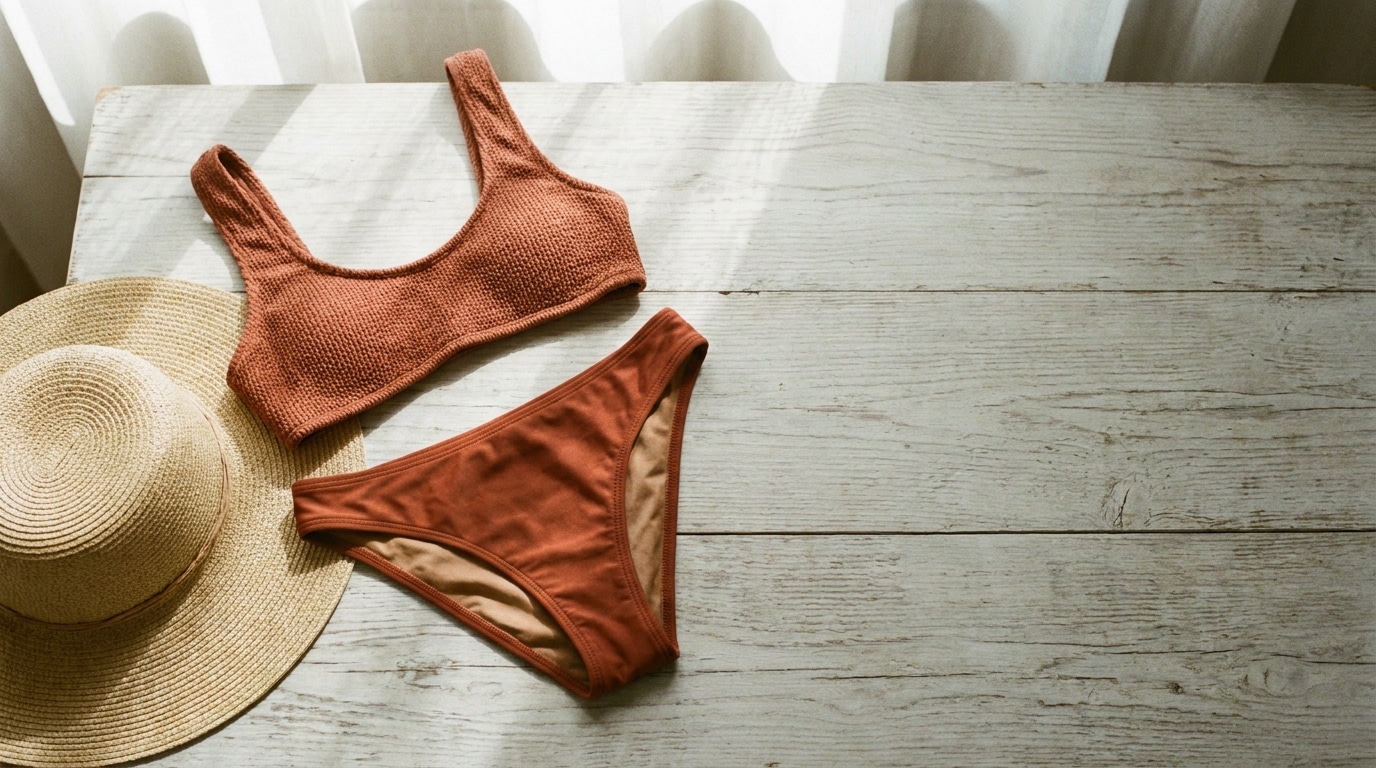
Color is often the dividing line between those who nail mix-and-match swimwear and those who just get dressed in the dark. And there is a method to the madness of a pulled-together bikini that we can break down.
Analogous, or colors that sit next to each other on the color wheel (like a terracotta top with a rust bottom, or a sage top with an olive bottom), create a tonal look. This reads as expensive and considered. It’s also the easiest color strategy for beginners because it’s genuinely hard to get wrong.
High contrast works too, but it has to look like you meant for it. A black top with a white bottom, or a navy top with a bright citrus bottom, doesn’t look thrown-together, because the contrast is clean and the colors themselves aren’t fighting. Where color pairing actually fails is when you put together two different neon or saturated brights that weren’t designed to sit together.
A hot pink top against an orange-red bottom doesn’t contrast cleanly, it just clashes, because both colors are competing for the same visual attention.
How to Create Multiple Outfits With One Printed Piece and Two Solid Colored Items
If you have one printed garment that you’d like to maximize, identify two solid colors that already exist within the print (one is often a neutral or a color that doesn’t dominate the print) and repeat that color in two separate pieces.
For instance, a printed blouse with grey, yellow, and white in the pattern provides a perfect excuse to (finally) buy a pair of yellow skinny jeans and a grey pencil skirt. You’ll be able to create multiple outfits just from the three new items you’ve bought because they connect back to pieces you already had.
Let Your Proportions Decide the Cut
The most effective way to decide which bottom to wear with which top is not to force them to obey a set of rules about angles and aesthetics, but to try them on and look in the mirror. It’s unavoidably the most boring, repetitive, practical advice because it endlessly works.
Body proportions matter more than trend, but no style “should” be off-limits if you want to wear it. It might just be that you get a cheeky butt bottom in a high-waisted cut because Emily Ratajkowski’s waist-to-bum ratio is not the one you’re working with.
Fashion is best when you’re having fun, but feeling like yourself – not when you’re wondering whether everything’s in its right place. Cross that off the list and you can concentrate on perfecting your canon ball.
Build Pieces That Survive More Than One Summer
The mix-and-match capsule only pays off if the pieces last, so buy with fabric performance in mind, not just color and cut. Look for a UPF rating of 50+ on core pieces you’ll wear the most, since sun exposure adds up fast over a season of repeated wear, and higher-rated fabric holds its protective quality longer than lower-rated alternatives.
Spandex or Lycra recovery matters just as much. A bottom that’s lost its stretch after a handful of wears will sag, ride, and generally undercut whatever top you’ve paired it with, no matter how good the color match is.
Chlorine and saltwater are both hard on synthetic fibers, and sand abrasion wears down the surface of fabric faster than people expect, so pieces with a higher percentage of quality spandex tend to hold their shape and color longer than budget alternatives.
This matters more once you’re building a capsule swim wardrobe rather than buying one outfit at a time. A capsule works because a handful of well-chosen separates can combine into far more outfits than the number of pieces would suggest, but only if every piece is still holding its shape by outfit number six.
Care for Separates Like the Different Fabrics They Are
Patterns and solid colors, lined and unlined items, heavy and delicate fabrics – it’s all in the mix when you put together a capsule wardrobe, and you inevitably wind up with clothes that require different care and handling in the laundry. Treating them all the same doesn’t do any of them any good in the long term.
Turn printed items inside-out before washing to help prevent colors from fading due to agitation and friction, as well as preventing damage to the fabric from the inside. Whenever possible, separate by weight.
The rough texture of a heavily-lined skirt or pair of pants rubbing up against a delicate, unlined top is a good way to begin the pilling process on a fine fabric. It’s also more likely to make lighter items eat lint, bleed dye if they’re dark, or generally wear out more quickly.
Avoid the dryer and use the heat cycle sparingly, if at all. In most cases, it’s the heat that breaks down spandex recovery. Washing and line drying aren’t nearly as tough on fabric, unless you live on the equator and use extremely hot water. It’s a small thing, but it’s the difference between a capsule wardrobe that starts to go limp by the end of the season and one that still looks good three years down the line.
From Beach to Resort Without Changing Clothes
Another bonus to building separates this way is that these sorts of pieces cease to be strictly “swimwear” and instead become resort wear coordinates. A top and a high-waisted bottom with structure in complementary solids can be worn right from the water to a beachside lunch with a sarong or shorts worn over the bottom. A printed one-piece makes that switch far more difficult, as it always comes across as swimwear no matter what you layer on top.
This is also one of the reasons the industry has been moving towards more body-inclusive marketing and sizing over recent years – it’s not just about the representation, it’s that separates as a category only function if people with different builds from each other can actually purchase individually fitting pieces for each part of them.
The more brands lean into that, the easier things get for you to shop around the coverage formula and proportion logic rather than settling for what a matching set happens to include.
The Framework, Not the Shopping List
Once you know your coverage formula, match fabric weight instead of guessing, and use color math instead of trend-chasing, mixing and matching stops being a gamble. You end up with a handful of pieces that combine into far more outfits than you paid for, and every combination looks like it was chosen on purpose – because it was.