Here is a thing almost nobody is told when they buy their first serious bottle of perfume: where you keep it matters roughly as much as what is in it. A well-made fragrance stored badly will turn within a year.
The same bottle in a drawer will still smell right in five. Nobody mentions this at the counter, and the place most of us instinctively put perfume is the single worst spot in the house.
Three Things Break Perfume, and Only Three
Light, heat and air. That is the whole list. Ultraviolet light breaks apart the aromatic molecules and, on the way, discolors the liquid, which is why a pale yellow juice slowly goes amber on a sunny windowsill. Heat accelerates every chemical reaction happening inside the bottle, including the ones you do not want.
Air oxidizes, which is why a bottle that is three quarters empty degrades faster than a full one; the space above the liquid is filled with oxygen doing quiet damage. Everything else you have read about perfume storage is a variation on avoiding those three.
The Bathroom Is the Worst Place in the House
And it is where most of us keep it, on an open shelf, next to a window, in a room that goes from cool to steaming twice a day. A bathroom cycles through humidity and temperature swings more violently than any other room, and those swings are worse for a fragrance than a single hot afternoon would be.
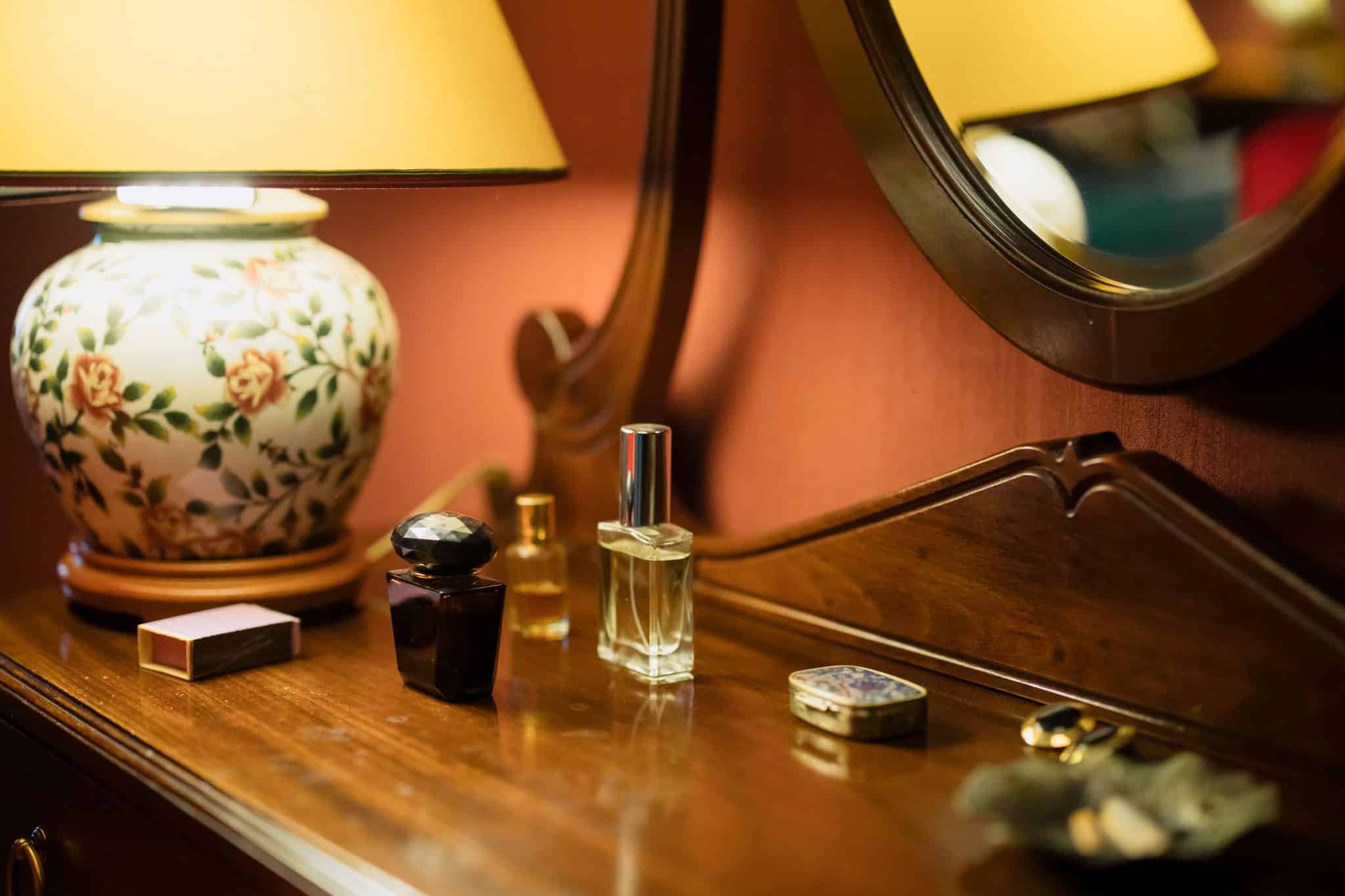
If you take one thing from this: move the bottles out. A bedroom drawer, a closet shelf, anywhere the temperature stays roughly constant and the light never reaches. You will notice the difference on the bottles you own longest.
What Good Storage Actually Looks Like
Keep the box. I know it feels like clutter, and the packaging on nice perfume is genuinely beautiful, but the box is a light filter that came free with the purchase. Store bottles upright so the liquid is not sitting against the atomizer seal. Pick an interior wall rather than an exterior one, since exterior walls track the outdoor temperature more than you would think.
Avoid the refrigerator, despite what you may have read; the cold is fine but the constant door-opening temperature swing is not, and neither is storing perfume next to food. A closed drawer in a room you sleep in is close to ideal and costs nothing.
Sometimes the Bottle Is Doing the Work for You
Some houses have quietly solved part of this through design. Opaque and lacquered cases block light entirely, which is a functional decision dressed up as a decorative one.
Anyone who owns a kilian fragrance will know the heavy lacquered clutch-style cases the house is known for, and the refill system that goes with them; the point of that design is that the vessel is meant to outlast the juice inside it and be topped up rather than discarded.
Dark or heavily tinted glass does a similar job less obviously. If you are choosing between two bottles you like equally, the one that keeps the light out will still smell like itself for longer.
Concentration Changes the Timeline
Not every bottle ages at the same rate. Higher concentration formulas hold up better over time, because there is proportionally more oil and less of the alcohol and water that carry the volatile top notes away. An eau de cologne is the most fragile thing in your collection and should be used within a couple of years.
An extrait can outlive the person who bought it. This is worth knowing before you buy: a bottle of initio perfume at extrait strength is a slower purchase in every sense, worn a spray at a time and stable on the shelf for years, while a light summer eau de toilette is something to finish rather than save. Buying a large bottle of something delicate and rationing it is how good perfume goes to waste.
How to Tell If a Bottle Has Turned
Trust your nose over the calendar. The first sign is almost always the opening: a sharp, slightly sour, vaguely metallic note in the first thirty seconds that was not there before. The base usually survives longer, so a turned bottle can smell wrong for two minutes and nearly normal afterward, which is confusing. Visible cloudiness or a significant color change is a clearer signal.
A turned fragrance is not dangerous, it just no longer smells like the thing you paid for, and no amount of storage will bring it back. If you are unsure, compare it against a sample of the same fragrance bought recently. Memory is unreliable about smell in a way it is not about color, and plenty of bottles get thrown out because someone’s taste changed rather than the liquid.
Frequently Asked Questions
Does perfume have an expiration date?
Not a fixed one. Most fragrances are usable for three to five years, and well-stored high-concentration bottles considerably longer. Citrus-forward and very fresh compositions are the shortest-lived, so use those rather than saving them.
Should I keep perfume in the fridge?
Generally no. A wine fridge held at a steady temperature is fine, but a kitchen fridge is opened constantly, which swings the temperature and defeats the purpose. A dark, cool drawer is easier and works just as well.
Is it bad to keep bottles on display?
Only if light reaches them. A shelf inside a closed cabinet is fine. An open shelf near a window is where fragrances go to die, however good the display looks.
Does a nearly empty bottle really go off faster?
Yes. The more air in the bottle, the more oxidation. If you have a favorite you barely use, decanting some into a smaller atomizer for daily carry and keeping the main bottle closed will slow it down.
Can I still wear something that has turned?
You can, it simply will not smell as intended. The opening notes go first, so a turned bottle often still works on clothing where you notice the base more than the first minute.