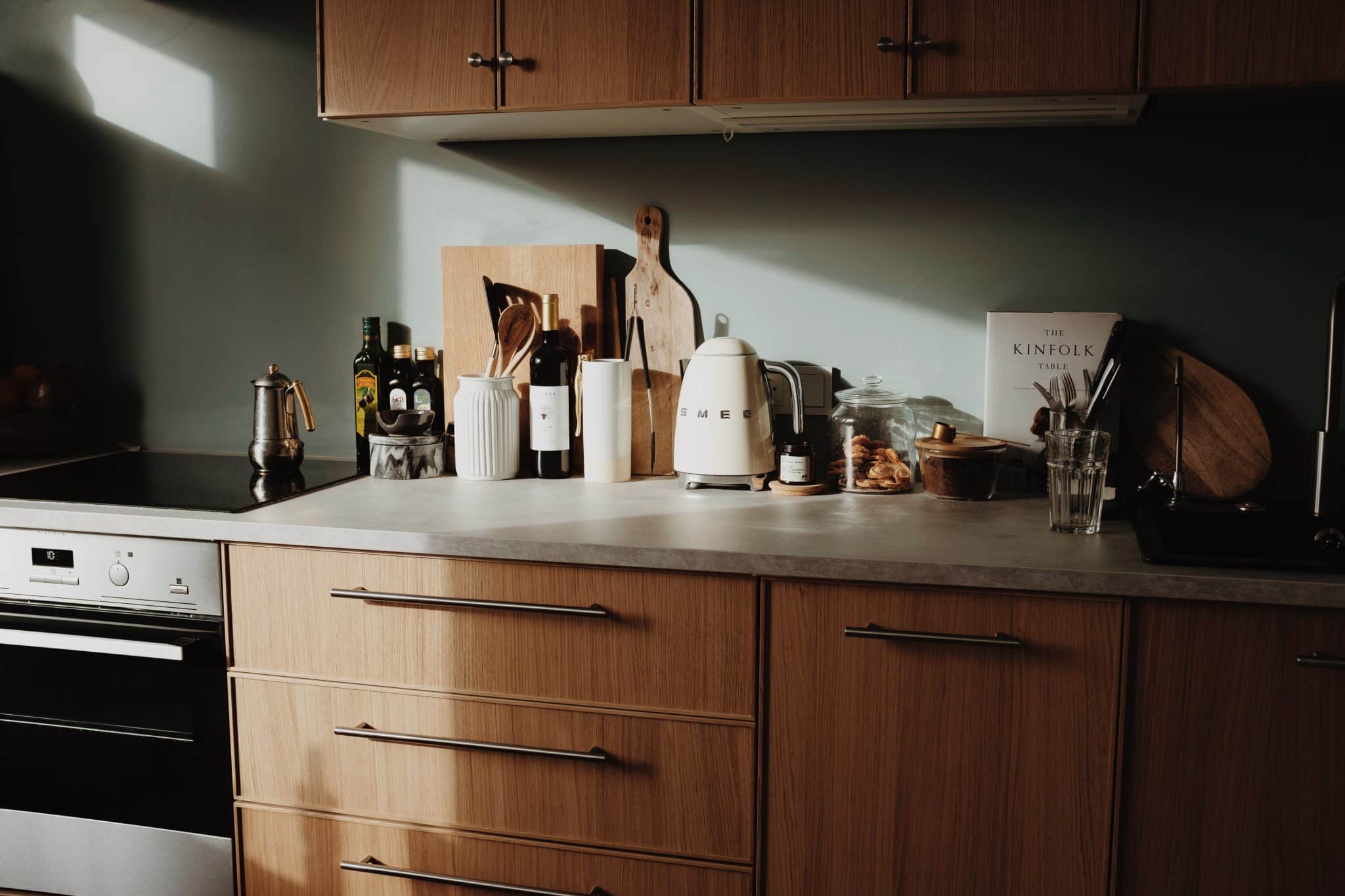
Luxury kitchen design is becoming less dependent on conspicuous ornamentation and more closely associated with material authenticity, architectural coherence and longevity. Choosing worktops for kitchens is therefore not merely practical: the worktop occupies a wide visual area and influences the atmosphere, colour balance and perceived quality of the room.
Natural timber excels in premium interiors because its grain, tonal movement and markings create individuality rather than mechanical uniformity. It can soften angular cabinetry, complement stone and metal, and introduce tactile warmth into a space used for cooking, dining, socialising and work.
As wood matures through use and maintenance, it develops chromatic depth and character, helping a kitchen feel established, personal and luxurious.
How Breakfast Bars Became the Social Centre of The British Kitchen
The British kitchen frequently accommodates informal dining, remote working, homework and entertaining, making the breakfast bar a pivotal element within an open-plan layout. Well-proportioned breakfast bar worktops in the UK can define the transition between the operational kitchen and a relaxed living area without creating a solid partition. The extended surface provides a gathering point while allowing occupants to remain connected with food preparation and conversation.
Timber is particularly effective here because its tactile warmth makes prolonged contact more comfortable than many mineral or metallic materials. Visible grain also gives a breakfast bar greater presence, transforming a projection into a focal point. Successful specification requires attention to overhang depth, structural support, stool clearance, edge profile and circulation space. When these details are resolved correctly, the surface can operate as a dining area, workspace and social anchor.
The Material Qualities That Make Timber Feel Premium
Natural timber communicates luxury through characteristics intrinsic to the material. Grain direction, figure, colour variation and pore structure create optical depth that changes with illumination and viewing angle. An oil finish can intensify this complexity by enriching tones and defining contrast between growth patterns. Unlike printed wood-effect surfaces, solid hardwood retains irregularities that make every installation distinctive and expressive of craftsmanship.
Its tactile character matters equally. Wood feels warmer and less austere than stone, metal or polished composites, making it appropriate for kitchens that combine work, dining and social functions. Knots, tonal transitions and markings should be understood as evidence of authenticity rather than defects. Careful board selection, stave arrangement and finishing transform these variations into a refined surface identity.
Oak, Cherry or Iroko? Choosing the Right Timber
Selecting a species requires consideration of colour, grain architecture and its relationship with surrounding cabinetry. Oak is versatile: its pronounced grain and pale-to-medium golden tones suit traditional, transitional and contemporary schemes, particularly alongside deep blue, muted green or warm neutral cabinetry. Cherry offers a smoother, furniture-like appearance, with restrained grain and reddish-brown colouring that becomes richer over time, making it suited to elegant, intimate interiors.
Iroko creates a stronger statement through golden-brown to bronze tones and naturally varied grain. It can provide contrast within pale kitchens or reinforce the depth of darker schemes. However, no timber should be selected on colour alone. Stave width, board arrangement, finish, lighting and adjoining materials all affect the result. Samples are best treated as indicative because natural variation is fundamental to the exclusivity of solid wood.
Designing With Wood: Colour, Contrast and Material Balance
A wooden worktop should form part of a complete material composition rather than function as an isolated decorative surface. Pale oak can warm charcoal, navy or deep green cabinetry; cherry complements taupe, warm white and subdued metallic finishes; and iroko can create an authoritative focal point alongside stone shades, off-white joinery or darkened steel. The objective is deliberate contrast without excessive visual competition.
Material hierarchy becomes particularly important when timber is combined with stone, ceramic, stainless steel or concrete. A wooden island can soften the severity of a mineral perimeter surface, while a timber breakfast bar can add comfort to an otherwise highly engineered scheme. Compatible undertones and a restrained palette allow the grain to remain prominent, producing a more coherent and sophisticated interior.
What Homeowners Should Know About Performance and Maintenance
Solid timber is responsive, so its performance depends on correct installation and routine care. Wood is hygroscopic, absorbing and releasing moisture as humidity changes, which can cause movement across the grain. Worktops should therefore be acclimatised before fitting, fixed to permit controlled movement and sealed around sinks, tap holes, cut-outs and exposed end grain. Standing water, concentrated heat and repeated abrasion require particular attention because they can compromise the protective finish.
Maintenance is manageable within household routines. Spills should be wiped promptly, hot cookware placed on trivets and chopping boards used for preparation. Re-oiling is appropriate when the surface appears dry, uneven or less resistant to moisture, with frequency determined by use. Solid wood is also renewable: superficial scratches, localised staining and wear can often be reduced through careful sanding and refinishing, extending its functional and aesthetic life.
Why Responsible Sourcing Is Part of Modern Luxury
Modern luxury is increasingly assessed through provenance, durability and purchasing intelligence. A premium wooden worktop should be considered in relation to timber origin, supply-chain transparency and manufacturing quality. Responsibly sourced hardwood connects visual refinement with accountable forestry and treats wood as a long-term architectural material rather than a disposable surface.
Longevity strengthens that value. Solid wood can often be sanded, re-oiled, repaired or adapted as the kitchen changes, reducing unnecessary replacement. Responsible luxury therefore combines beauty with traceability, repairability and enduring relevance, allowing the material to acquire character instead of becoming prematurely obsolete.
Conclusion: A Kitchen Surface That Becomes More Personal With Time
Wooden worktops define natural luxury through visual depth, tactile warmth, practical functionality and adaptability. Their success depends on appropriate species selection, installation, material coordination and maintenance, yet these requirements are balanced by repair potential.
In a well-designed British kitchen, timber does more than provide a working surface: it unites cooking, dining and social life while developing a distinctive patina that records the evolving character of the home.