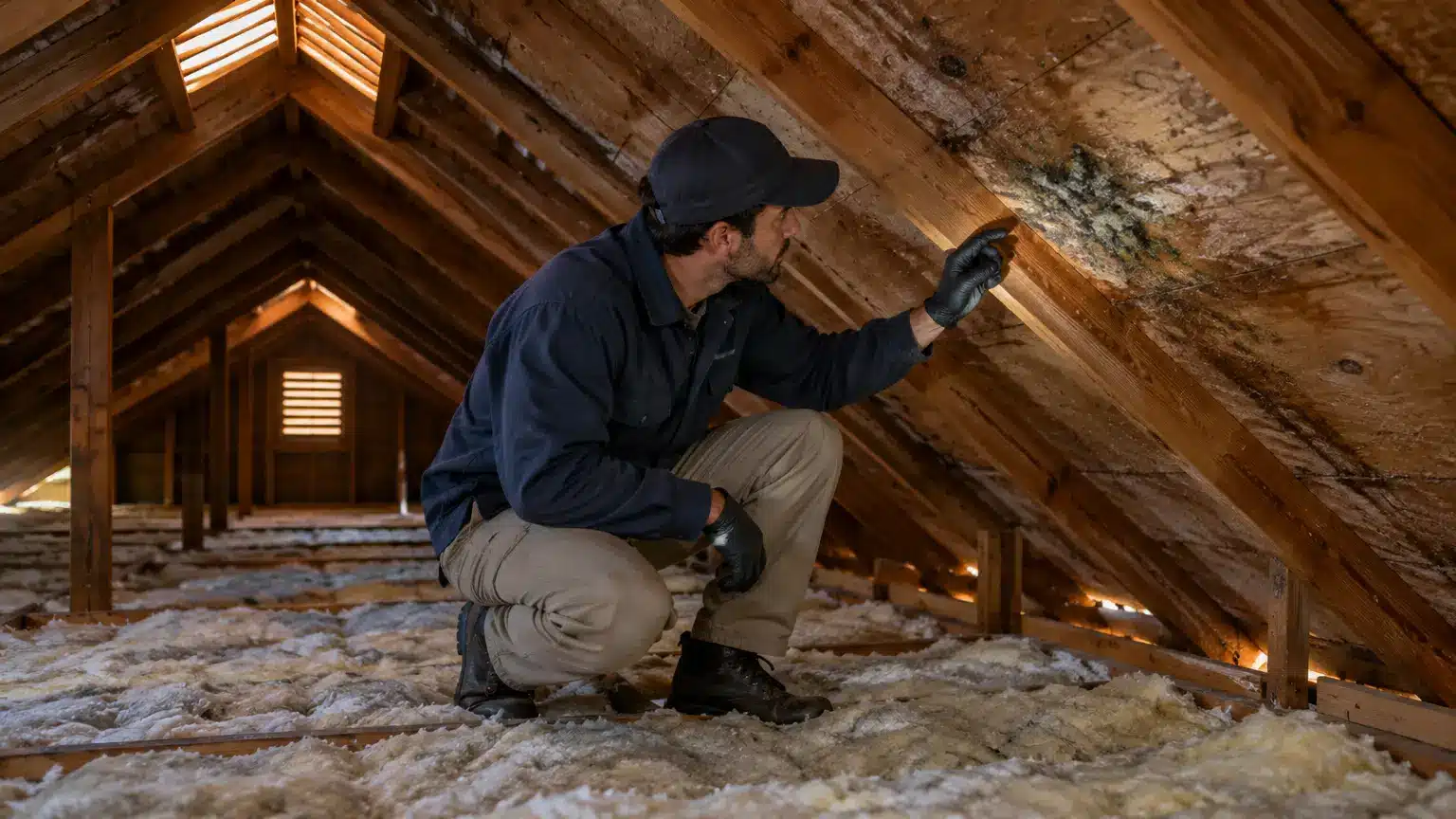
Houston doesn’t do dry. With average relative humidity hovering above 75% for most of the year and summer afternoons that feel closer to a sauna than a city street, the air in Greater Houston carries more moisture than almost any other major metro in the country. Most homeowners think about that humidity when they’re outdoors, but the space sitting directly above your ceiling is where it quietly does the most damage.
Why Houston’s humid climate makes attic maintenance more important than it would be in Phoenix or Denver comes down to simple physics: warm, moisture-laden air rises, it finds every gap and crack, and it settles in your attic whether you’ve invited it or not. Ignoring that space for a few seasons can mean mold colonies, rotting rafters, and insulation that no longer insulates. The good news is that the problem is predictable, and predictable problems have straightforward answers.
How Houston’s Humidity Gets Into Your Attic
Moisture doesn’t wait for an obvious hole. When homeowners schedule attic cleaning services in Houston, technicians consistently find that condensation has built up along roof decking, insulation batts have absorbed ambient vapor, and recessed light fixtures have acted as direct channels for humid air to travel from living spaces into the attic above. Houston’s climate is particularly aggressive in this regard because the temperature differential between your air-conditioned interior and the uninsulated roof deck above can exceed 40 degrees Fahrenheit on a July afternoon.
That gap creates a strong pressure gradient, and air – carrying its full load of moisture – pushes upward continuously. Add the fact that older Houston homes frequently have inadequate vapor barriers, and you have the conditions for slow, steady moisture accumulation that most homeowners don’t notice until visible damage appears. The attic becomes a collection point for everything the rest of the house is shedding, and without regular inspection and cleaning, that accumulation compounds year over year in ways that are expensive to reverse.
Moisture Pathways Most Homeowners Overlook
Your attic pulls in moisture from far more sources than just the air outside. Kitchen exhaust fans, bathroom vents, and dryer ducts that aren’t properly routed to the exterior dump humid air straight into the attic, where it can’t escape. In Houston’s climate, that trapped moisture hits dew point fast – especially at night, when temperatures fall and surfaces cool – and condensation builds on wood framing, insulation facing, and HVAC components.
Pipe penetrations, wiring chases, and access hatches without proper weatherstripping are common culprits too. Most homeowners never check these spots because the damage comes on slowly, over months rather than days. A single badly routed bathroom exhaust fan can deposit the equivalent of several gallons of water into an attic over a Houston summer. Finding and sealing those pathways is the first step in any serious attic maintenance plan, and it’s work that means actually getting into the space and looking, not guessing from the floor below.
What Happens When Vapor Has Nowhere to Go
Proper attic ventilation – soffit vents drawing in cooler outside air paired with ridge vents pushing out hot, humid interior air – is what stops moisture from stagnating. But ventilation systems get blocked. Blown-in insulation can cover soffit baffles, bird nests clog ridge vents, and careless roofing work sometimes seals exhaust pathways entirely.
When airflow stalls, relative humidity in the attic can hold above 70% for days, even after outdoor conditions improve. At that level, mold spores – always present in the air – find everything they need to germinate on wood surfaces. In Houston, things move fast. Colonies that are microscopically small in spring can blanket visible square footage of roof decking by fall. You won’t smell it from the living room. It grows in the dark, in the heat, in a space most people enter once every few years if that.
The Long-Term Cost of Skipping Attic Maintenance in Houston
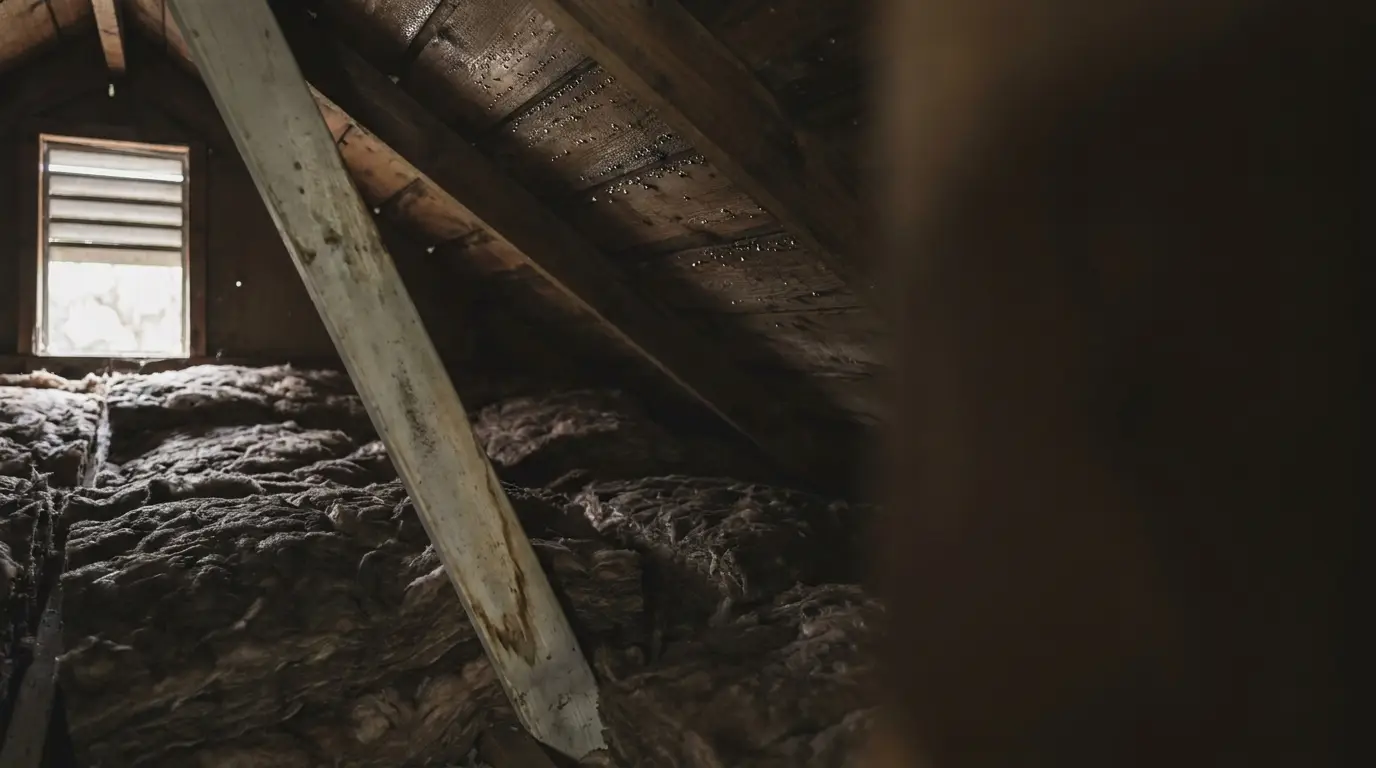
The financial case for regular attic upkeep isn’t subtle. Insulation that has absorbed moisture loses its thermal resistance, what builders call its R-value, and your HVAC system has to run longer to compensate, which shows up directly on your electricity bill every month. The U.S. Department of Energy estimates that proper attic insulation and air sealing can reduce heating and cooling costs by 10% to 50% depending on the home’s current condition.
In Houston, where air conditioning runs roughly nine months of the year and electricity costs are high, that range translates to real money. Beyond energy, the structural repair costs that follow unchecked moisture damage are far steeper than any maintenance budget. Replacing sections of roof decking that have rotted from prolonged moisture contact costs several thousand dollars before you even account for the insulation, mold remediation, and drywall work that typically accompanies it. Regular attic inspections and cleanings aren’t a luxury; they’re the cheaper option by a large margin.
Mold Remediation Versus Prevention
Once mold takes hold in an attic, getting rid of it is more involved than most homeowners expect. Surface treatments don’t reach mold that’s penetrated wood grain, and standard cleaning products don’t work on porous materials like OSB sheathing or wood framing. Professional remediation typically involves HEPA vacuuming to capture spore-laden debris, antimicrobial treatment of affected wood surfaces, and in severe cases, physical removal of contaminated material.
The process takes time, needs proper containment to keep spores from spreading into living spaces below, and carries costs that reflect all of that. Prevention, by contrast, runs a fraction of the price. An annual inspection that catches early moisture accumulation, clears blocked vents, and pulls contaminated insulation before mold establishes itself keeps the scope of work small and the bill manageable. Houston’s climate means moisture pressure on your attic never really lets up; the maintenance calendar needs to reflect that reality, not the drier-climate assumption that checking every few years is enough.
Insulation Performance in a Humid Climate
Not all insulation types hold up the same way in Houston’s conditions. Fiberglass batts – still common in older Houston homes – can trap moisture between the facing and surrounding wood framing when vapor management is imperfect, creating hidden wet zones that accelerate mold growth without any visible sign. Blown-in cellulose is more airtight, but it’s also hygroscopic, meaning it can hold onto moisture if it gets saturated. Spray foam handles moisture resistance better, though it brings its own considerations around vapor permeability and ventilation design.
No single material is the universal answer; what matters is that the choice of insulation and how it’s installed actually accounts for Houston’s specific vapor pressure conditions. An attic maintenance visit is the right moment to judge whether your current insulation is still performing, whether moisture has damaged its structure, and whether the ventilation design still suits the insulation type in place. These details carry more weight in Houston than they would in a lower-humidity market.
Conclusion
Houston’s humidity makes the attic one of the hardest-working and most vulnerable parts of any home here. The same conditions that make the city feel oppressive in July – warm, moisture-heavy air pressing into every gap – are quietly working on your roof structure, your insulation, and your indoor air quality all year long. Why Houston’s humid climate makes attic maintenance more important than homeowners typically expect comes down to the pace at which moisture damage compounds when it’s left alone. It compounds fast.
A routine inspection and cleaning each year keeps moisture pathways identified, insulation performance intact, and mold from quietly occupying a space for years without detection. Consistent upkeep always costs less than deferred repairs. Don’t let Houston’s climate work against your home, stay ahead of it.