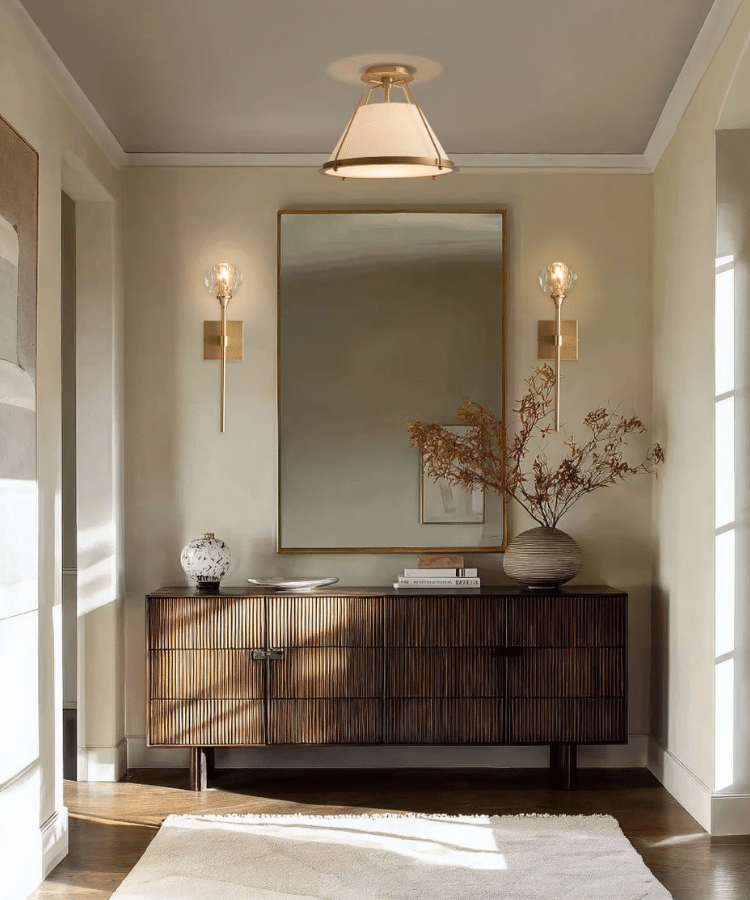
An eight-foot ceiling is not unusually low in an American home, but it is low enough to make lighting choices unforgiving. A pendant that looks elegant in a product photo can feel surprisingly close once it hangs over a living room. Go too far the other way and choose a tiny ceiling light, and the fixture looks lost above the sofa.
The decision is less about whether pendant lights are “allowed” and more about what sits below the fixture.
In open walking areas, current lighting guides commonly plan for roughly 80 to 84 inches of clearance from the floor to the lowest part of the fixture. On an eight-foot ceiling, that leaves only about 12 to 16 inches for the fixture, canopy, and any suspension. That is why low-profile flush mount ceiling lights are usually the easier choice in the center of a living room.
A pendant still has a place. It just needs a zone where nobody is expected to walk underneath it.
Flush Mount vs. Pendant Lighting – What’s Different
The two fixture types solve different problems.
|
Feature |
Flush Mount |
Pendant Light |
|---|---|---|
|
Position |
Sits directly against or very close to the ceiling |
Suspends below the ceiling by cord, rod, or chain |
|
Vertical space |
Preserves more headroom |
Uses more vertical space |
|
Typical role |
General or ambient lighting |
Task, accent, decorative, or zoned lighting |
|
Visual effect |
Keeps ceiling plane more open |
Creates a stronger suspended focal point |
|
Best use with 8-foot ceilings |
Open walking areas and central living-room lighting |
Above fixed furniture or in carefully controlled zones |
A flush mount is usually easier to work with in an eight-foot room because it takes up less vertical space. A pendant gives you more sculptural presence, but every inch of suspension needs to earn its place.
Why Flush Mounts Usually Win in an 8-Foot Living Room
In a typical living room, people move through the center of the space, around the sofa, toward windows, and between adjoining rooms. A hanging fixture in one of those routes can make the ceiling feel lower even if nobody actually bumps into it. Flush mounts avoid most of that problem.
They keep the light source close to the ceiling, preserve headroom, and allow the eye to travel across the room without a long cord or shade interrupting the sightline.
They also work particularly well when the living room already contains large furniture. A substantial sofa, coffee table, media unit, and rug occupy plenty of visual space below. The ceiling light does not always need to add another heavy suspended form.
But choosing a flush mount does not mean settling for an anonymous white disk.
Modern fixtures can use:
- woven fiber;
- rattan;
- jute;
- glass;
- metal;
- wood details;
- sculptural low-profile shades.
A fixture such as the Vela Flush Mount, for example, uses a shallow woven form to bring texture overhead without introducing the drop of a pendant. The Aurelia Rattan Flush Mount Light takes a more layered approach while still keeping the fixture close to the ceiling.
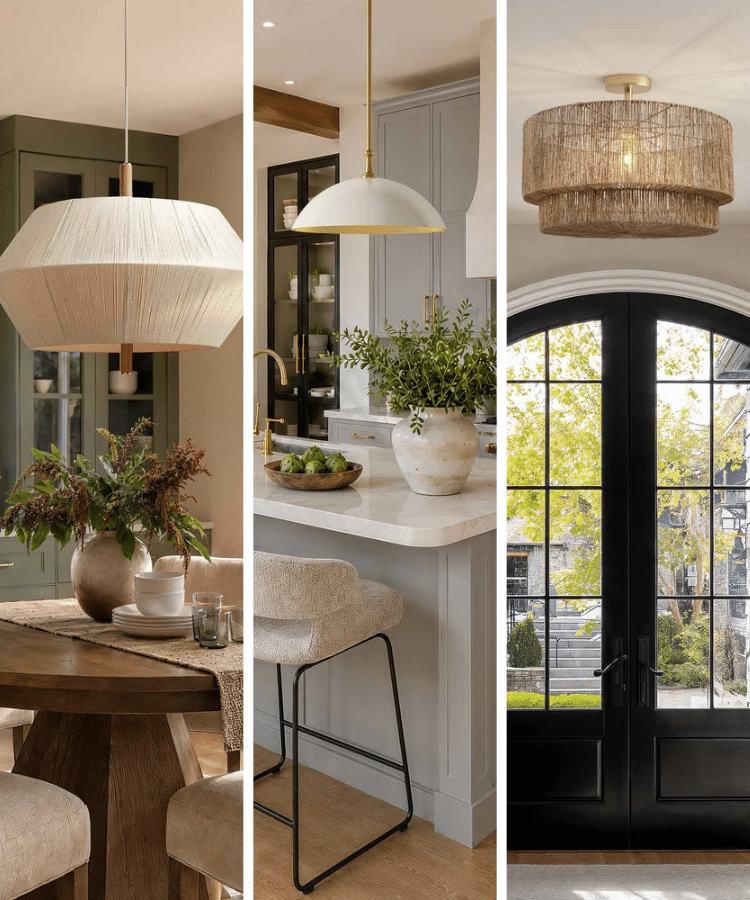
If you want a cozy, layered environment without sacrificing head clearance, comparing living room flush mount lights by both width and overall projection can help you find a fixture that feels decorative without making the room feel shorter.
Can You Actually Hang a Pendant in an 8-Foot Living Room?
Yes! but only when the placement makes sense. A pendant becomes difficult when people need to walk beneath it. If nobody passes underneath, you have more flexibility.
Over the Coffee Table
A coffee table creates a fixed zone where people normally do not walk upright. That can make a pendant possible even with an eight-foot ceiling.
The fixture should still relate to the table rather than hanging randomly in the middle of the room. Check the table width, pendant diameter, seated sightlines, and distance from the sofa. If the shade hangs so low that someone seated on the sofa constantly sees it in front of another person’s face, raise it.
In a Corner
A pendant can also work in a corner as an alternative to a floor lamp. This is especially useful beside a reading chair where the fixture hangs outside the main circulation route.
Here, the pendant becomes a local task or ambient light rather than the room’s main ceiling fixture.
Above Another Fixed Furniture Zone
A pendant may work above a side table or another location where furniture permanently prevents people from walking directly underneath. The important part is that the furniture should truly be fixed. Do not design the lighting around a temporary chair position if the room layout is likely to change.
Adjustable Cords Matter More Than You Think
With eight-foot ceilings, pendant suspension length needs to be controlled carefully. An adjustable cord, chain, or rod system gives you more flexibility to shorten the fixture during installation.
Before ordering, check the specification sheet for:
- minimum hanging height,
- maximum hanging height,
- canopy depth,
- shade height,
- whether rods can be removed individually,
- whether excess cord can be concealed properly.
Do not assume that because the cord is adjustable, the fixture can become a semi-flush mount.
The shade itself may still be deep. A 12-inch shade attached directly beneath the canopy still occupies 12 inches of vertical space before any cord is added.
Always calculate the total ceiling-to-lowest-point dimension.
Choose Flush Mounts for Open Circulation
If the fixture sits over the main walking area, a flush mount is usually the cleaner choice.
This includes living rooms where:
- the center of the room is part of a circulation route,
- the furniture layout changes frequently,
- children regularly use the open floor area,
- the living room connects directly to a kitchen or dining area,
- the ceiling already feels visually busy.
A low-profile fixture lets you change furniture later without having to reconsider whether a hanging light is suddenly in the wrong place.
That flexibility is easy to overlook when designing the room around today’s sofa placement.
Choose a Pendant When You Want to Define a Zone
A pendant earns its place when it helps explain the room. For example, a hanging fixture over a reading corner tells the eye that this area has a separate function. A pendant over the coffee table can make the central seating group feel more intimate.
This is especially useful in an open-plan space where architecture alone does not clearly separate the living area. But do not use a pendant simply because you want something more decorative.
If the same visual interest can be created with a wider flush mount, wall sconces, artwork, or a floor lamp, you may get a more comfortable result without giving up headroom.
Check the Fixture From the Sofa, Not Just From the Ladder
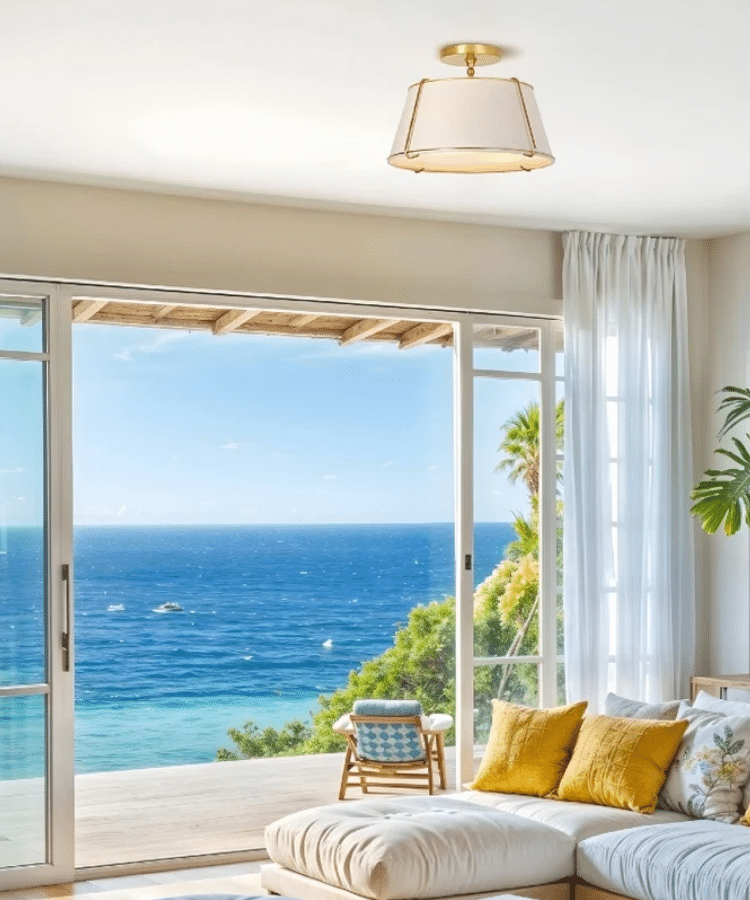
Living rooms are designed from plans and installed while standing. Then people spend most of their time sitting down. That shift in eye level changes how a fixture feels.
A deeper semi-flush may seem harmless while you are underneath it and unexpectedly dominant when viewed from the sofa. A pendant above the coffee table may look perfectly centered from the doorway and block conversation once everyone sits down.
Before buying or finalizing the drop, check four views:
- the main doorway,
- the sofa,
- the primary armchair,
- the adjoining kitchen or dining space.
If the fixture keeps becoming the first object you notice, ask why.
- It may have too much contrast against the ceiling. Or the shade may simply carry more visual mass than its measurements suggest.
- A piece of string marking the lowest point and a cardboard outline matching the fixture diameter can answer that question before installation.
Conclusion
For most eight-foot living rooms, a well-scaled flush mount is the easiest central fixture to live with. Choose one that is wide enough to relate to the room but shallow enough to keep the ceiling feeling open. Then let sconces, table lamps, or floor lamps handle the softer evening layers.
A pendant can still work, but give it a specific zone rather than placing it automatically in the middle of a walking area. The best solution is not the fixture that attracts the least attention. It is the one that gives the room character without constantly reminding you that the ceiling is only eight feet high.
Rowabi currently offers both low-profile woven flush mounts and other decorative ceiling-lighting options, with many in-stock designs shipping from its Houston operation on an estimated 3–5-business-day delivery timeline within the U.S.