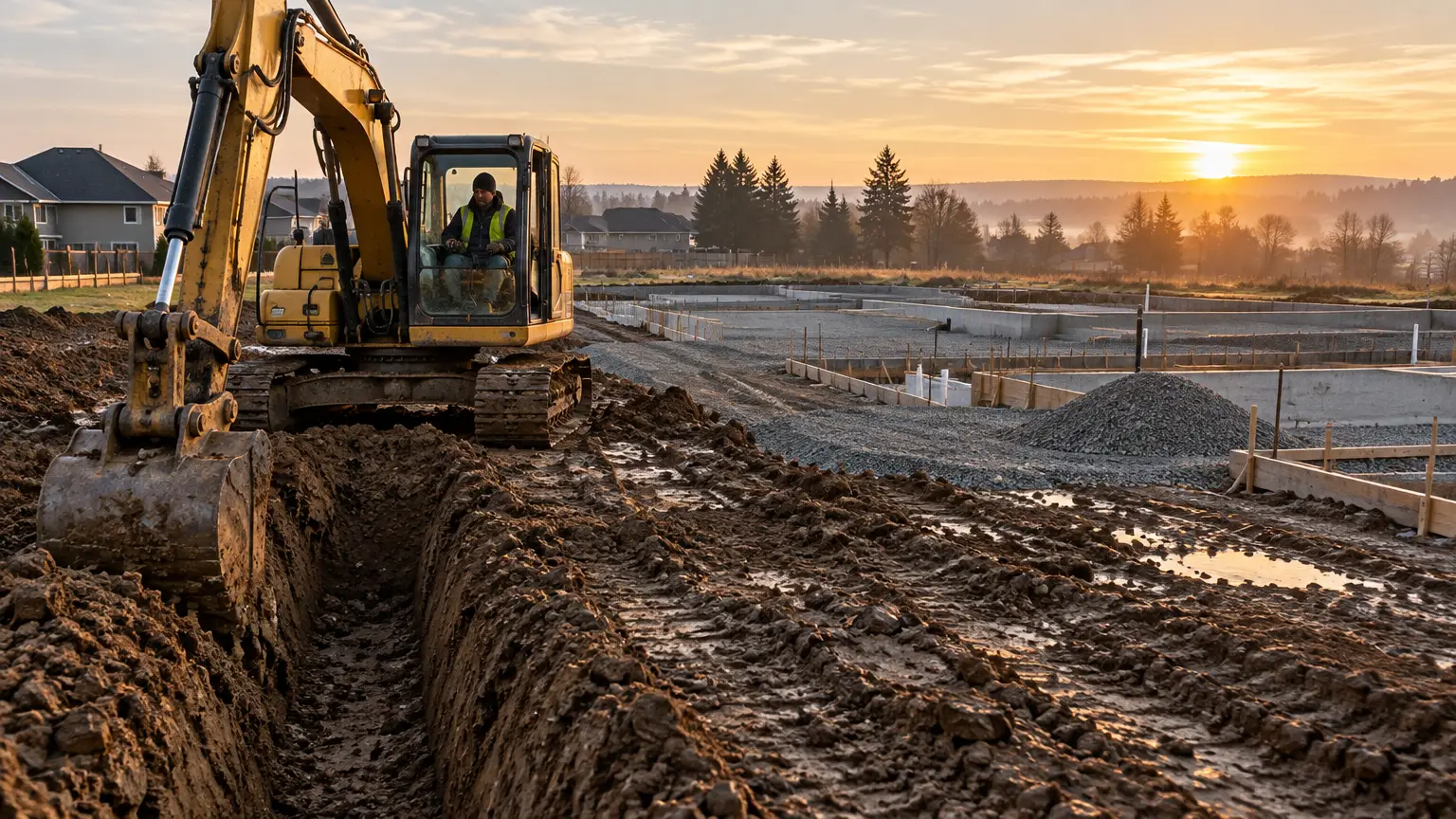
The ribbon-cutting photo shows a finished structure, clean lines, crews in matching hard hats, a timeline that looks effortless. It omits the three weeks before the first foundation pour, when the site is a churned field of mud, rebar, and half-demolished concrete. A general contractor wins or loses the schedule in that stretch.
By the time a contractor notices the sitework is late, it has been late for days. The crew scheduled to break concrete on Monday arrives Wednesday. The excavator sits idle, waiting on a demolition permit. The gravel shows up before the subgrade is ready, and rain turns it into mud. None of this appears in the final photo. All of it appears in the final invoice.
The cause is fragmentation. To prepare one site, an owner or general contractor lines up four or five separate trades instead of one contractor for site management and excavation services: one crew tears down the old shed or garage, a second breaks out the existing concrete, a third digs the basement or trenches, a fourth hauls and spreads gravel, and a fifth handles drainage and grading. Each crew arrives with its own schedule, its own equipment, and its own view of what the previous crew did wrong. When one slips a day, the others fall behind it. The framing and mechanical crews booked weeks in advance stand idle, on the clock.
Builders across the Mid-Atlantic have stopped coordinating five contractors. They hire one.
The Cost of Fragmented Subcontractors
Fragmentation does not appear as a line item on a bid, which is what makes it expensive. A developer compares a $42,000 sitework number from one excavator against a $38,000 collection of smaller quotes and concludes they saved money. They bought a coordination job that no one on site gets paid to manage.
“Every handoff between trades is where responsibility disappears,” says Elam Stoltzfus, Partner and VP of Excavation at Site Prep. “Crew A blames Crew B for the bad grade. Crew B blames Crew C for leaving debris in the trench. The owner stands there with a schedule bleeding a day at a time, and nobody owns the outcome.”
The costs compound. Miss one day of sitework and you lose a week downstream, as foundation, framing, and rough-in crews get pushed off their booked windows. In commercial work, where cranes and concrete pumps run on hourly schedules, a missed site-prep handoff triggers penalties and remobilization fees that dwarf the original savings.
The fix is one contract and one crew that carries the job from first cut to final grade and pays when the schedule runs late.
Demolition First: Why Precision Clearing Sets the Stage
Before excavation starts, the crew clears the site. That step is where crews cause the most preventable damage. A careless structural demolition severs a neighboring utility line, cracks an adjacent foundation, or leaves buried concrete the excavator hits when it tears a track.
Precision clearing is a discipline. It covers a simple shed removal service, full structural demolition, and concrete demolition and removal. The objective stays the same whether the job is a backyard garage or a 40,000-square-foot commercial slab: remove what needs to come down, protect what stays, and leave the subgrade clean enough to build on.
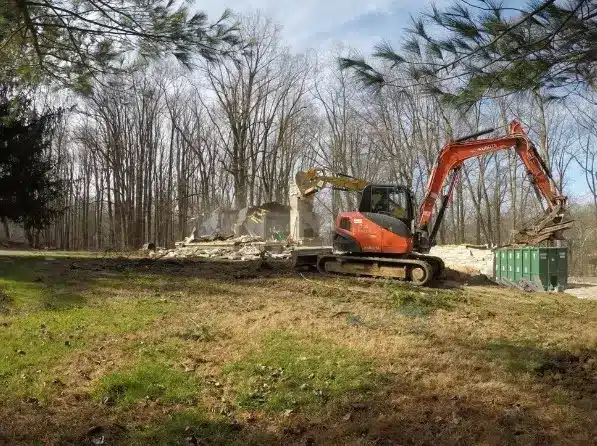
From rough clearing to laser-accurate subgrades: Single-source excavation keeps construction schedules intact.
“A good demolition contractor thinks two steps ahead of the excavator,” Stoltzfus says. “If we leave a buried footing or an old cistern in the ground, we haven’t saved the client anything. We’ve moved the surprise to a more expensive point in the job.”
Concrete breaker work needs the same restraint. Breaking out a driveway or pad next to a standing structure means controlling vibration, protecting gas and water laterals, and keeping debris clear of the crew that follows. Demolition done wrong causes half the change orders on a site-prep contract.
Precision Earthmoving: From Basements to Heavy Commercial Grades
Once the site is clear, the earthwork starts. You see the gap between a generalist with a backhoe and a commercial excavation contractor in the tolerances.
Residential excavation covers basements and crawl spaces, foundation over-dig, utility trenching, septic systems and footers, and final grading and water runoff, the shaping that controls whether a backyard drains or ponds. Commercial work scales to deep excavations, retention systems, stormwater management, and building pads that must match engineered specifications within fractions of an inch.
“People think of dirt as forgiving,” Stoltzfus says. “It isn’t. A building pad two inches out of grade is a structural problem. Water finds the low spot every time.”
Get final grading and water runoff right, and the building stays dry for decades. Get them wrong, and it fights moisture from day one. A contractor who understands hydrology shapes the grade so water moves away from the structure and into the designed drainage paths.
Infrastructure That Lasts: Engineered Gravel Driveways & Parking Pads
A gravel driveway or parking pad that holds up under truck traffic, freeze-thaw cycles, and heavy rain is an engineered structure. The difference comes from the layers beneath the surface.
The sequence starts with stripping organics and soft soil, then laying a geotextile fabric that keeps the stone from sinking into the subgrade. A compacted base of larger aggregate goes on top, followed by a surface layer sized for the load. The crew compacts each lift before placing the next. Skip the fabric or skimp on compaction, and the road ruts in the first wet spring and needs re-graveling the next year.

A properly graded gravel driveway combines timeless curb appeal with structural durability, using compacted aggregate and permeable sub-bases to eliminate ruts and standing water.
The same logic holds for commercial parking pads, equipment yards, and staging areas, where a bad pad strands trucks and stalls logistics. “A gravel driveway done right outlasts a poorly done asphalt one,” Stoltzfus says. “It’s all in the base.”
What to Demand from an Excavation Partner
A general contractor or homeowner comparing excavation bids should weigh the low number against the coordination risk behind it. Ask these three questions before you sign.
First, ask who owns the sequence. A full-cycle contractor can describe the whole job in one schedule with one point of contact: demolition, earthwork, utilities, gravel, grading. If the bid assumes “others” handle clearing or drainage, you have the coordination risk back in your lap.
Second, ask about the machine and the operator. Tight grades require both GPS- and laser-guided equipment and a skilled hand at the controls.
Third, check the track record. Site Prep, founded in 2014 in Lancaster County, Pennsylvania, brings more than 12 years in heavy earthwork and 25-plus years in concrete. The company has earned a place on the Inc. 5000 (#4,181, with 112% three-year revenue growth) and holds more than 2,200 five-star Google reviews. It serves a radius of over 80 miles from Gap, PA, reaching Philadelphia, Allentown, Lancaster, and Harrisburg, plus Baltimore, Wilmington, and parts of New Jersey. Founders John Dienner (CEO) and Michael Dienner (VP of Sales) built the firm so clients do not have to manage the trades themselves.
“We take the job nobody wants to coordinate and turn it into one phone call,” Stoltzfus says. “You bring us a piece of ground, and we hand back a site ready to build on.”
The ribbon-cutting photo does not show that value. The schedule holds because you do not let the dirt work become a problem. Stop chasing four trades through the first ten days. Hire one excavation partner who owns the ground from the first strike of the breaker to the final laser grade.