Three bikinis went to Mexico with me last spring. I wore one of them twice, and the other two sat in my suitcase with their tags still attached. That trip is the whole reason I started paying attention to silhouette instead of whatever showed up first on a sale rack.
Choosing a swimwear cut comes down to two things most people never separate: how the piece actually fits your body, and what you plan to do while wearing it. A suit built for lying flat on a lounger is a different animal from one you will wear swimming, walking to lunch, and chasing a boat ferry. Get those two questions straight and the shopping gets a lot shorter.
Start with the bottom, since that is where most fit problems hide. If you have ever felt like you needed a sizing chart, a mirror, and a friend just to order a pair online, that anxiety is normal, and it is the exact gap brands like brazilian bikinis are built to narrow, since cutting for a real range of shapes rather than one sample size is the entire point of a fit-focused label.
What the Cut Names Actually Mean
Swimwear labels throw around the same six or seven words, and nobody explains them at the checkout.
- Brazilian: narrower at the back, with less coverage than a standard cut. Great if you want minimal tan lines and you are not planning to sit on a hot bench for an hour.
- Cheeky: a middle ground. More coverage than Brazilian, less than full. Most people who say they want “a little less” actually want this one.
- Full: classic coverage. The safest pick if you will be moving around a lot or swimming laps in a hotel pool.
- High waist: sits above the navel and holds everything steady. Good for boat days and for anyone who hates adjusting a waistband every ten minutes.
- Tie side: adjustable at the hip, which matters more than people think, because a knotted side can be tightened after lunch.
On top, the vocabulary is shorter but the stakes are similar. A triangle ties at the neck and back, a bandeau has no straps at all, and an underwire or DD cup option exists specifically for people who need structure rather than a string. If you are shopping for a top and a bottom separately, know your two sizes before you start, and do not assume they match.
A Quick Fit Checklist Before You Buy
Here is the check I run now, every time, and it has saved me more money than any coupon code.
- Measure your underbust and your fullest bust point separately if you are buying a structured top. One number is not enough.
- Stand up and bend forward in the fitting room, or in front of a mirror at home. If anything gaps, size down in the top, not the bottom.
- Pull the bottom band gently. It should snap back without rolling. A rolled band will keep rolling all day.
- Check the lining. Unlined suits look fine dry and turn transparent in the water, every time.
- Test the strings. If a tie stretches more than an inch when you pull it, it will loosen on you.
That last point is the one I learned the hard way on a rough ferry crossing between two Greek islands. Half my hair was in my mouth and the other half was tangled in a strap that had worked itself loose in the wind. Now I check ties before I pack, not after.
Match the Suit to the Trip, Not the Mirror
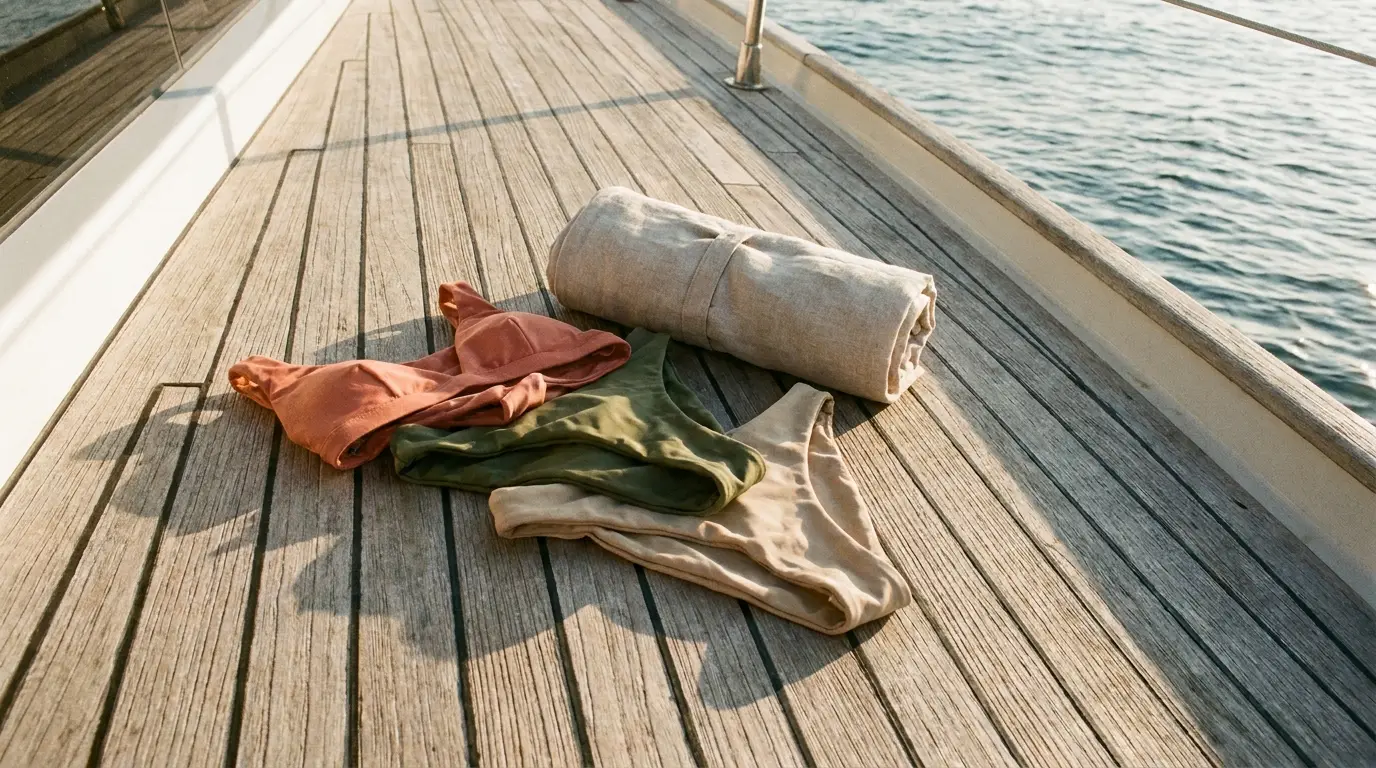
This is where most buying advice falls apart. A bikini is a piece of equipment, and equipment gets judged on the job it has to do.
| Trip type | Silhouette that works | Why |
|---|---|---|
| Resort lounging | Brazilian or cheeky | Minimal tan lines, easy to swap for a sarong at lunch |
| Swimming and water sports | Full coverage, high waist | Stays put when you move, less adjusting in the water |
| Boat day | High waist or tie side | Holds steady in wind and spray |
| City beach with lots of walking | Anything with a matching cover up | You will be in and out of shops all afternoon |
Notice what is missing from that table: your body type. I left it out on purpose. The useful variable is what you are doing, not what you look like. A high waist looks good on absolutely everyone, and a Brazilian cut does too, provided the fit is right and you actually feel comfortable in it. Fabric matters here as well, and textile production has been a global trade for centuries, a history documented by the Smithsonian Institution in its collections on dress and material culture.
Packing Like You Mean It
Two suits for a one week trip is plenty. Three if you will be swimming daily, because a wet suit needs a full day to dry, and damp nylon in a suitcase smells like a warning.
Roll, do not fold. Rolling keeps the cups from creasing and takes up less room. Put a sarong in first as a base layer, and pack one cover up that works with both suits. Stick to two or three colors total so everything mixes. I bring a neutral, a color that flatters my skin tone, and that is it.
Check the forecast before you finalize anything, and check it again two days out. Coastal weather shifts, and a week that looked sunny can turn into a week of wind. Official outlooks from the National Oceanic and Atmospheric Administration are a free, quick way to see what you are actually walking into.
Care That Keeps a Suit Around for Years
Rinse in cold water the moment you get out of the pool or the ocean. Chlorine and salt both break down elastic, and they do it faster than most people realize. Then lay the suit flat to dry in the shade. Never wring it, and never leave it balled up in a beach bag overnight.
Skip the washing machine entirely. If it needs more than a rinse, a drop of gentle soap in cold water is enough. Stretch and sun are what kill swimwear, so if you dry it on a line under direct midday sun, expect the color to fade within a season.
The retail side of this market is enormous, which is why there is so much to choose from and so little guidance. Fashion retail is a major employer in the wider economy, and according to the Bureau of Labor Statistics, retail trade supports millions of jobs across the country. That scale is exactly why a filter helps. There are hundreds of near-identical listings, and the difference between a suit you keep and one you donate is almost never the print.
Where I Land on This
Buy two suits you have actually tested, not five that looked good in a photo. Spend the money on fit, not on the pattern. And if you cannot decide between a Brazilian cut and a full coverage option, take the Brazilian one and bring a sarong for the walking parts of the day. That combination has never let me down.
Which trip is next on your list, and what did you wear on the last one? Dig that suit out of the drawer before you book anything. If it passed the bend forward test and the string test, it is coming with you.