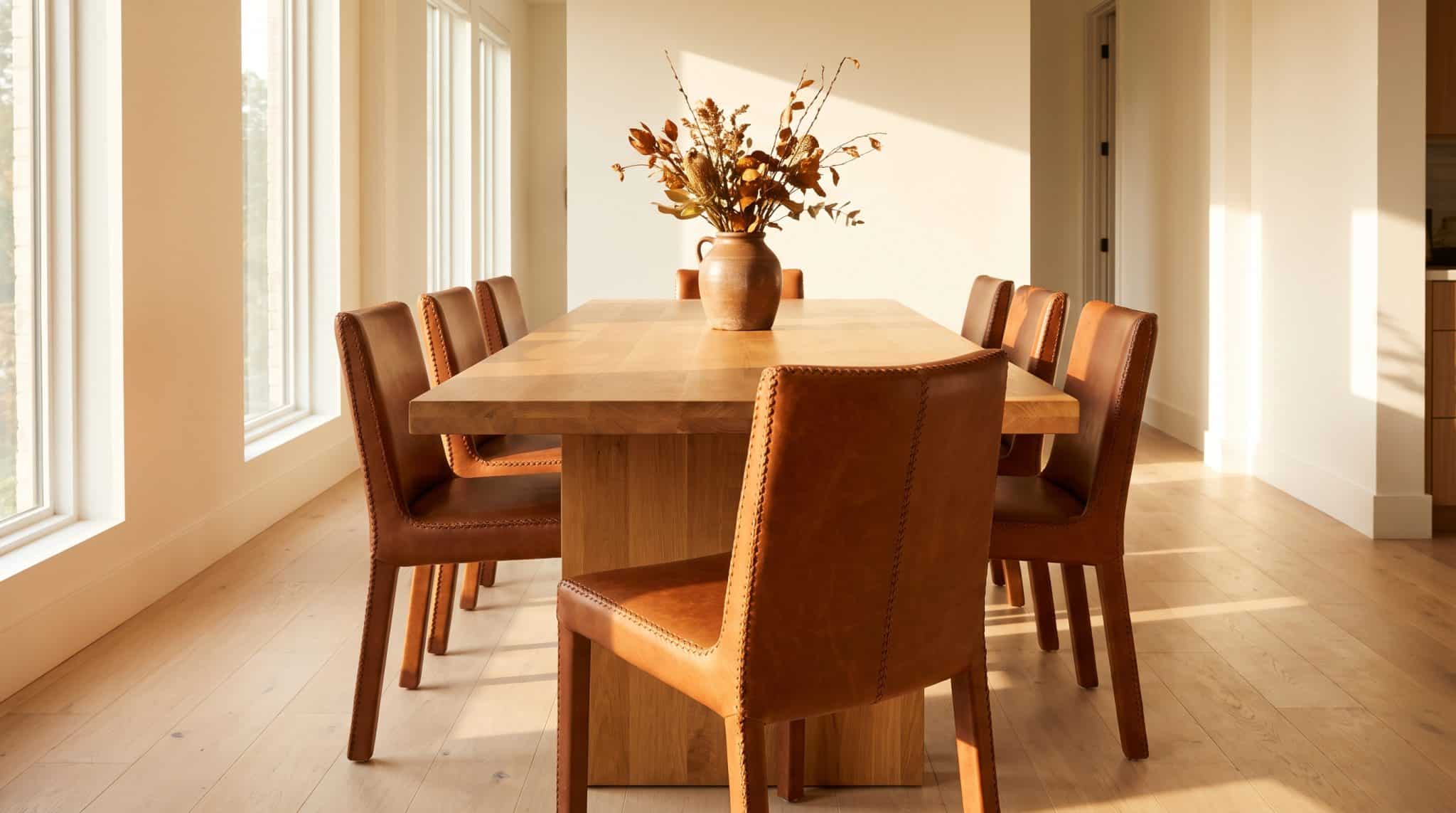
Furniture manufacturers are really pushing the envelope for dining chair design these days. On social media, in magazines, online style edits and in the homes of our parasocial faves, we’re greeted by new and familiar seating silhouettes: the viral COLAMY chair’s mid-century curves; fresh, Scandi takes on classic ladderbacks; a resurgence of industrial bistro stools and an explosion of banquettes. The throughline weaving it all together is a deeper appreciation for artisan materials with heritage and personality. Hence today’s focus on leather dining chairs.
Populating more contemporary kitchen-diners this year, this rich, supple material is, of course, easy on the eyes, but it’s also easy to live with. And we humans have been for millennia – even the ancient Egyptians were partial to a leather stool over 3000 years ago! This immense staying power, along with its signature luxe-look warmth, is perhaps why we’re preoccupied with them to this day.
Now, if you’re just as enamoured, keep reading. This guide is designed to support you as you deliberate which models and styles are for you. Time to spill all the interior design secrets.
Taking Stock of Your Interior’s Needs
The starting line, as it is with any home improvement project, is looking at your current setup and pinpointing what you tangibly need from it.
For instance, in teeny tiny dining nooks, your seating solutions will have to pull extra weight and will likely sit on the slim end of the size spectrum. In a large, open plan, kitchen-diner, you might require seating with a bit of bulk to visually ‘pin down’ a particular zone, whereas a separate dining room frequently used for parties might benefit from the more generous seats of a set of dining armchairs and proper armrests.
Other early considerations include maintenance. Although, on the whole, leather is a breeze to look after, not all upholstery is made equal. Lower-quality faux leather might come with a cheaper price tag but, remember, it’s wont to fade with age, unlike its genuine counterparts. Considering the lived-in patina the real deal accrues with time, it simply doesn’t compare.
Settling Scale and Proportion
Another crucial element not to forget is the scale and proportions of your dining chairs. First there’s the obvious stuff: ensuring the seating height is compatible and comfortable with the table and providing enough clearance around and between chairs. The golden rule stands at 60cm apart for the latter, and then a drop of 25–30cm from the tabletop to your legs.
That’s not all. Experienced interior designers will tell you that proportionality to the room is just as important; your leather dining chairs need to sit naturally within the space and complement the surrounding décor to look like they belong in the room.
This can be done either through harmony or contrast with other elements. So, try opting for chairs with more depth in open spaces to ground them, or pick something low-slung, large and relaxed where you want to instil a laid-back, cosy vibe and fix clustered dining spots in place.
Light-touch, backless chairs, on the other hand, are an exceptionally good idea for cramped areas as they open up sightlines and don’t dominate the scheme. Another bonus? Without a formal back, you can tuck them neatly under the table like a barstool.
Speaking of… if you’re really struggling to cram everything in, maybe it’s time to forgo traditional chairs altogether. Dining stools save so much space and look chic doing so.
Thinking User-Focused Ergonomics
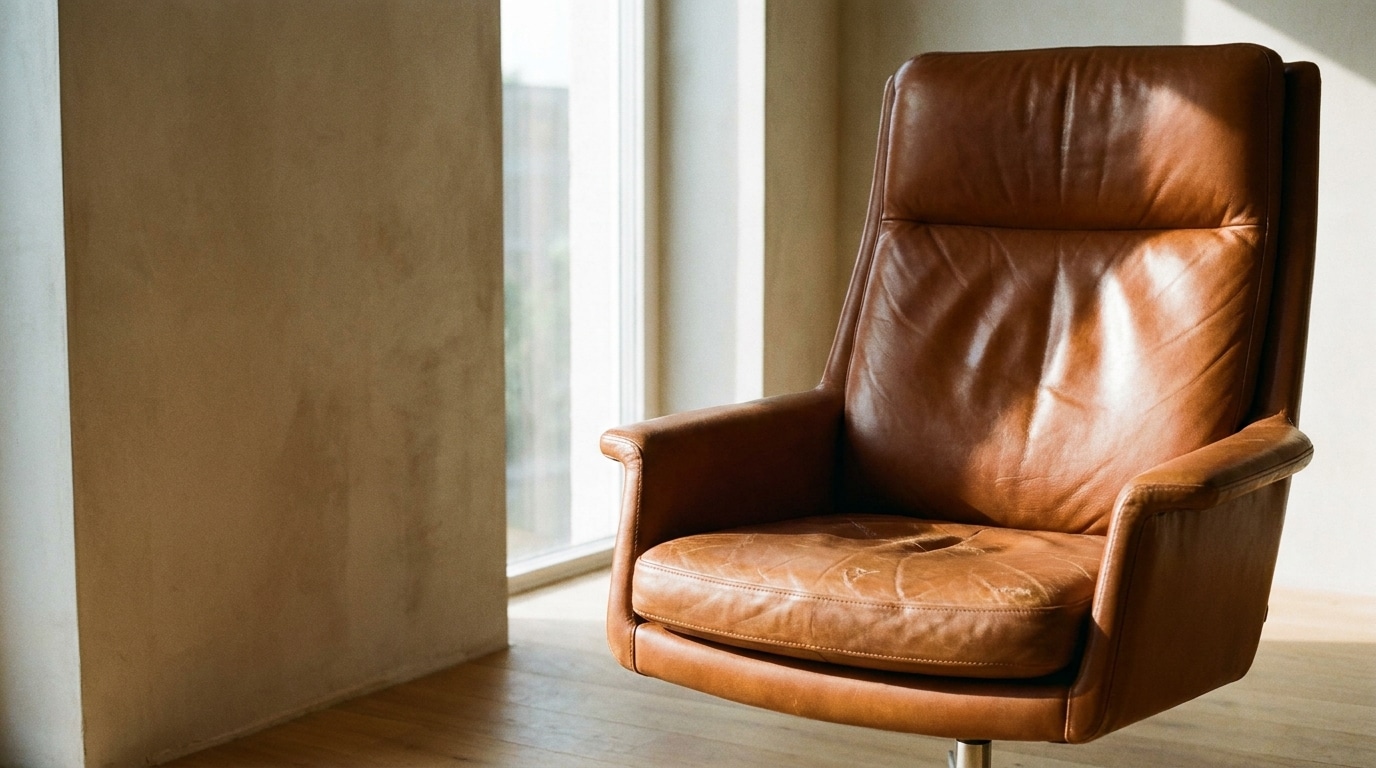
As it pertains to dining chairs, I don’t think the “beauty is pain” argument tracks, especially when many timeless and trending examples prove that one doesn’t necessarily have to usurp the other.
When you outfit your dining room with the new chairs, consider who will be using them. People with bad posture that needs correcting (guilty as charged!)? Young children? Those with mobility issues, such as a parent or grandparent? As with most ergonomic decisions, don’t just think of the here-and-now, but what you might want for the future.
That could be…
- Tall backs for optimal lumbar support
- Swivel action to keep eye contact and help the conversation flow
- Thick, chunky armrests
- A support spindle for your weary feet to rest on
- Healthy amounts of padding so you can sink deep into the chair’s embrace
- But enough firmness to make mealtimes practical and cosy
- A pleasing texture that won’t get on your nerves or be too overstimulating
- Lightweight profiles, so the dining chairs are easy to manoeuvre if you need to modify the layout for whatever reason.
Comparing Dining Chair Designs
This is where the bulk of your brain power goes; after all, there are thousands of designs to sift through. With that in mind, the following list is by no means exhaustive.
- Wraparound, curved-back chairs: A massive trend right now, they feature a softly curved back that partially encircles the sitter like a cocoon. Many contemporary versions draw on mid-century modern design, but you’ll see them in plenty of minimalist dining rooms too.
- Parsons chair: An interior design classic going back to the 30s. They sport a simple, upright silhouette with a tall rectangular back, typically with no arms. Typically, the seat and legs are fully or partially upholstered.
- Eames chairs: A mid-century modern staple, Eames-style dining chairs are recognised by their moulded, body-contouring seats, often paired with slender metal or wooden legs, with leather versions adding a more luxurious finish.
- Ladderbacks: Here, only the cushion tends to be leather, but this supple upholstery adds a crisp, modern finish. The design? It incorporates a tall, open back with horizontal slats cutting through as a backrest, almost always crafted of wood.
- The iconic egg chair: Self-explanatory, these dining chairs take the form of an egg, creating a dramatic sculptural silhouette usually supported by a pedestal base.
- S-curve cantilever chairs: Increasingly popular crafted from mixed materials, such as leather, chrome and rattan, the appeal is all in the silhouette. They have an armless seat supported by a continuous bent frame rather than four conventional legs, which creates a distinctive flowing profile when you view it from the side
- Tub armchair: Substantial and cosy, they boast a uniquely deep-set seat and one fluid form that envelopes the sitter with big, chunky armrests.
- Cross-back chairs: Like the ladderback chair, but instead of the uniform spindles, we have two slats forming an X.
- Stretched leather director’s chair: Striking and lightweight, these leather dining chairs pile on narrative and invite curiosity. Made from a stretched piece of tan leather suspended between a relatively lightweight frame, they have straight arms and either crossed or folding legs.
The Question of Detail & Upholstery Finishes
Detail breeds texture, so you can’t afford to let it become an afterthought. So along with the particular design, it’s worth mulling over the decorative touches you warm to.
Common frills you see alongside leather include visible hand-stitched seams, bobbin spindles, copper-clad, tapered feet, diamond-stud buttoning, fluted wood arms, and even woven elements. Bring these details into your dining room, and it will scream prestige.
…Which brings me on to upholstery finishes, because some truly deserve all the praise. Although most types of leather feel incredibly indulgent, the various finishes have an impact on the resultant feel of the piece.
Full-grain leather is widely regarded as the top-quality choice, thanks to the distinct, authentic look it garners from being the product of the top layer of the hide. Corrected grain leather is, again, real leather, but its imperfections have been buffed away during processing; thus, the look is more uniform, so modern, even minimalist, in character.
For those seeking some drama and gravitas, you may want to consider cracked, vintage, dyed, or distressed leather, which display distinct colouration and grain patterns that complement eclectic and period interiors.
Styling In Situ: How Your Dining Chairs Interact with the Décor
You probably have a clearer list of criteria in your head now. But how will your dream leather armchairs translate into your space?
It’s a loaded question, but fortunately you don’t have to impulse-buy, fool around and find out. We have the internet. So, do some background research. Visit visual social media sites and look for examples in homes that look like yours; notice what you like and dislike.
Ideally, the leather should spark conversations with the broader décor, speaking the same visual language. To give you a concrete example, I recommend echoing the accent details of your chairs across your hardware: brassy light fixtures and doorknobs to complement a dining armchair’s buttons or mid-tone wood sideboards that go with the oak of the chair legs.
You could even use one of the many new tools that use AI to visualise a particular dining chair in your actual home. This makes the decision process so, so easy. Good riddance, buyer’s regret!
Conclusion: Leather Dining Chairs Are a Style Chameleon
Really, leather dining chairs are what you make of them. Their inherent ability to code-switch to the interior in which they’re placed and the sheer variety of options, design- and upholstery finish-wise, means that they can serve whatever purpose you want. Well, besides the obvious: being a comfortable, real-life-worthy perch for mealtimes. Depending on your placement and styling, they can double as interior design anchors, a source of additional texture and a fitting focal point in your beautifully considered living space.