Every house seems to have one.
The bedroom in the back of the house. The bonus room above the garage. The office in the north corner of the house that requires a blanket in December and the living room doesn’t.
The thermostat reads 70 degrees. The furnace blower is blowing. Still, that one room maintains itself five degrees cooler than all the others. It always has, year after year, regardless of how long the heat is on.
Most folks blame the thermostat. Or the furnace. Or they shrug and say “the cold side of the house.”
Here’s the problem with that:
A cold room never occurs by accident. It is indicative of an issue taking place within the walls, ducts, or attic — and chances are bleeding you dry each month that it remains unresolved.
Here’s what is actually going on…
What You’ll Discover:
- Why one room runs colder than the rest
- The 5 most common causes of uneven heating
- What a home energy audit actually measures
- The fixes worth paying for (and the ones that aren’t)
A Cold Room Is a Symptom, Not the Cause
Trying to follow the symptom is why homeowners purchase space heaters, switch thermostats, and remain chilly.
A home energy audit does the exact opposite. Rather than speculating, it treats the home as one integrated system — the shell, ductwork, insulation, heating equipment — and identifies the culprit causing the temperature variation.
Which is why certified energy auditors arrive armed with blower doors and infrared cameras instead of opinions. A proper home energy audit makes an unseen draft become an actionable number on a report. And once you know where a leak is coming from, the repair list pretty much writes itself.
That is the difference between fixing a cold room and living with it.
The 5 Reasons One Room Runs Colder
Cold rooms are, almost invariably, caused by one of five problems. Sometimes it’s more than one.
1. Leaky or Undersized Ductwork
This is the big one, and it is invisible.
Warm air from your furnace travels through ductwork. Lots of that ductwork goes through uninsulated attics, crawl spaces and garages – areas that are cold in the winter. When you have a duct with a separated seam or disconnected joint, the warm air you paid for never makes it to the room you intended.
So how much heat? ENERGY STAR reports that 20 to 30 percent of duct air escapes through leaks, holes, and duct joints that were never sealed properly in the average house.
Read that again. Close to 33% of your heated air may never make it to a vent.
What about the room at the end of the longest duct run? Well, chances are that room is the first to suffer.
2. Air Leaks in the Building Shell
Hot air rises. This is elementary physics, and it doesn’t help your house in the winter.
Warm air leaves the house and goes into the attic via recessed lights, plumbing chase ways, top plates and more. Cold air outside replaces it near the bottom of the house.
Cracks in the shell add to the effect. The U.S. Department of Energy estimates that $200 to $400 per year of typical household energy costs are lost to drafts, air leaks around openings, and old heating and cooling equipment.
Bedrooms which suffer most are on the top floor above the leaks – rooms above unheated garages and against exterior corners.
3. Missing or Compressed Insulation
Insulation only works when it is continuous.
Batts are shoved aside when electricians run cable. Boxes stored on attic insulation flatten it. Exterior walls in many old houses were never insulated.
Two feet of uninsulated wall acts like an entirely uninsulated wall, since heat always flows through the path of least resistance.
Seconds with an infrared camera and you’ll see these gaps clearly. Without one, you won’t see them at all.
4. The Room Has More Exposure
Some rooms are simply working harder than the rest of the house.
Imagine a bedroom that has three exterior walls. Two big windows. And uninsulated flooring above a garage. That room has significantly more exterior surface area than a hallway or common area. It also loses heat quicker and takes longer to warm up.
The heat treates it no differently than any other room. That is where the issue lies.
5. The System Was Never Balanced
Forced-air systems need balancing. Very few ever get it.
When the return air path is obstructed, or the dampers were never configured, or a room has a supply vent but no return path for air to come back, the air will just not move correctly.
Having interior doors closed exacerbates this problem greatly. If air cannot leave a room, it cannot be filled with warm air.
Signs the system is out of balance:
- One room is always cold while another is always too warm
- The problem gets worse when interior doors are shut
- Weak airflow at the vent even with the fan running
- The furnace runs constantly but the house never feels even
What a Home Energy Audit Actually Measures
Guesswork is expensive. Measurement is not.
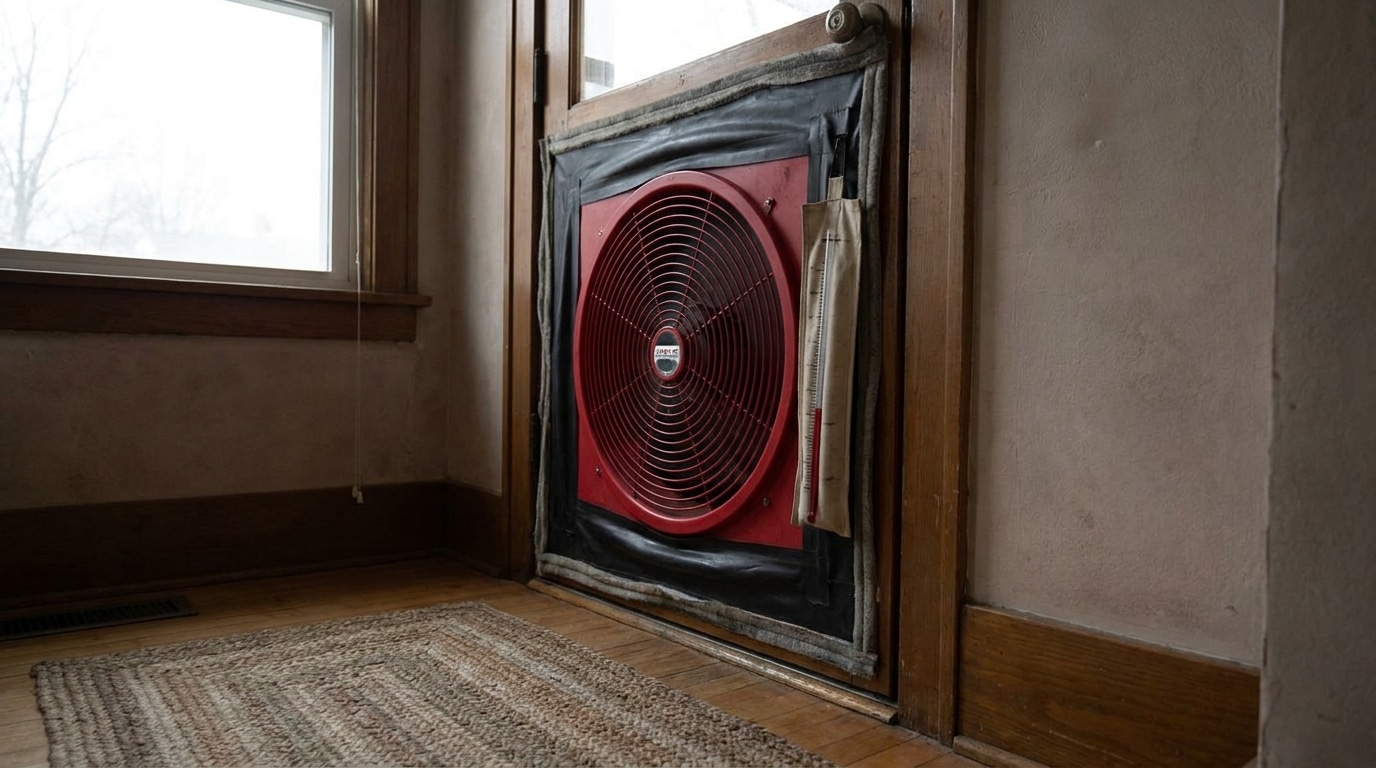
A home energy audit depressurizes your house with a blower door. This exaggerates every leak so it can be detected and quantified.
Infrared imaging pinpoints every area where insulation is missing behind drywall. Duct testing shows how much conditioned air is being lost before it reaches the rooms.
The payoff is a prioritized list – biggest problem first, smallest last – instead of a heap of guesses. That’s important, because attic air sealing and duct repairs pay off financially almost every time over new replacement windows, and most homeowners believe just the opposite.
Fixes That Actually Work
Start with the cheap stuff, then move up.
Sealing attic bypasses/topping off attic insulation ranks highest in value among whole house repairs, since it repairs the top-floor cold room at the same time.
Sealing and insulating ductwork that runs through unconditioned space is next. Installing a return air path – even just undercutting a door or installing a transfer grille – resolves surprisingly many chronic cold rooms by itself.
Weatherstripping doors, caulking window trim, and sealing rim joists are all easy weekend projects with tangible results.
What rarely works:
- Cranking the thermostat up (it heats the whole house, not the cold room)
- Closing vents in other rooms, which increases duct pressure and makes leaks worse
- Space heaters, which mask the problem while raising the power bill
- New windows, before the attic and ducts have been dealt with
The Bottom Line
A cold room is the house pointing at its own weak spot.
Somewhere heat is escaping — through a torn duct, an attic gap, a patch of missing wall insulation or a room that can’t return air to the furnace.
Each of those problems can be found, and almost all of them can be repaired for much less than it would cost to replace your heating system.
Take measurements. Correct the largest loss. Then live in a house that heats evenly throughout.