For generations, wedding jewelry followed a relatively stable visual vocabulary. Diamonds, polished gold, platinum bands, solitaires and restrained engraving dominated the category because they communicated permanence without requiring much explanation. That formula remains commercially powerful, but it no longer defines the full range of what couples expect from symbolic jewelry. A growing number of buyers now want rings that reflect interests, fictional worlds, aesthetic identities and shared experiences rather than established bridal conventions alone. Space imagery, fantasy motifs, dark metals, unusual stones and complementary ring designs have consequently moved closer to the mainstream. The shift suggests that couples increasingly view wedding rings not simply as formal markers of marriage, but as compact expressions of the private culture they have built together.
The change is partly generational, but it is also connected to the broader personalization of consumer goods. Couples accustomed to customizing playlists, travel plans, wardrobes and digital identities are less likely to assume that one traditional jewelry template should represent every relationship. They often approach engagement and wedding purchases with a more specific question: What object actually looks and feels like us? That question creates room for designs inspired by stars, moons, galaxies, fantasy kingdoms, mythical creatures and literary symbolism. It also changes the role of the jeweler, who increasingly serves as a translator between personal interests and wearable design. Rather than merely selecting metal, stone and size, buyers are making decisions about symbolism, narrative and emotional relevance.
This does not mean the conventional wedding band is disappearing. Traditional styles continue to appeal because they are versatile, familiar and closely associated with major life events. What is changing is the assumption that convention carries more emotional legitimacy than personalization. A starry band can represent commitment as seriously as a plain platinum ring if the imagery has significance for the couple wearing it. A fantasy-inspired pair can function as heirloom jewelry even if its design language originated in contemporary fiction or gaming culture. The market is therefore becoming more plural rather than simply less traditional. Wedding jewelry is expanding to accommodate relationships that want symbolism with a recognizable point of view.
Why Space and Fantasy Themes Have Become Natural Symbols of Commitment
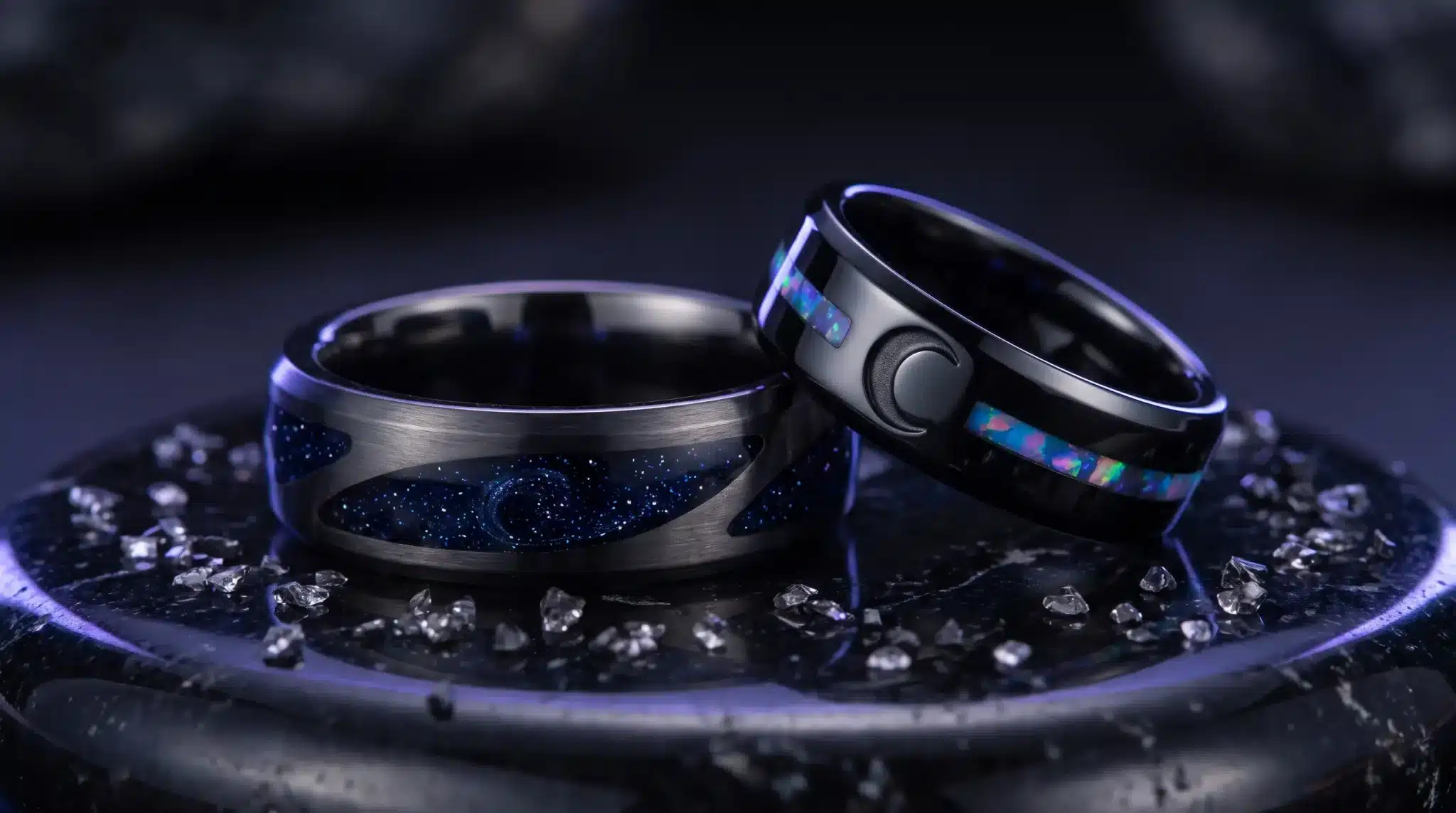
Space provides unusually rich material for romantic symbolism because its imagery already carries associations with scale, time, mystery and permanence. Stars have been used for centuries to represent guidance, destiny and distance, while moons often suggest cycles, constancy and change. Modern couples can draw on those established meanings without selecting jewelry that feels historical or overly formal. A ring patterned with a night sky can feel futuristic, intimate and ancient at the same time. Meteorite textures and celestial engraving introduce another layer by connecting the object to something larger than everyday life. For a wedding category built around promises intended to last for decades, that sense of cosmic scale has obvious emotional appeal.
That growing appetite for symbolic, unconventional jewelry is becoming visible as sellers respond to couples who want shared interests and personal narratives reflected in the objects marking their relationships. Rather than treating fantasy and celestial imagery as novelty motifs, some retailers incorporate those themes into engagement rings, wedding bands and coordinated couples sets designed for everyday wear. One example is Foreverings, an e-commerce jewelry brand whose assortment includes fantasy-inspired matching rings influenced by ACOTAR and romantic fantasy aesthetics, alongside celestial wedding bands shaped by galaxies, stars and cosmic imagery. The broader significance is not any single theme, but the willingness of couples to treat these references as symbols of commitment. This shift is encouraging jewelers to create rings connected through color, texture and symbolism rather than duplication, making matching jewelry feel personal, expressive and relevant.
Fantasy offers a similarly flexible symbolic language, though its appeal is somewhat different. Many fantasy stories revolve around loyalty, chosen families, impossible journeys, rival kingdoms, sacred promises and partnerships forged under pressure. Those themes can make fictional imagery unusually compatible with wedding jewelry, especially for couples who encountered the stories together. A ring inspired by a fictional universe does not necessarily function as merchandise in the conventional sense. When designed with restraint, it can communicate its meaning primarily to the couple while appearing to everyone else as an unusual piece of fine or alternative jewelry. That balance between private reference and public elegance has become one of the category’s strongest attractions.
Matching Rings Are Becoming More Sophisticated
The traditional idea of matching wedding bands often meant two nearly identical rings produced in different sizes. Contemporary couples jewelry is increasingly moving away from that literal interpretation. Designers are instead creating coordinated sets in which the rings share materials, motifs or visual rhythms while retaining different shapes and proportions. One ring might use a prominent gemstone while the other carries the same color through an inlay or engraved detail. A moon motif on one band might be paired with a constellation pattern on the other. Matching, in this context, means connection rather than duplication.
That distinction matters because many couples have different preferences regarding width, color, texture and ornamentation. One partner may prefer a dramatic black band while the other wants a more delicate ring with a raised stone. Identical jewelry can force one person to compromise in order to achieve visual consistency. Complementary design offers another path by allowing each ring to suit its wearer while preserving an obvious relationship between the two pieces. This is particularly useful in fantasy and space-themed collections, where a shared story can be expressed through multiple symbols. The result can feel more personal because the rings operate like two related characters rather than copies of the same object.
The trend also reflects a broader evolution in how couples define partnership. Modern relationship symbolism often emphasizes two distinct individuals choosing a shared life, rather than two people being visually absorbed into a single identity. Complementary rings fit neatly into that framework. The individual pieces can differ in finish, stone placement and silhouette while still making sense as a pair. For jewelers, this creates opportunities to design collections around visual systems rather than individual products. For buyers, it turns the search for wedding rings into a conversation about both personal taste and shared meaning.
Materials Have Become Part of the Story
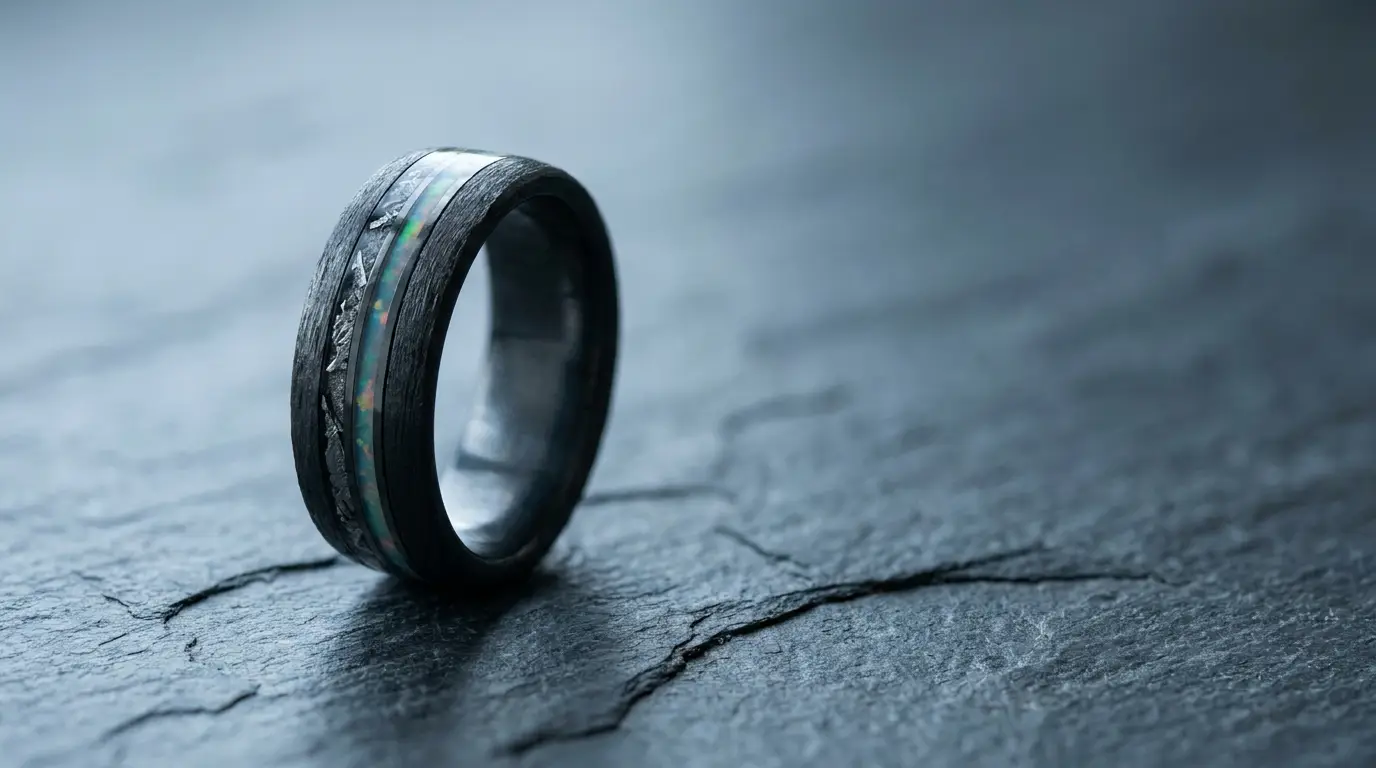
The rise of unconventional wedding rings would be difficult to separate from changes in materials. Traditional precious metals remain important, but alternative metals and composite materials have dramatically expanded the range of available colors and textures. Tungsten, titanium, ceramic and dark metal finishes can create visual effects that would be difficult to achieve with classic yellow gold alone. These materials are especially compatible with space themes because their darker surfaces can resemble night skies, planetary landscapes or futuristic objects. Wood, opal-like inlays and crushed stone can introduce contrasting colors associated with nebulae or distant galaxies. Material selection therefore becomes part of the narrative rather than merely a technical choice.
Meteorite has attracted particular attention in celestial jewelry because it offers both texture and a compelling origin story. Its patterned surface can evoke the physical reality of space rather than simply representing it through engraving. Yet unusual materials require more practical evaluation than their appearance may initially suggest. Some materials can be resized more easily than others, while certain inlays may require different maintenance than a conventional solid-metal band. Surface coatings can also age differently depending on wear patterns and manufacturing methods. Buyers interested in symbolic materials should consequently pay attention to construction quality, care instructions and long-term service options alongside aesthetics.
Gemstones have undergone a similar broadening of expectations. Diamonds still carry powerful cultural associations with engagement, but couples interested in fantasy or cosmic design may prioritize color and atmosphere over traditional hierarchy. Deep blue stones can evoke the night sky, while iridescent materials can suggest nebulae, magical landscapes or shifting light. Black stones can create contrast in designs built around stars or moons. The choice does not have to reject tradition outright, since diamonds can be incorporated into highly unconventional settings. What has changed is the assumption that a wedding ring’s emotional value must be communicated primarily through one specific stone.
Fandom Has Changed From Merchandise to Personal Design Language
Popular culture once occupied a relatively separate category from fine jewelry. Fans might buy posters, figurines, T-shirts or collectible replicas, while engagement and wedding purchases remained governed by more formal conventions. That boundary has weakened considerably as entertainment franchises, games, novels and online communities have become persistent parts of adult identity. People who met through a shared fandom, attended conventions together or spent years discussing the same fictional universe may see that interest as part of their relationship history. Incorporating it into wedding jewelry can therefore feel less like novelty merchandising and more like autobiographical design. The important distinction is whether the ring merely displays a recognizable logo or interprets the underlying world with sophistication.
The strongest fantasy-inspired jewelry often works through indirect references rather than obvious branding. Designers can use architectural patterns, botanical motifs, celestial imagery, symbolic colors, runic textures or gemstone combinations that recall a fictional world without turning the ring into a costume accessory. This makes the jewelry more adaptable to daily wear. It also gives the couple greater ownership over the meaning because the reference can remain partly private. Someone unfamiliar with the inspiration may simply see an unusual ring with a coherent aesthetic. Someone who understands the source material may recognize an additional layer of significance.
That subtlety is important because wedding rings are expected to function differently from most fandom products. They are worn repeatedly, often every day, across professional settings, formal events and ordinary routines. A design that feels exciting for a weekend convention may not necessarily feel appropriate after years of continuous wear. Successful fantasy jewelry therefore requires editing and restraint, even when the source material is elaborate. The objective is not to reproduce an entire fictional universe on a few millimeters of metal. It is to identify the visual or symbolic elements capable of carrying meaning over time.
Social Media Has Accelerated the Search for Unconventional Rings
The jewelry discovery process has changed substantially with the rise of visual platforms. Couples once relied heavily on local jewelry counters, bridal magazines and recommendations from family or friends. Today, a buyer can encounter hundreds of niche ring designs before entering a store or contacting a jeweler. Short-form videos make unusual materials particularly effective because reflective surfaces, glowing inlays and textured metals can produce an immediate visual impression. Fantasy and celestial designs are well suited to this environment because they often look distinctive even on a small screen. A category that might once have seemed obscure can now reach potential buyers globally.
Social media also gives consumers a vocabulary for preferences they may not have known how to describe. A shopper might begin with the vague idea of wanting something “different” and eventually discover terms associated with galaxy rings, celestial wedding bands, gothic engagement rings or fantasy couples sets. Once a design category has a searchable name, demand becomes easier to organize. Algorithms can then reinforce the interest by presenting increasingly specialized variations. This produces a feedback loop between designers and buyers. Consumers discover possibilities, designers see evidence of demand, and the market becomes more specific.
There is, however, a downside to buying jewelry primarily through imagery. Photographs and videos can emphasize visual novelty while revealing little about durability, comfort or construction. A highly reflective inlay may look dramatic under studio lighting but behave differently after months of ordinary wear. An unusually wide ring might be visually impressive yet uncomfortable for someone accustomed to thinner jewelry. Couples evaluating unconventional pieces online should therefore look beyond the initial image and consider dimensions, materials, sizing policies and care requirements. The strongest purchase is one that survives both the excitement of discovery and the realities of daily use.
The Economics of Wedding Jewelry Are Also Shifting
Personalized jewelry does not necessarily mean more expensive jewelry. The growing range of materials, independent brands and direct-to-consumer retailers has created price points that differ significantly from the traditional luxury-jewelry model. Some couples would rather allocate their budget toward distinctive design than toward maximizing gemstone size or precious-metal weight. Others are seeking durable symbolic rings at prices that leave more money for travel, housing or wedding expenses. The emotional importance of the purchase remains high, but the criteria used to justify spending are changing. A ring’s story can carry as much value for some buyers as its conventional material status.
Direct-to-consumer retail has played a significant role in this development. Online jewelry brands can present a much larger range of highly specific designs than a physical store with limited display space. That makes niche collections more commercially viable because the retailer does not need every local shopper to appreciate the same aesthetic. A celestial collection can reach astronomy enthusiasts across numerous regions, while a fantasy-inspired series can appeal to readers and gamers who may never encounter comparable products in nearby stores. Digital merchandising also makes it easier to show ring sets together rather than as isolated products. This is particularly important for couples shopping for coordinated designs.
Price, however, should not be confused with value or durability. An alternative material may offer excellent scratch resistance but limited resizing options. An elaborate inlay can add visual distinction while introducing maintenance considerations that a simple gold band does not have. Precious metals, meanwhile, may cost more but offer established repair pathways and long histories of jewelry use. Buyers need to compare products according to the way they expect to wear them rather than relying solely on price or marketing language. The economics of unconventional rings are most favorable when couples understand the tradeoffs they are making.
Personal Symbolism Is Becoming the New Luxury
Luxury jewelry has traditionally been defined by scarcity, craftsmanship, precious materials and recognizable prestige. Those factors remain influential, but younger and more design-conscious consumers often add another criterion: relevance to the individual. An expensive object that feels generic may carry less emotional weight than a moderately priced object that perfectly captures a shared experience. This does not eliminate the appeal of diamonds or precious metals. It changes the framework through which value is interpreted. Personal specificity can itself become a form of luxury because it makes the object feel difficult to substitute.
Space-themed wedding rings demonstrate this particularly well. A constellation can mark the sky associated with a meaningful date, while a planetary motif can refer to a shared interest in astronomy or science fiction. The night sky can also function more abstractly as a metaphor for distance, endurance or possibility. These meanings do not require public explanation to remain powerful. In fact, the private nature of the symbolism may increase its significance for the people wearing the rings. Jewelry becomes less about broadcasting status and more about carrying a coded reminder of the relationship.
Fantasy-inspired rings operate in much the same way. A motif connected to a beloved story may represent perseverance, loyalty or partnership rather than fandom alone. The source material supplies a language through which the couple can articulate ideas that already matter to them. Over time, the ring may become less associated with the original book, game or fictional world and more associated with the marriage itself. That is how personal objects develop emotional histories. Their initial symbolism provides a starting point, but lived experience gradually becomes the more important story.
Choosing a Themed Ring That Can Still Feel Right Decades Later
The central challenge with any highly distinctive wedding ring is longevity. Couples are choosing an object intended to remain relevant even as clothing, interests and aesthetic preferences change. The safest solution is not necessarily to avoid unconventional design. Instead, buyers can focus on themes that have durable personal meaning and designs that do not depend entirely on a passing visual trend. A subtle star pattern may age differently from an oversized novelty motif. A fantasy influence expressed through texture and color may remain wearable longer than a literal reproduction of a fictional symbol.
Comfort deserves similar attention. Rings with heavy detailing, unusual edges or substantial width can feel different from standard bands during everyday activities. Buyers should consider how the design interacts with work, exercise, gloves and other jewelry. Couples purchasing matching sets should also remember that each person may need a different profile or thickness for comfort. Visual coordination does not require identical construction. A well-designed set can preserve shared symbolism while adapting to the practical needs of each wearer.
Long-term ownership also means thinking about maintenance before purchase. Couples should understand whether a ring can be resized, refinished, repaired or restored if an inlay is damaged. They should know which cleaning methods are appropriate for its materials and whether the manufacturer offers support after the initial sale. These questions may appear less romantic than choosing stars, gemstones or fantasy motifs, but they are central to turning an appealing design into lasting jewelry. Symbolism is strongest when the object carrying it remains functional. A wedding ring should be capable of accumulating memories rather than becoming too fragile to wear.
The Future of Couples Jewelry Will Be More Personal, Not Less
The rise of space and fantasy themes points toward a broader transformation in the jewelry market. Consumers are unlikely to abandon traditional symbols, but they are increasingly unwilling to accept the idea that commitment must look the same for everyone. Jewelry makers are responding with more specialized collections, varied materials and designs built around shared interests. Matching sets are becoming less literal and more conceptually connected. Engagement rings and wedding bands are also beginning to occupy the same aesthetic universe rather than being treated as separate purchases. The overall direction is toward greater narrative coherence.
Technology may push personalization further. Digital customization tools can make it easier for couples to experiment with engravings, stone colors, metal finishes and complementary designs before ordering. Advanced manufacturing can also support smaller production runs, allowing niche styles to reach the market without requiring mass demand. That could make wedding jewelry increasingly fragmented into highly specific subcategories. Instead of choosing only between classic, vintage and modern, couples may search according to worlds, themes and symbols. Space, fantasy and mythology are likely to remain influential precisely because they contain such broad visual vocabularies.
The underlying appeal, however, is less about any particular trend than about ownership of the symbol itself. Wedding rings have always represented relationships, but the market increasingly allows couples to decide what visual language should carry that meaning. For some, that will remain a plain gold band whose restraint is part of its beauty. For others, commitment will be represented by a galaxy, a moonlit landscape, a fictional kingdom or two rings designed as complementary halves of a larger idea. Neither approach is inherently more serious than the other. The most significant change is that couples now have far greater freedom to make the symbolism their own.