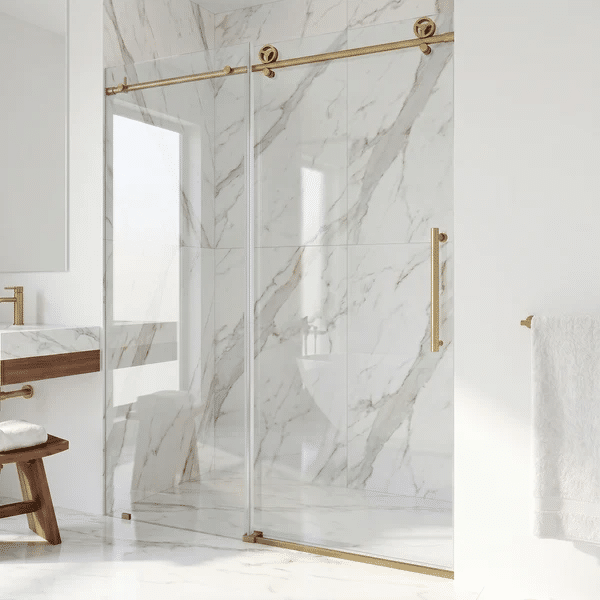
I’ve now been through two bathroom renovations, and if there’s one thing I underestimated both times, it’s the shower door. You spend weeks agonizing over tile and vanity finishes, and then the door gets picked in the last twenty minutes because you’re tired of looking at samples. Big mistake. The shower door is the thing you touch every single day, and a bad one announces itself fast — a track that gunks up with soap scum, hardware that goes dull within a year, rollers that start to stick so you’re shouldering the door open like it owes you money.
So when I started looking into sliding shower doors for a friend’s renovation recently, I paid a lot more attention to the boring mechanical stuff than I did the first time around. Turns out that’s exactly where the good ones separate from the mediocre ones.
Quick answer: The best sliding shower doors use 3/8-inch tempered glass, sealed self-lubricating rollers, a trackless (groove-free) bottom rail, and a corrosion-resistant hardware finish. Those four factors — not the color of the handle — determine whether a door still glides smoothly and looks good five years in.
Why Sliding Doors Keep Winning Over Hinged and Pivot Styles
The appeal is pretty simple once you’ve lived with one: a sliding door doesn’t need a swing radius. In a lot of North American bathrooms, especially older homes with smaller footprints, that’s a bigger deal than it sounds. A hinged door needs floor clearance to open, which either eats into your vanity space or forces awkward layout decisions. A sliding door just glides along its track and stays flush.
There’s also the shared-bathroom argument, which nobody talks about enough. If you’ve got a household where the bathroom door and the shower door are both swinging open at the same time some mornings, a sliding enclosure just removes one more thing to bump into.
None of that matters, though, if the door itself is poorly made. And this is where a lot of shopping guides gloss over the parts that actually matter.
The Stuff That Actually Determines Whether You’ll Be Happy in Year Three
Style sells the door in the showroom. Mechanics decide whether you still like it three years later. A few things I’d tell anyone to check before buying:
Glass thickness and tempering come first. Thin glass looks fine in photos and feels flimsy in person — and it’s more prone to chipping at the edges over time. For a frameless or semi-frameless door that’s going to see daily use for a decade, 3/8-inch tempered glass is a reasonable line in the sand. Anything noticeably thinner is a corner being cut somewhere.
Roller and track hardware matters more than anything else on this list, honestly. This is the part that fails first on cheap doors — squeaky wheels, binding tracks, a door that slowly drifts off its rail. Sealed, self-lubricating rollers are worth paying for, because replacing a roller assembly two years in is not a fun weekend project.
Then there’s the bottom track itself, which is the single grossest part of any shower if you’ve ever actually cleaned one. Traditional sliding doors use a grooved track along the shower base that collects hard water deposits, soap residue, and mildew in all the little channels a scrub brush can’t quite reach. Trackless designs get rid of that groove entirely. It sounds like a minor upgrade until you’re the one on your knees with a toothbrush trying to get at it.
Finish durability is the other sneaky one. Matte black looks incredible on installation day. The question is what it looks like after eighteen months of steam, water spots, and whatever bathroom cleaner is under the sink. A cheap plated finish will start showing its base metal at the edges pretty quickly. A properly coated, corrosion-resistant finish holds its color and doesn’t pit.
And finally, manufacturing tolerances — how precisely the glass is cut and drilled. This is less visible to a shopper but it’s the difference between a door that installs flush and seals well against leaks, and one that needs to be forced into place with extra caulk to hide the gaps.
Where VIGO Fits Into This
I ended up pointing my friend toward VIGO’s sliding shower door collection, mostly because it checked the boxes above without requiring a ton of digging to confirm.
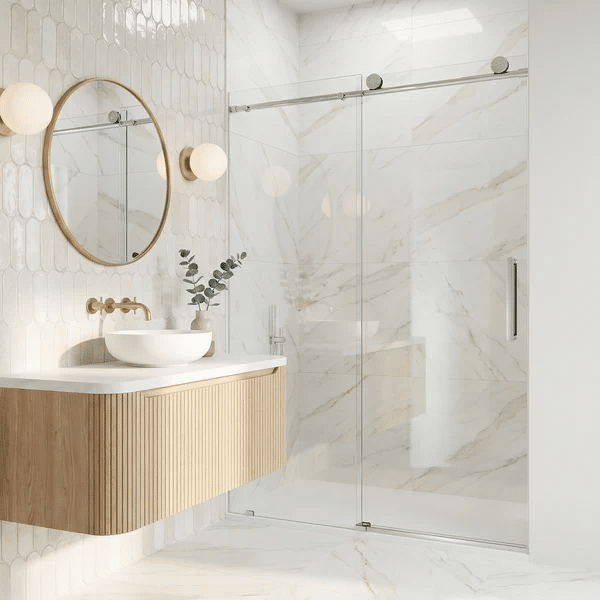
The glass across the line is solid tempered glass, and several models skip the traditional bottom track altogether — which, again, doesn’t sound like much until you’ve spent a Saturday scrubbing grime out of one. The roller systems are built for smooth, quiet operation rather than the stiff, jerky slide you get with bargain-bin doors.
Finish-wise, there’s actual variety — brushed nickel, chrome, matte black, matte brushed gold — and it’s the kind of coating that’s meant to hold up rather than a thin flash-plated layer that wears through at the handle within a year (which, if you’ve ever owned a cheap towel bar, you already know is a real thing).
Widths run from around 44 inches up past 72 inches, so it’s not a one-size-fits-all situation where you’re stuck making an alcove opening work with a door that’s technically the wrong size. And most models can be configured with the handle on either side, which matters more than you’d think once you’re standing in the actual bathroom trying to figure out which way you want the door to travel.
Don’t Sleep on Fixed Shower Screens
Sliding doors get most of the attention, but fixed screens are doing a lot of the quiet work in open-concept and walk-in shower designs — the kind of curbless setup that’s become popular in a lot of newer builds and renovations. A fixed screen contains the splash without boxing the whole shower into a sealed enclosure, which keeps a bathroom feeling open.
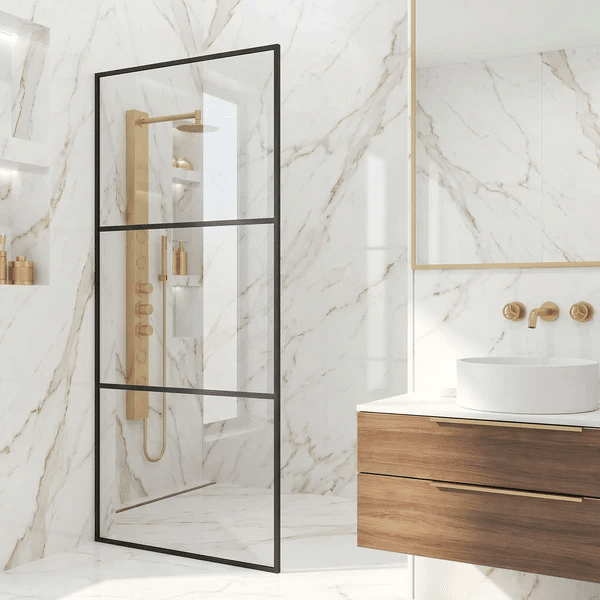
VIGO’s fixed shower screens are built to the same glass and finish standards as the sliding doors, which matters if you’re trying to pair a door and a screen and don’t want them to look like two unrelated products awkwardly installed next to each other. You’ve got framed and frameless options, and glass ranges from clear to fluted and textured finishes if you want a bit of privacy without losing light.
Because a fixed screen doesn’t move, the wall seal and mounting hardware carry even more weight than they do on a sliding door — a poorly sealed panel is one of the more common ways water ends up somewhere it shouldn’t in a walk-in shower. That’s an area worth checking closely regardless of which brand you’re comparing.
Installation Is Where Cheap Products Really Show Their Hand
This is the part nobody photographs for the marketing page, but it’s where a lot of frustration comes from. A poorly designed door shows up with vague instructions, mismatched screws, and glass or brackets that need to be shimmed and fussed with just to sit level. That means longer install times, more trips back to the hardware store, and — if you’re paying a contractor — more billable hours.
The doors that install cleanly tend to share a few traits: components that are pre-drilled and pre-fitted rather than left for the installer to figure out on-site, a hardware kit that actually includes everything needed for a standard alcove install, mounting brackets with enough adjustability to compensate for walls and floors that aren’t perfectly plumb (which is most walls and floors, especially in older houses), and configurations that can be flipped left or right instead of forcing you to special-order a mirror-image version.
That’s the difference between an installer muttering under their breath for two hours and one who’s done in forty-five minutes. It’s not glamorous, but it’s exactly the kind of thing that decides whether a renovation day feels smooth or miserable.
So Which One Do You Actually Need?
If you’ve got a standard alcove tub-shower combo and space for a swinging door is tight, a sliding door is the obvious call. If you’re doing a curbless walk-in with an open layout, a fixed screen contains the water without closing the space in. And if you’ve got a bigger walk-in shower, plenty of people are now combining both — a fixed panel on one side for a clean line, a sliding door at the entry point — which has become a pretty common move in primary bathroom remodels lately.
Frequently Asked Questions
What glass thickness should a sliding shower door have?
3/8-inch (10mm) tempered glass is the standard for a frameless or semi-frameless sliding door built for daily, long-term use. Thinner glass is more prone to chipping and feels less substantial.
Are trackless sliding shower doors easier to clean?
Yes. Trackless designs remove the grooved bottom rail that traditionally collects soap scum, hard water buildup, and mildew, which is one of the hardest parts of a shower to clean with a standard track system.
What’s the difference between a sliding shower door and a fixed shower screen?
A sliding shower door moves along a track and serves as the shower’s entry point, typically in an alcove or tub-shower combo. A fixed shower screen doesn’t move and is used to contain water in curbless, walk-in, or open-concept shower designs.
Can sliding shower doors be installed with the handle on either side?
Most quality sliding doors, including VIGO’s line, are designed to be reversible, so the handle position can be configured for either the left or right side depending on the bathroom layout.
What makes shower door installation easier or harder?
Pre-drilled, pre-fitted glass and hardware, a complete mounting kit, and adjustable brackets that compensate for out-of-plumb walls all reduce installation time. Doors lacking these features often require on-site shimming and adjustment, which slows installation down.
The Actual Takeaway
Nobody thinks about their shower door until it starts failing them — a track that won’t stay clean, a handle that’s gone dull, a roller that’s started to grind. The doors and screens that avoid all that share the same handful of traits: thicker glass, better roller hardware, finishes that actually resist corrosion, and installation hardware designed by someone who’s clearly watched an installer struggle with a bad kit before.
If you’re shopping for either a sliding door or a fixed screen, spend the extra ten minutes checking glass thickness and roller quality before you buy. It’s the difference between a door you’re still happy with five years from now and one you’re quietly replacing again sooner than you’d like.
Image credit: Product photography provided by VIGO Industries.