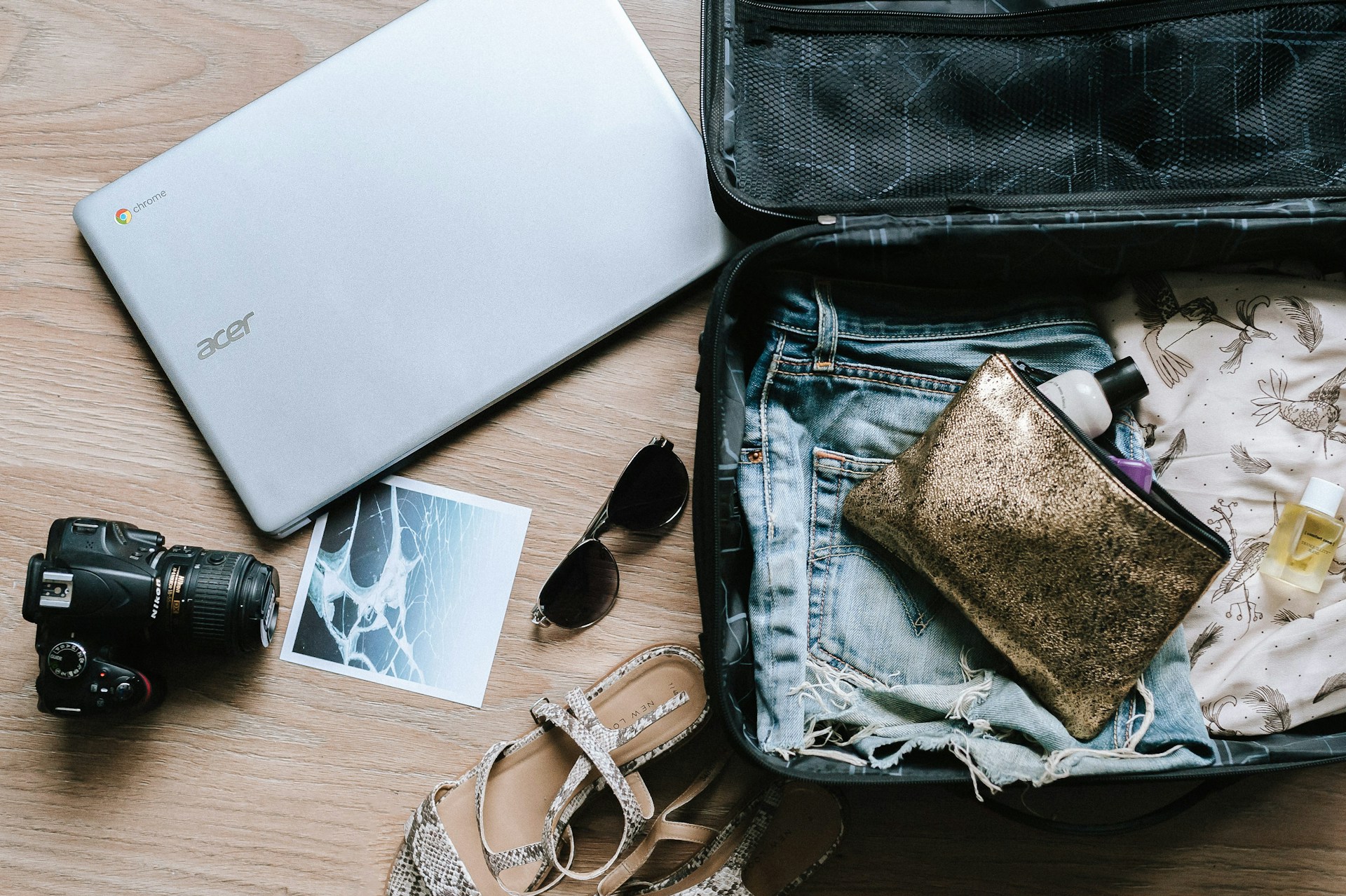
Most people who overpack are not bringing too many clothes. They are bringing too many unrelated ones. In a survey of 2,200 American travelers, 40 percent said they often or always come home with items they never took out of the bag.
A capsule fixes that, and it works the same way on the road as it does in a closet. You are not choosing seven outfits. You are choosing a small group of pieces that combine into seven, which takes up far less room and makes the morning decision shorter.
Here is how to build one that fits a cabin-sized case and still looks considered on day six.
The Three-Number Rule
Three bottoms. Six tops. Two layers.
That is 18 combinations before you add a layer, and 36 after. For a week away, you will wear maybe nine of them, and the surplus is what gives you room to change your mind.
- Three bottoms. One tailored trouser, one casual (jeans, chinos, a denim skirt), one that reads dressed up.
- Six tops. Four for daytime, two that carry a dinner.
- Two layers. One for warmth, one for weather. They do different jobs, so a wool cardigan does not replace a rain shell.
Everything on that list has to work with everything else on it. The moment a piece only goes with one other piece, it stops being a capsule item and starts being an outfit you are transporting.
Build Around One Colour Spine
Pick a single neutral and run it through every bottom and both layers. Navy, charcoal, camel and black all work. The spine does the structural job, so your tops are free to carry colour and pattern without anything clashing.
I lean toward camel and navy together, partly because the combination photographs better than black does in most daylight, and partly because scuffs show less on the trip home.
Two practical consequences of a colour spine:
- Shoes get easier. One neutral spine means one pair of shoes covers most of the week.
- Accessories do more. Against a consistent base, a scarf or a different earring reads as a new look rather than an addition.
What Actually Earns Its Space
Shoes
Two pairs, and you wear the bulkier one through the airport. A third pair is the single most common packing mistake, and shoes are the heaviest thing most people put in a case for the least use.
Outerwear
A coat belongs on your body or over your arm, never inside the bag. Airlines do not count what you are wearing, which makes outerwear the one category where bulk costs you nothing.
Accessories
A scarf, a belt, two pairs of earrings, one necklace. Keep jewellery in a small zip pouch rather than loose in a pocket, where chains knot against each other and stones chip. A watch travels on your wrist.
Accessories are where a capsule stops looking like a uniform. They weigh almost nothing and they are the only part of this list where bringing a spare is sensible.
The Bag Decides the Wardrobe
Before you fold anything, check what you are folding it into. Most US carriers hold carry-on bags to 22 x 14 x 9 inches, and those measurements include wheels and handles. A case advertised as 22 inches tall often measures closer to 23 once the wheels are counted, which is what gets it stopped at the gate.
Two cases with identical outside dimensions can hold noticeably different amounts depending on the interior. A fixed divider wastes the space it occupies. Look for carry-on luggage with a compressible main compartment, which is what lets a week fit where four days used to.
One warning on expandable cases: leave them unexpanded on the way out. An expanded bag usually breaks the depth limit even when height and width are fine, and depth is exactly what the gate sizer catches.
The financial case for staying in the cabin got stronger this year. Southwest, Delta and United all raised the first checked bag to at least $45 each way in April 2026, with the second at $55. Two people flying round trip pay $180 before they have bought anything. US airlines also mishandled just over a million bags in the first half of 2026, which is a small risk per flight and a larger one across a year.
What Compression Actually Saves
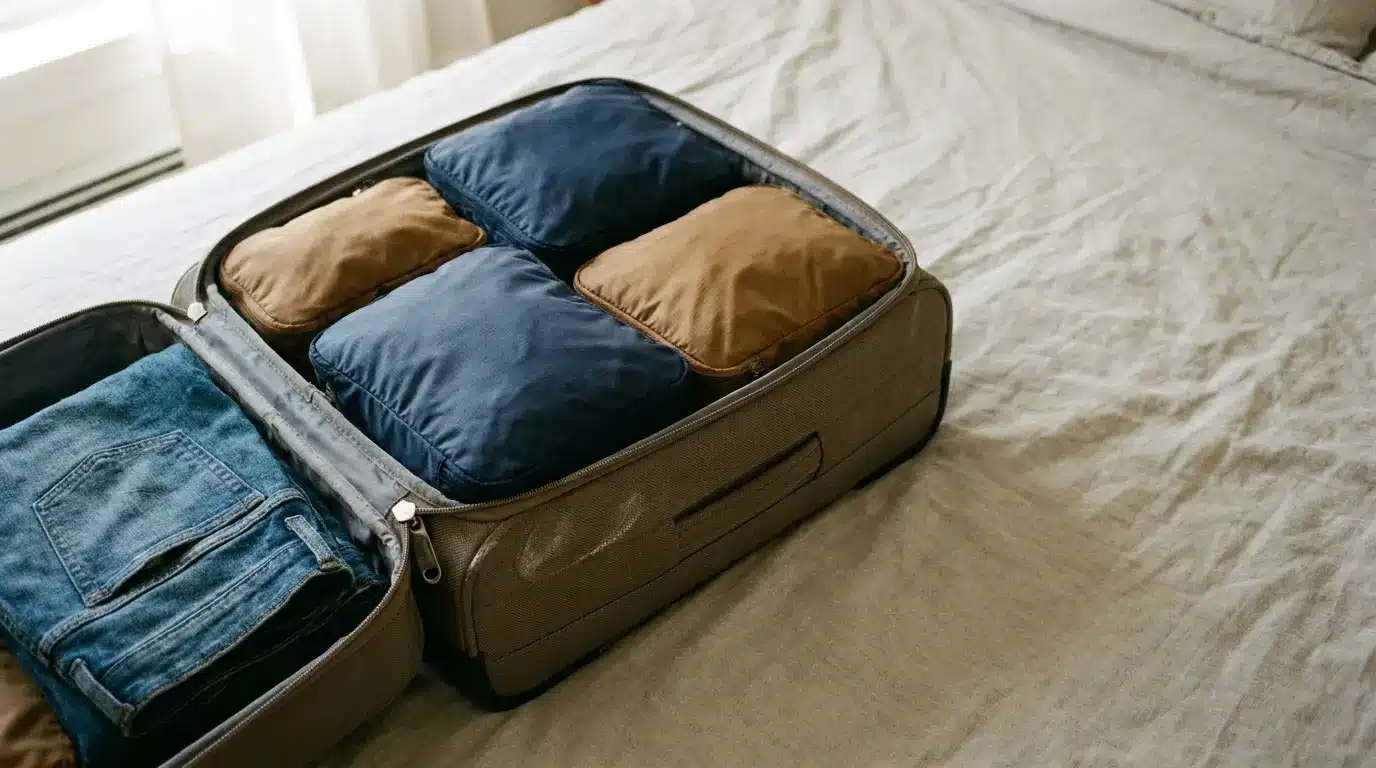
Folding gives you a neat bag. Compression gives you a smaller one, and those are not the same project.
Packing cubes squeeze soft items down and keep the case organised enough that you are not unpacking everything to find one top on day four. Vacuum bags save more volume but need a way to reseal, which makes them better suited to the journey home than the journey out.
Four rules that hold up:
- Roll knits, fold structure. Jersey and cotton roll without creasing. Anything tailored folds along its existing seams.
- Shoes go against the wheels. Soles facing outward, heels nested.
- Fill the shoes. Socks, chargers, jewellery pouch, anything small.
- Day one on top. You will arrive tired and you will not want to dig.
The Pre-Trip Cull
Lay the whole capsule out on the bed before it goes near the case. Then take three things out.
The items that go are almost always the same ones. The dress for a dinner nobody has booked. The second jacket. The workout kit for a gym you have not confirmed exists. Pack for the itinerary you actually have, and leave a small gap for whatever you buy while you are there.
It helps to separate the two kinds of mistakes. Forgetting a t-shirt is recoverable in any town on earth. Forgetting medication, a charger or your documents is not. Everything in the second category travels in the cabin regardless of how you are packing the rest.
Your First Carry-On Capsule, Step by Step
- Pick the spine. One neutral, carried through every bottom and both layers.
- Count to three, six and two. Bottoms, tops, layers. Lay them out together and check each piece works with at least three others.
- Add two pairs of shoes. Wear the larger pair to the airport.
- Pack accessories last and small. One pouch, nothing loose.
- Remove three items. Whatever you hesitated over is the right answer.
Build it once and the second trip takes twenty minutes, because the pieces already know how to work together. That is the actual benefit of a capsule, more than the space it saves.