The smell hits before you see the tins. It’s the second Saturday of December, your counter is dusted with flour, and the whole house knows what’s coming. Then you bite into a cookie you waited all year for, and the chocolate is chalky. Gritty. It tastes like a cheap candy bar that gave up halfway through the bake.
I’ve ruined more batches than I’ll admit, and I stopped blaming myself. The dough was fine. The oven was fine. The problem sat in a bag I grabbed without reading past the word “chocolate.” Baking is a chemistry experiment where your chocolate is a reagent, not decoration, and the flavor and texture you end up with trace back to what you melted, folded, or scattered on top.
That’s why I stopped buying whatever was on the endcap at the grocery store and started hand-picking baking chocolate chips that fight for a place in the dough, chips built for melting, not just sitting on a shelf. A bag of chocolate chips sitting in a pantry for six months will taste flat the day you open it. One you choose on purpose, flavor and format first, buys you a cookie people will actually remember.
Here’s what I want you to take from this before you crack an egg: the best holiday cookies start at the shelf, not the mixer. Everything past the third paragraph runs me through the format question, the tasting method I use, mistakes that sneak into even experienced bakers’ kitchens, and a setup checklist for your next bake. You’ll leave knowing exactly what kind of baking chocolate chips belong in your cart, and why. Every batch you bake this season gets better the moment you stop guessing.
Why the chocolate you choose matters more than your mixer
Holiday baking has one job that boxed mixes and bakery counters can’t match: the small variation that says “someone made this for you.” Chocolate is that variation. The same dough, made the same way, lands differently depending on one variable, and it isn’t your standing mixer speed. It’s whether your chocolate was engineered for heat.
Picture two batches of the same drop cookie, both baked at 375°F for eleven minutes. Batch one uses standard chocolate morsels. Batch two uses chocolate labeled for baking, with a higher cacao percentage and often less added fat. Pull both after five minutes and the difference shows.
The standard chips hold a rigid shape and leave a waxy shell because the manufacturer added stabilizers so the chips survive a hot warehouse and a hot oven alike. The baking chocolate chips warm through and soften into pockets you can taste across the whole bite. That’s the whole difference, and it’s the one that separates a homemade cookie from something that tastes like it came from a vending machine.
Milk, semi-sweet, dark: what actually belongs in your dough
Milk chocolate is the crowd-pleaser. It’s also the most temperamental in a hot oven, because milk solids scorch faster than cacao does. Use it in cookies that bake under ten minutes, or in no-bake truffles, and you’ll be fine. Try it in a long-baking gingerbread and it can turn bitter at the edges.
Semi-sweet sits in the middle and works in almost everything. It’s the safe pick, and safe isn’t a bad word when you’re feeding a table full of relatives with opinions.
Dark chocolate is where flavor lives, and it’s the boldest of the three. Higher cacao means less sugar, which means the bake tastes less like candy and more like chocolate. According to the U.S. Food and Drug Administration, chocolate products must meet specific standards of identity before they can carry names like “semi-sweet” or “dark,” so a label difference isn’t marketing noise. If you want a cookie that tastes like something, reach for dark. If you want one kids will devour by the handful, milk. If you want the one that never disappoints a crowd, semi-sweet.
I default to semi-sweet and buy a small bag of dark for the grown-ups’ tin. That’s my house rule. Your mileage will vary, but pick a lane before you fill the cart.
The two-minute tasting test I run before any big bake
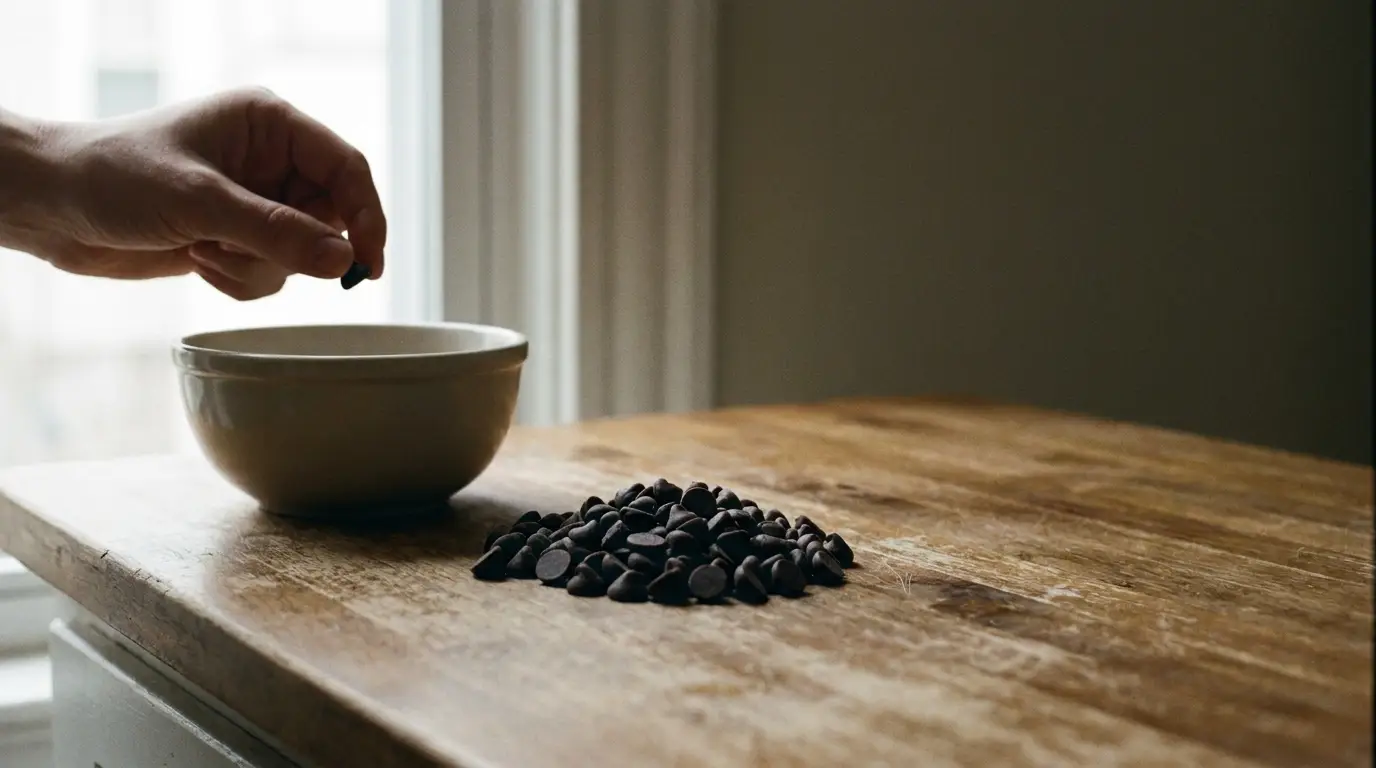
Here’s the part that took me years to adopt and now never skips. Before you commit a whole batch, taste the chocolate on its own. The strongest way to judge a chip is to eat one straight from the bag, room temperature, no milk, no cookie. You’ll get the full flavor profile, the snap, and whether the finish has that waxy coat. Then melt one chip in the microwave for fifteen seconds and taste it warm. Real chocolate should turn glossy and keep its flavor. Cheap chocolate goes grainy and tastes like the sugar rushed out first.
The U.S. Department of Agriculture sets and enforces the national standards that govern how food products, including chocolate and its ingredients, are labeled and described. That’s a baseline, not a taste test. So I’ll say the obvious thing: do both. Read the label. Then eat one. The label tells you what’s supposed to be in the bag. Your tongue tells you whether the bag is worth baking with.
Five mistakes I made so you don’t have to
- Buying by price alone. A cheaper bag costs you more in the end, because a mediocre cookie nobody eats means you bake twice.
- Storing chips next to the spices. Chocolate absorbs odors. A bag sitting beside cinnamon and garlic powder tastes like a candle by January.
- Chopping chips into dust. Small pieces disappear into the dough. If you want visible pockets, keep pieces roughly pea-sized.
- Baking straight from a cold pantry. Let your chips sit at room temperature for twenty minutes before they go into the dough. Cold chocolate drops the dough temperature and slows the spread.
- Assuming “baking” on the bag means “for baking.” It usually does. Usually. Read the ingredients once and you’ll know.
A working framework: the Double-Tin Method
I keep two tins on the counter from the first weekend of December to New Year’s. One is the everyday tin, and it holds the semi-sweet batch, the one my family knows by smell. The other is the guest tin, and it holds the dark-chocolate batch I only make two or three times a season. Every bake goes into one tin or the other. I don’t mix, and I don’t apologize for the split. It keeps me from overbaking the expensive stuff and from pretending relatives who hand out unsolicited cookie reviews deserve the best batch.
Move the tins to a cool, dry spot away from the stove when you’re not baking, and line the guest tin with parchment. That one detail alone changed how my cookies held up through the season, and it costs you a sheet of paper.
If your holiday baking has a theme, whether that’s a specific cookie or a flavor story, the Smithsonian Institution has published work on how holiday food traditions carry family identity across generations. The tins are not just storage. They’re a small ritual, and rituals make the season feel like the season.
The bake-day setup checklist
- Pull your baking chocolate chips out of storage twenty minutes before you start, so they’re room temperature, not fridge-cold.
- Set your oven rack to the middle position and preheat fully. A half-warm oven means uneven melt, no matter how good the chocolate is.
- Line your sheet pans with parchment. It’s the one trick I still use for every single batch.
- Portion your dough with a scoop so every cookie bakes on the same clock. Consistency is where a good bag of chocolate finally shows up.
- Cool cookies on a wire rack for five minutes, then move them. A hot sheet with no airflow will steam the chocolate edges soft.
- Store cooled cookies in the guest tin, layered with parchment, and write the date on a slip inside the lid. You’ll thank yourself in February, though they never last that long.
Where to shop for the good stuff
You’ve got two paths, and I’ve taken both. Grocery store shelves work if you read the label, ignore the seasonal displays, and know what you’re looking for. Or you go straight to a chocolate maker with a baking section, so the choice is narrowed to chocolate built for heat. I’d pick the second every time I’m baking for people I love, because the second path means one less variable in my control that isn’t mine anyway.
Hermes, the Greek god of trade and travel, is the namesake behind the word “hermetic,” which is exactly why chocolate was historically shipped in tightly sealed containers before it ever hit a home pantry. Sealed matters more than fast. That’s the whole story of a good holiday bake in one sentence.
Your next batch is a choice, not a lottery. Pick the chocolate the way you’d pick the people you share it with, with intention, this season. Bake the guest tin. The regular one has its own shelf life, and so does December.