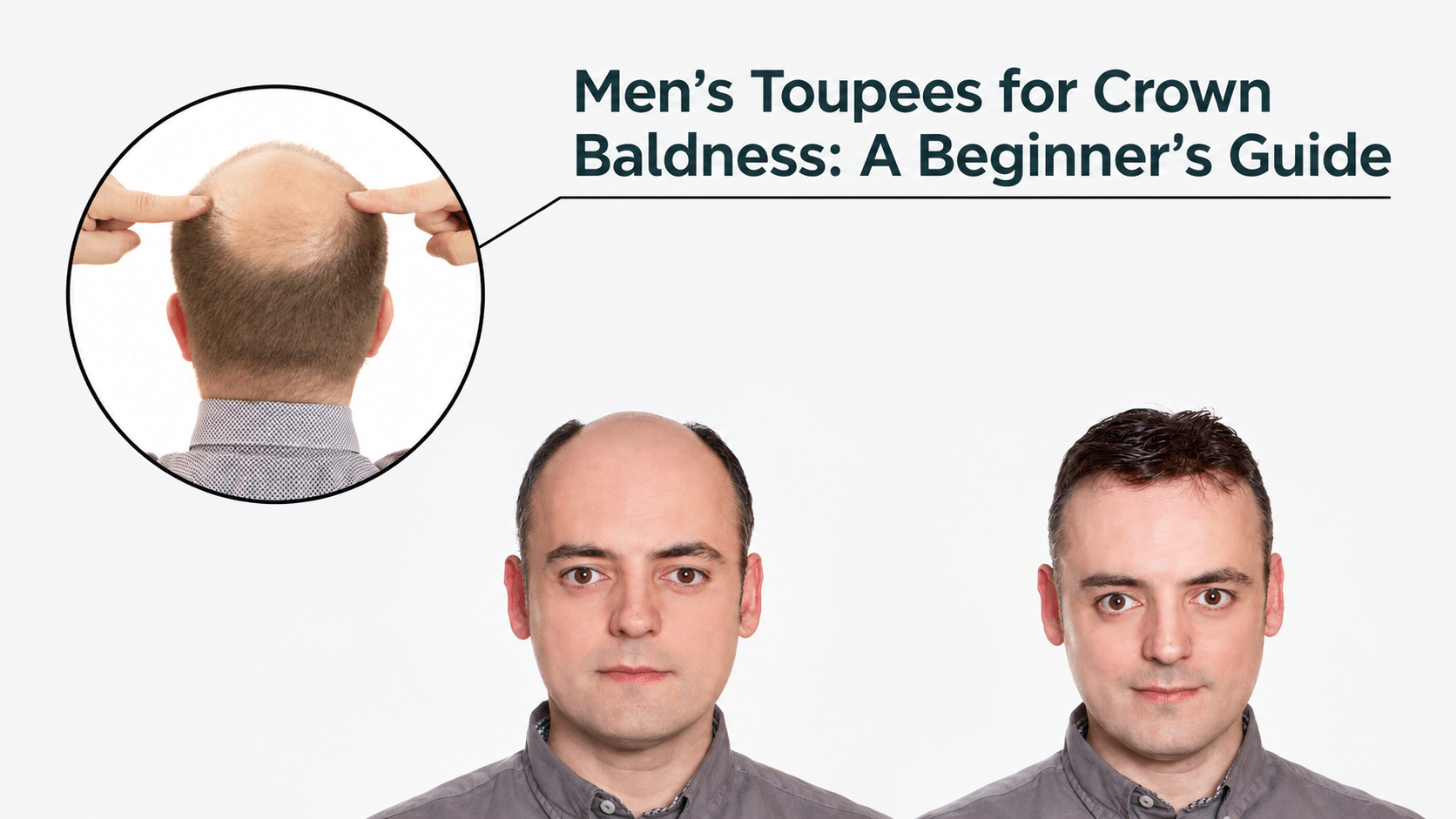
Crown thinning has an annoying habit of becoming obvious to everyone except the person experiencing it.
From the front, your hair may still look reasonably full. Then you see a photo taken from behind or notice the top of your head under bright overhead lighting.
Suddenly, the thinning area seems impossible to ignore.
A toupee can cover crown baldness immediately, but simply putting more hair over the area doesn’t guarantee a natural result. In fact, too much hair is one of the easiest ways to make a hairpiece noticeable.
For beginners, the goal shouldn’t be maximum coverage or maximum density.
It should be matching the replacement hair to what’s already growing around it.
Here’s how to do that.
First, Understand What You’re Actually Covering
Not all crown hair loss looks the same.
Some men have a small circular thinning area around the vertex while maintaining relatively dense hair elsewhere. Others have thinning that begins at the crown and extends toward the middle or front of the scalp.
Before choosing a toupee, determine where your thinning begins and ends.
Take photos from above, behind, and both sides. Good lighting helps.
Then ask:
- Is the crown the only thin area?
- Is the middle also losing density?
- Is the frontal hairline still strong?
- How dense is the hair around the sides and back?
These details determine how much coverage you actually need.
Buying a large system for a relatively small crown area isn’t automatically better.
Don’t Automatically Choose the Thickest Toupee
This is probably the most common beginner mistake.
Your natural hair is thinning, so adding lots of hair seems logical.
But density has to make sense relative to the biological hair surrounding the system.
Imagine someone with medium-light hair around the sides wearing an extremely dense hairpiece on top. Even if the base itself is difficult to detect, the sudden change in density can reveal that something is different.
A men’s hair toupee should look like part of your existing hair rather than a separate layer sitting above it.
For crown coverage, matching density can be especially important because the transition between replacement hair and biological hair may be visible from multiple angles.
More hair isn’t always more realistic.
Measure the Balding Area Before Buying
Hair systems come in different base sizes, and many can also be trimmed to fit a particular area.
Don’t guess.
Measure the thinning region from front to back and side to side. If your hair loss is still relatively localized, you may not need to cover the entire top of your scalp.
At the same time, don’t make the base so small that its edges sit directly inside weak, actively thinning hair.
You need a practical attachment area and enough coverage to blend the system into stronger surrounding hair.
Hair loss can also progress.
If the crown has been gradually expanding, consider whether the size you choose leaves reasonable room for future changes.
Crown Hair Direction Is Easy to Overlook
Look closely at natural hair around the crown.
It rarely grows in perfectly straight, parallel lines.
Many people have a whorl or spiral pattern where the hair changes direction around a central point.
That’s important.
If the replacement hair falls in a completely different direction from the biological hair around it, the crown can look unusual even when the color and density are correct.
This becomes particularly noticeable with shorter hairstyles.
When evaluating a system, think about how the hair is ventilated and how you intend to style it.
A convincing crown isn’t only about covering skin.
It’s about recreating the way hair naturally behaves in that area.
Color Matching Means More Than “Black” or “Brown”
Hair color can look deceptively simple on a product page.
Real hair usually contains variation.
Someone who describes his hair as dark brown may have lighter areas from sun exposure, subtle warm or cool tones, or gray concentrated around the temples.
The replacement hair needs to work with those variations.
Lighting matters too.
Two colors that appear almost identical indoors may look noticeably different in daylight.
If you’re choosing between close shades, compare the system with your biological hair under more than one type of lighting whenever possible.
For men with some gray hair, matching the gray percentage can also help create a smoother transition.
A perfect base with the wrong color will still look like a hairpiece.
Do You Actually Need an Invisible Front Hairline?
This is where crown-focused hair loss can give you an advantage.
If your natural frontal hairline is still strong, you may be able to keep it.
That means the hair system can sit behind your existing front hair rather than replacing the entire hairline.
In that situation, the front edge of the base isn’t necessarily the main visual concern.
Blending becomes more important.
This can change which base construction makes sense because you don’t have to prioritize an exposed artificial hairline in the same way as someone with advanced frontal recession.
Don’t pay for a solution to a problem you don’t actually have.
Preserving a good natural hairline can sometimes make the final result easier to disguise.
Choose the Base Around Your Routine

Once you understand the coverage area, consider how you’ll actually wear the system.
Lace, skin/poly and hybrid constructions have different characteristics.
Lace uses a mesh structure that allows airflow through the base, which can appeal to people who exercise frequently or live in warmer conditions.
Thin skin creates a different scalp-like appearance and provides a smooth surface for attachment and cleanup.
Hybrid systems combine materials, usually to balance characteristics from more than one construction.
There isn’t one universally correct choice for crown baldness.
Think about your priorities:
Do you sweat frequently?
How often do you plan to remove the system?
How comfortable are you handling delicate materials?
Do you care more about realism, durability, easy cleanup, or breathability?
Your answers narrow the options quickly.
Where TopUnique Fits Into the Search
Once you understand those variables, browsing a brand like TopUnique becomes much easier.
Instead of opening the catalog and asking which hair system looks best, you can compare its lace, skin and hybrid options against specifications you’ve already decided on.
For example, someone covering only the crown while retaining a strong natural hairline has different requirements from someone whose thinning extends from the crown all the way to the front.
The first buyer may prioritize blending with existing hair.
The second has to think much more carefully about frontal realism as well.
Starting with the problem rather than the product prevents you from choosing a system based purely on how it looks on a model.
Your Hairstyle Can Hide or Expose the Transition
The haircut matters enormously.
Longer isn’t automatically better.
A hairstyle with some texture can help replacement hair blend into the surrounding biological hair. Extremely rigid or precise styles may make differences in density and direction easier to notice.
The crown itself also needs enough movement to avoid looking unnaturally uniform.
Think about the hairstyle you already wear.
If possible, choose a system that works with it rather than completely redesigning your appearance around the hairpiece.
A familiar hairstyle often makes the transition less dramatic, particularly when you’re wearing a system for the first time.
Don’t Skip the Professional Cut-In
A new toupee isn’t necessarily supposed to look finished straight out of the box.
The hair may arrive longer than you need because it still has to be blended with your biological hair.
That’s what the cut-in is for.
A stylist can adjust the system’s length, remove unnecessary bulk, create layers, and connect the replacement hair visually with the sides and back.
This is particularly important around the crown.
The stylist needs to consider the direction of the hair and how the replacement section transitions into the surrounding area.
An expensive system with a poor cut-in can look less convincing than a modest system that’s been fitted and blended carefully.
Watch Out for the “Helmet” Effect
A natural head of hair isn’t perfectly uniform.
Density varies. Individual strands move independently. The scalp may show slightly in certain areas depending on lighting and hairstyle.
Trying to eliminate every hint of scalp can therefore create the opposite of the intended result.
Too much density, excessive styling product, and an overly rigid hairstyle can produce what wearers sometimes describe as a helmet effect.
The hair looks like one solid mass.
For a more natural result, allow some movement and variation.
You don’t need to recreate baldness, but you also don’t need to make every square inch equally dense.
Bright Lighting Is Your Best Reality Check
Bathroom mirrors can be forgiving.
Overhead lighting isn’t.
Before deciding that your installation is finished, look at it under several conditions.
Check natural daylight. Stand underneath overhead lighting. Take photos from behind and above.
Video can be even more revealing because you’ll see how the hair moves when you turn your head.
Pay attention to the transition between your biological hair and the system.
Does the color remain consistent?
Is there an obvious density jump?
Does the crown direction make sense?
These checks can catch problems that are difficult to see when you’re staring directly into a mirror.
Your First Toupee Probably Won’t Be Your Perfect Toupee
Beginners often put too much pressure on the first purchase.
You can research base materials, density percentages, colors, sizes, and attachment methods for weeks and still discover something unexpected after actually wearing the system.
Maybe you’d prefer less density.
Perhaps a different base would suit your maintenance routine better.
You may decide you want the hair shorter next time.
That’s useful information.
Your first system teaches you what specifications mean when they’re actually on your head.
Use that experience when choosing the next one.
Natural Crown Coverage Is Mostly About Restraint
Covering crown baldness doesn’t require recreating the thickest hair you’ve ever had.
Often, the more convincing approach is subtler.
Choose enough coverage for the thinning area. Match the replacement hair to the density and color surrounding it. Pay attention to the crown’s natural direction, and make sure the final haircut blends the system into your biological hair.
Then stop.
Don’t keep adding density simply because more hair is available.
The goal isn’t to make people notice how much hair you suddenly have.
It’s to make the crown stop being something they notice at all.