A well-designed entertainment space does two things well. It functions without friction, meaning people can relax, watch, play, or gather without fighting the layout. And it looks like it belongs in the rest of the house, rather than feeling like a forgotten corner that got a TV and a couch thrown into it.
Getting both right requires more thought than most people apply. The good news is that the principles aren’t complicated. Layout, acoustics, lighting, art, and game play each have straightforward solutions that add up to a space worth spending time in.
According to the 2025 Houzz Home Study, 41% of renovating homeowners purchased large furniture as part of their projects in 2024, up from 37% the year before. Entertainment spaces are driving a meaningful share of that spend, as homeowners invest in seating, storage, and the pieces that make a room genuinely livable.
Layout Comes Before Everything Else
The single most common entertainment room mistake is placing the TV first and arranging everything around it. That approach almost always produces bad viewing angles, awkward conversation setups, and seating that doesn’t serve the room well.
Start with the room’s dimensions and natural focal points. In a rectangular room, the longest wall usually anchors the main screen. In a square room, diagonal placement can work better for distributing viewing angles across more seating.
Seating distance from the screen matters technically. For a 65-inch 4K display, optimal viewing distance is roughly 5.5 to 8 feet. For an 85-inch screen, that range extends to 7 to 11 feet. These aren’t arbitrary preferences. Sitting too close to a large screen creates eye fatigue. Too far and the resolution advantage disappears.
Traffic flow is equally important. Leave at least 36 inches of clearance between furniture pieces that people will walk between regularly. Blocking the path to a bar cart, a game table, or an exit kills the energy of a space faster than bad lighting.
Art That Anchors the Room’s Identity
An entertainment space without considered art often looks like a showroom floor. Art is what gives a space a point of view.
Scale is the most important variable. A single small frame on a large wall is a design mistake regardless of the subject matter. Art should be sized in proportion to the wall and furniture it anchors. A piece above a sofa should span at least two-thirds the width of the sofa. A gallery wall needs to be planned as a single visual unit, not assembled randomly.
Subject matter for entertainment spaces should reflect what actually happens in the room. Wildlife photography has an energy and presence that reproduces beautifully at large scale. A piece like the silverback mountain gorilla photograph demonstrates exactly how fine art nature photography at the right scale can anchor a room and become the visual centerpiece that everything else organizes around. It’s a different visual language than abstract art or landscape photography, and it’s particularly effective in masculine or nature-forward design aesthetics.
Black and white photography works well in entertainment spaces because it doesn’t compete with screen light or introduce color conflicts with the rest of the room’s palette. A single large-format photographic print often does more for a room than a wall covered in smaller pieces.
Acoustic Design Is Practical, Not Just Technical
Most entertainment spaces are acoustically bad by default. Hard floors, flat walls, and minimal soft furnishings produce echo and poor sound quality that no speaker system fully compensates for.
The fix is straightforward. Area rugs absorb floor reflections. Upholstered seating diffuses mid-range sound. Heavy curtains on windows reduce flutter echo. Bookshelves filled with irregularly sized objects scatter sound in ways that prevent standing waves from building up.
Acoustic panels are available in fabric-wrapped formats that look like wall art and perform genuine acoustic work. In a dedicated media room, they’re worth installing on the front wall behind the screen and on the side walls at first reflection points. In a general-purpose entertainment space, a rug, a sectional, and some curtains will solve most of the obvious acoustic problems.
Speaker placement matters more than speaker brand for most setups. A 5.1 surround setup with properly positioned speakers in a treated room will sound better than a premium system placed badly in an untreated one.
Game Tables That Do Double Duty
A well-chosen game table transforms an entertainment space from passive to interactive. It gives people something to do, creates conversation around an activity, and adds a piece of furniture with genuine presence.
Pool tables are the most visually dominant option. A standard 8-foot table requires a room with at least 13.5 by 17 feet of clear floor space to accommodate the cue on all sides without obstruction. Going smaller on the table because the room feels tight usually produces a table that’s frustrating to play on and defeats the purpose.
If you’re looking for pool tables and billiards equipment in Orange County, getting the right table size and room clearance sorted before buying saves a lot of headache. The combination of a quality table and proper room planning is what makes a game room feel considered rather than crowded.
Shuffleboard tables work well in longer, narrower spaces where a pool table won’t fit. They require significantly less clearance on the sides and have a lower visual profile. Foosball and air hockey are better suited to dedicated game rooms or larger open spaces where the activity level won’t conflict with the rest of the room’s use.
Lighting Layers That Work for Every Mode
Entertainment spaces need to function in multiple modes. Bright enough to socialize and play games. Dark enough to watch content without glare washing the screen. And ambient enough to look good when the space is at rest.
The practical solution is separate circuits for different lighting zones. Overhead dimming handles general brightness. Sconce or table lamp circuits handle ambient warmth. Backlighting behind the TV reduces eye strain by bridging the contrast between a bright screen and a dark wall.
Bias lighting behind the TV is a specific detail worth addressing. A bias light kit, an LED strip mounted to the back of the TV panel at the same color temperature as your room’s ambient light, significantly reduces the perceived harshness of watching in a dark room. It’s a $30 to $80 upgrade that most viewers notice immediately.
Avoid cool white bulbs (above 4,000K) in entertainment spaces. Warm white (2,700 to 3,000K) creates the atmosphere that makes people want to stay. Cool white is functional in kitchens and offices. In a room designed for relaxation, it works against you.
Storage That Keeps the Space Clean
Cable management and storage are the unsexy details that determine whether an entertainment space actually stays usable over time.
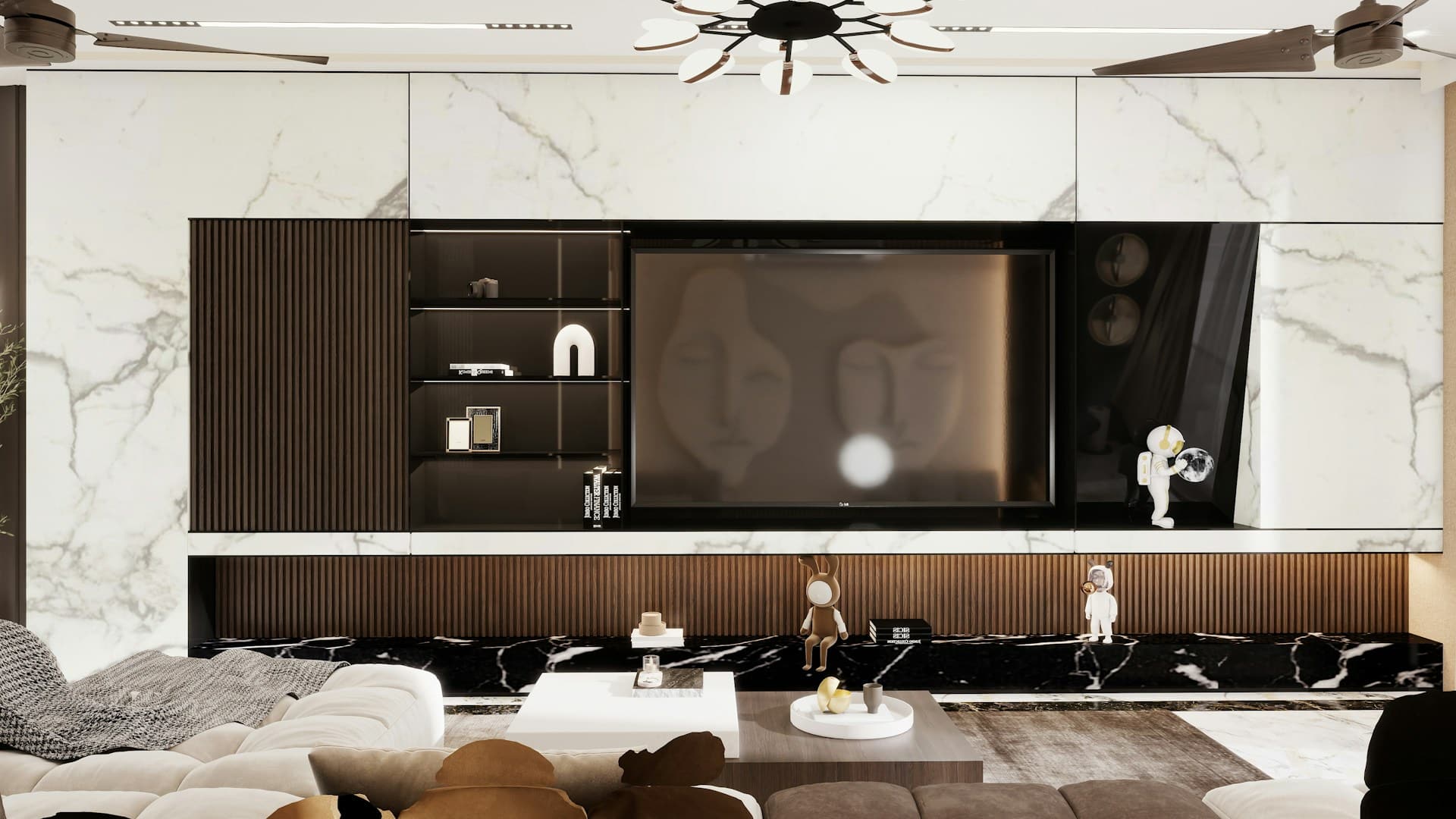
Built-in cabinetry around a fireplace or media wall creates storage that looks architectural rather than improvised. Closed storage hides gaming equipment, remotes, media accessories, and the inevitable accumulation of items that find their way into a room people spend time in.
Media consoles with integrated cable management, rear-vented back panels for component ventilation, and soft-close doors are worth specifying rather than defaulting to a basic shelf unit. The difference in how the space reads when cables and clutter are managed is significant.