Most people who buy the wrong solar generator do not buy the wrong brand. They buy the wrong size. This guide gives you a five-step framework to calculate exactly what you need before spending a dollar, and maps your result directly to the right product tier.
Why “Just Get a Big One” Is Not a Strategy
The instinct to buy the largest solar generator you can afford sounds sensible until you think through what oversizing actually costs you. A unit with far more capacity than your load requires is heavier to move, slower to recharge from solar panels, and significantly more expensive both upfront and in replacement cost when the battery eventually reaches end of life. For anyone buying for camping or portable use, an oversized unit defeats the purpose entirely.
Undersizing creates the opposite problem, and it tends to show up at the worst possible moment. A unit that cannot handle your refrigerator’s startup surge will trip its overload protection the first time the compressor kicks on. A unit with insufficient watt-hours will go dark overnight, leaving you without power during exactly the kind of emergency you bought it for.
The root cause of both errors is the same. Product pages display specifications, not answers. A label that says 2,000 Wh and 2,000W tells you nothing about whether that unit fits your situation unless you know what your situation actually demands. Two numbers determine the answer, and most buyers confuse them.
The Two Numbers That Determine Everything
Before working through the sizing steps, you need a clear understanding of what watt-hours and watts actually measure and why they are not interchangeable.
Watt-Hours: How Long You Can Run
Watt-hours measure the total energy stored in the battery. Think of it as the size of a fuel tank. A unit with 2,000 Wh stores twice as much energy as a unit with 1,000 Wh, meaning it can run your devices for twice as long under the same load conditions.
The critical detail most buyers miss is that the stated watt-hour capacity is not the same as usable capacity. Every solar generator loses some energy to heat and resistance as it converts stored DC power to AC power through its inverter. That conversion efficiency typically runs between 85 and 90 percent. A unit rated at 2,000 Wh delivers approximately 1,700 to 1,800 Wh of actual usable power. Your calculations need to account for this gap, or you will run out of power earlier than your math predicted.
Watts: What You Can Run at Once
Watts measure the rate of power delivery, not storage. A solar generator rated at 2,000W can supply up to 2,000 watts of power at any given moment. If your total connected load exceeds that number, the unit will shut down or trigger its overload protection.
There are two wattage figures that matter: continuous output and surge or peak output. Continuous output is the sustained rate the unit can maintain indefinitely. Surge output is the higher rate it can deliver for a few seconds to handle the startup demands of motor-driven appliances.
This distinction causes more buyer frustration than any other technical detail. A refrigerator rated at 150 watts of running power can draw 400 to 600 watts for the two or three seconds it takes the compressor motor to start. A solar generator whose continuous output comfortably handles 150 watts may still trip its protection circuit when the refrigerator compressor initiates. Air conditioners, sump pumps, and well pumps behave the same way. Any appliance with a motor requires a surge overhead that must be factored into your power requirements separately from running wattage.
EcoFlow’s X-Boost technology, available across the DELTA series, addresses this by using software to manage power delivery in a way that allows the unit to run appliances rated up to 3,800 watts even when the unit’s continuous output ceiling is lower. For buyers whose essential load includes high-wattage appliances, this feature materially changes which product tier is sufficient.
The Five-Step Sizing Framework
Work through these steps in order. The output of each step feeds directly into the next. By the end of Step 5, you will have a specific capacity target and a corresponding product recommendation.
Step 1: List Your Essential Appliances Only
The first and most important discipline in this process is restraint. You are not sizing for your normal household consumption. You are sizing for the appliances you cannot function without during an outage or on a camping trip. A refrigerator that keeps medications cold is essential. The basement chest freezer full of last summer’s harvest is a want, not a need, during a 48-hour outage.
Go through your home or campsite and build a list of only the devices that must stay running. For each one, find the wattage listed on the label, in the manual, or through a quick search. If the device has a motor, note it separately because you will need to account for its startup surge in Step 4.
The following table covers the most common essential appliances and their typical wattage ranges to help you fill in your list.
|
Appliance |
Typical Running Watts |
Typical Surge Watts |
|---|---|---|
|
Refrigerator |
150 to 200 |
400 to 600 |
|
LED light (per bulb) |
10 to 15 |
10 to 15 |
|
Wi-Fi router |
10 to 20 |
10 to 20 |
|
Laptop |
45 to 100 |
45 to 100 |
|
CPAP (without heat) |
30 to 60 |
30 to 60 |
|
Phone charging |
20 to 45 |
20 to 45 |
|
Portable fan |
30 to 75 |
30 to 75 |
|
Small television |
60 to 150 |
60 to 150 |
|
Sump pump |
800 to 1,050 |
1,300 to 2,150 |
|
Window AC unit (small) |
500 to 900 |
1,300 to 2,000 |
Step 2: Calculate Your Daily Energy Consumption
For each appliance on your list, multiply its running wattage by the number of hours per day you expect to use it. This gives you that appliance’s daily energy consumption in watt-hours. Add the results for all appliances together to get your total daily energy requirement.
The formula is: Running Watts multiplied by Hours of Daily Use equals Watt-Hours per Day. Sum across all appliances for total daily Wh.
A practical example makes this concrete. Consider a household running the following essential load during a power outage: one refrigerator at 175W running 24 hours a day, four LED lights at 12W each running 6 hours, one Wi-Fi router at 15W running 24 hours, two laptops at 65W each running 8 hours, and phone charging at 30W for 4 hours.
The refrigerator consumes 4,200 Wh per day. The four lights consume 288 Wh. The router consumes 360 Wh. The two laptops consume 1,040 Wh. Phone charging consumes 120 Wh. The total daily essential load for this household is approximately 6,008 Wh, which rounds to 6,000 Wh per day.
Step 3: Factor In Your Runtime Requirement
How long do you need the system to run without any solar replenishment? The answer to this question drives your minimum battery capacity requirement more than anything else.
For a camping weekend with reliable sunshine during the day, you may only need the battery to cover overnight hours, roughly 10 to 12 hours, with solar panels recharging it each day. For a home emergency backup scenario, the standard benchmark is 72 hours, reflecting FEMA’s recommended minimum self-sufficiency window. For regular off-grid use with consistent solar charging, a single day of consumption is the appropriate baseline.
Once you have your daily energy requirement from Step 2 and your target runtime in days, calculate the raw capacity target using the following formula.
Required Capacity in Wh equals Daily Energy Requirement multiplied by Number of Days, divided by Inverter Efficiency of 0.85, multiplied by a Safety Factor of 1.2.
The 0.85 divisor accounts for inverter conversion losses. The 1.2 multiplier adds a 20 percent safety margin, which extends battery cycle life by preventing deep discharge and gives you a buffer for days when your actual usage runs higher than estimated.
Applying this to the household example above, a 72-hour runtime target produces the following calculation. 6,000 Wh multiplied by 3 days equals 18,000 Wh. Divided by 0.85 equals approximately 21,175 Wh. Multiplied by 1.2 equals approximately 25,400 Wh. That is a significant capacity figure that points toward a multi-battery expandable system rather than a single unit. For the more common scenario of a 24-hour essential backup, the same household would need approximately 8,470 Wh, well within the range of a single large unit with an expansion battery.
Step 4: Verify Your Peak Power Requirement
The capacity calculation from Steps 2 and 3 tells you how much energy you need stored. This step tells you how fast the unit needs to be able to deliver it.
Go back to your appliance list and identify every device with a motor. Write down its surge wattage. Then consider which appliances are most likely to be running simultaneously and add their surge wattages together for the worst-case peak demand scenario.
For the household in our example, the refrigerator is always running. If someone turns on a window fan at the same moment the refrigerator compressor starts, the peak demand is 600 watts of surge for the refrigerator plus 75 watts for the fan, totaling 675 watts. That is well within the surge rating of any mid-range solar generator. However, if the same household also wants to run a sump pump during a storm-related outage, the sump pump’s 2,150-watt surge combined with the refrigerator’s 600-watt surge produces a 2,750-watt peak demand that requires a unit with a surge rating above that threshold.
Confirm that the surge output rating of your target unit exceeds your worst-case peak demand figure. If it does not, you either need a higher-rated unit or you need to stagger the startup of motor-driven appliances manually.
Step 5: Map Your Result to the Right Product Tier
With your required capacity and peak power figures in hand, use the following table to identify the appropriate product tier. The capacity ranges account for the fact that expandable units can grow with your needs over time.
|
Required Capacity |
Typical Use Case |
EcoFlow Product Tier |
|---|---|---|
|
500 to 1,000 Wh |
Camping, day trips, device charging |
RIVER 3 or RIVER 3 Plus |
|
1,000 to 2,000 Wh |
Overnight backup, small RV, light home use |
DELTA 3 Plus or DELTA 2 |
|
2,000 to 4,000 Wh |
24 to 48 hour home backup, mid-size RV |
DELTA 2 Max or DELTA 3 Max Plus |
|
4,000 Wh and above |
72-hour full household backup, off-grid living |
DELTA Pro 3 or DELTA Pro Ultra |
For households whose calculation lands in the upper tier, EcoFlow’s DELTA Pro 3 starts at 4,096 Wh and expands to 48 kWh with additional batteries. The DELTA Pro Ultra starts at 6 kWh and scales to 90 kWh across multiple inverters and battery packs, covering even the most demanding whole-home scenarios.
Three Households, Three Complete Calculations
The five-step framework works differently depending on who is using it. The following three scenarios illustrate the full calculation process for different buyer profiles. Find the one that most closely matches your situation.
Scenario A: The Camping Family
Profile: Two adults, two children. Weekend camping trips two or three times per year. No grid access. Need to charge phones and tablets, run a small LED lantern, power a portable fan overnight, and watch a small 12V television in the evening.
Essential load: Four phones at 20W each for 2 hours equals 160 Wh. One LED lantern at 15W for 5 hours equals 75 Wh. One portable fan at 50W for 8 hours equals 400 Wh. One small television at 80W for 3 hours equals 240 Wh. Total daily load: 875 Wh.
Runtime target: Two nights without guaranteed solar replenishment. Applying the formula: 875 Wh multiplied by 2 days divided by 0.85 multiplied by 1.2 equals approximately 2,470 Wh. However, if the family brings a small solar panel and gets 4 to 5 hours of charging each day, the battery only needs to cover overnight hours of roughly 10 hours. In that scenario the single-day requirement of 875 Wh divided by 0.85 multiplied by 1.2 equals approximately 1,235 Wh.
Peak power check: No motor-driven appliances. Maximum simultaneous load is approximately 165 watts. No surge concern.
Recommendation: EcoFlow DELTA 3 Plus at 1,024 Wh covers the solar-assisted camping scenario comfortably. For solar-independent multi-day use, stepping up to the DELTA 2 at 1,024 Wh with an extra battery covering 2,048 Wh total provides adequate margin.
Scenario B: The Home Emergency Household
Profile: Family of four. Suburban home. Primary concern is power outages from severe weather lasting 24 to 48 hours. Must keep the refrigerator running, maintain lighting in the kitchen and bedrooms, keep the Wi-Fi and phones charged, and run a CPAP machine overnight.
Essential load: One refrigerator at 175W for 24 hours equals 4,200 Wh. Five LED lights at 12W for 6 hours equals 360 Wh. One router at 15W for 24 hours equals 360 Wh. Two laptops at 65W for 6 hours equals 780 Wh. One CPAP at 45W for 8 hours equals 360 Wh. Phone charging at 30W for 3 hours equals 90 Wh. Total daily load: 6,150 Wh.
Runtime target: 48 hours. Applying the formula: 6,150 Wh multiplied by 2 days divided by 0.85 multiplied by 1.2 equals approximately 17,365 Wh. This is a large figure reflecting the refrigerator’s dominant contribution. If the household owns a 400W solar panel and expects some daylight hours during the outage, the effective battery requirement drops substantially. Assuming 4 hours of useful solar generation per day producing 1,200 Wh in net charging, the battery needs to cover approximately 4,950 Wh per day rather than 6,150 Wh, reducing the 48-hour requirement to approximately 13,976 Wh.
Peak power check: Refrigerator surge at 550W is the primary concern. Maximum realistic simultaneous peak is approximately 700 watts, well within any mid-to-large unit’s surge rating.
Recommendation: EcoFlow DELTA Pro 3 starting at 4,096 Wh expanded with two extra batteries to reach approximately 12,288 Wh, paired with a 400W solar panel for daytime replenishment. This covers the 48-hour window with a realistic solar contribution factored in.
Scenario C: The Off-Grid Cabin User
Profile: Single adult using a remote cabin for extended stays of one to two weeks. No grid connection. Solar panels available on the roof. Needs to run a small refrigerator, maintain consistent lighting, charge work laptops, run a CPAP every night, and occasionally use a small coffee maker in the morning.
Essential load: One small refrigerator at 120W for 24 hours equals 2,880 Wh. Four LED lights at 12W for 5 hours equals 240 Wh. One laptop at 80W for 8 hours equals 640 Wh. One CPAP at 45W for 8 hours equals 360 Wh. One coffee maker at 900W for 0.25 hours equals 225 Wh. Total daily load: 4,345 Wh.
Runtime target: The system relies on daily solar replenishment, so the battery must cover at least one full day without solar input. For homeowners integrating rooftop solar with battery storage, working with an experienced installer like Suntrek Solar ensures the panel array is properly sized to meet daily replenishment targets and the system is configured for maximum efficiency year-round. Applying the formula: 4,345 Wh divided by 0.85 multiplied by 1.2 equals approximately 6,134 Wh.
Peak power check: Coffee maker at 900W running watts plus refrigerator surge at 400W if simultaneous startup occurs peaks at approximately 1,300 watts. Confirm unit’s continuous rating exceeds 900W for the coffee maker alone.
Recommendation: EcoFlow DELTA Pro 3 at 4,096 Wh expanded with one extra battery to approximately 8,192 Wh, paired with two 400W rigid solar panels producing up to 800W of combined input. Daily solar generation of approximately 3,200 Wh under good conditions covers the majority of the daily load and keeps the battery above 50 percent through most conditions.
Five Sizing Mistakes That Lead to the Wrong Purchase
Understanding the framework is only half the equation. The following errors consistently send buyers in the wrong direction regardless of how carefully they read the spec sheets.
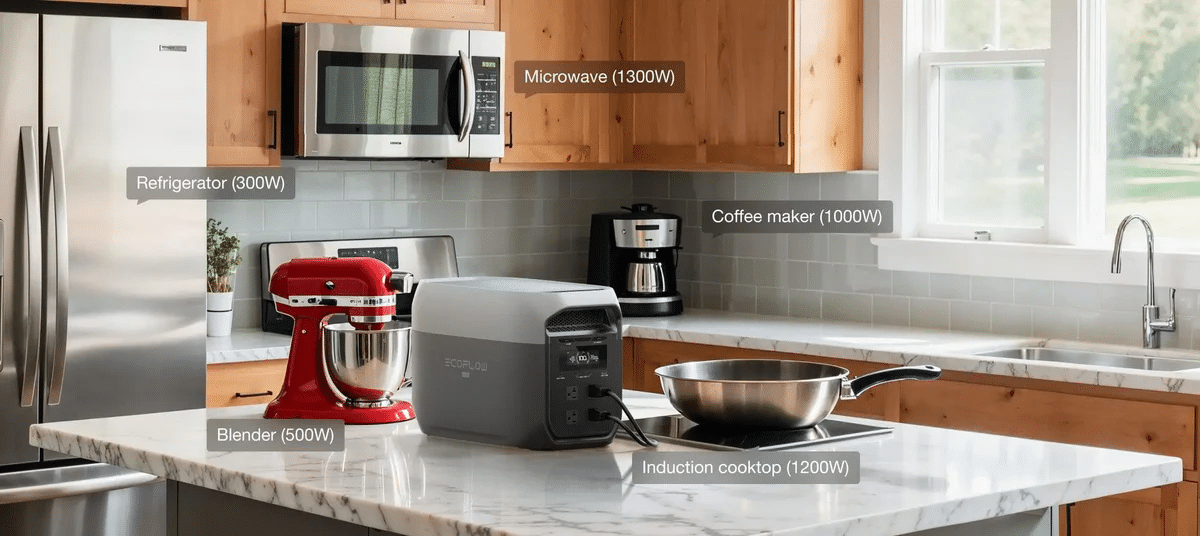
Checking capacity but ignoring continuous output rating. A unit with 3,000 Wh of capacity but only 1,500W of continuous output cannot run a 1,200W microwave and a 175W refrigerator simultaneously without tripping. Always verify that continuous output covers your maximum simultaneous running load before checking capacity.
Using nameplate capacity as usable capacity. A 2,000 Wh unit does not deliver 2,000 Wh of usable power to your appliances. After inverter losses, the practical figure is closer to 1,700 to 1,800 Wh. Plans built on nameplate capacity run short predictably and avoidably.
Forgetting surge wattage for motor-driven appliances. This error is responsible for the majority of “my solar generator trips when I plug in my refrigerator” complaints across online forums. If a compressor, pump, or motor is on your list, its surge wattage must be verified against the unit’s peak output rating before purchase, not after.
Running the battery to zero regularly. Operating a lithium iron phosphate battery down to 0 percent state of charge consistently and repeatedly accelerates capacity degradation. The 20 percent safety margin built into the sizing formula exists precisely to prevent this. A unit sized with appropriate headroom will spend most of its life cycling between 20 and 80 percent, which is the range where LFP batteries achieve their rated 6,000 cycle lifespan.
Buying a unit with no expansion path. A buyer who purchases a fixed-capacity unit and later finds their needs have grown faces a full replacement purchase rather than an incremental battery addition. EcoFlow’s DELTA series supports modular expansion through smart extra batteries. Confirming that your chosen unit supports expansion at the point of purchase gives you a significantly better upgrade path as circumstances change.
Start With the Appliance List
The most expensive mistake in solar generator buying is skipping the calculation and defaulting to a rough guess. A unit that is too small fails when you need it most. A unit that is too large costs more than necessary and delivers less portability than the task requires.
The five-step framework in this guide produces a specific watt-hour target and a corresponding power output floor. Those two numbers reduce the product selection process from a confusing comparison of marketing specifications to a straightforward match against your actual requirements.
EcoFlow’s product lineup spans from the RIVER 3 at the portable entry level through the DELTA Pro Ultra at the whole-home end of the range, with expandable capacity options at every tier above the entry level. Whatever your calculation produces, there is a configuration that fits it precisely.