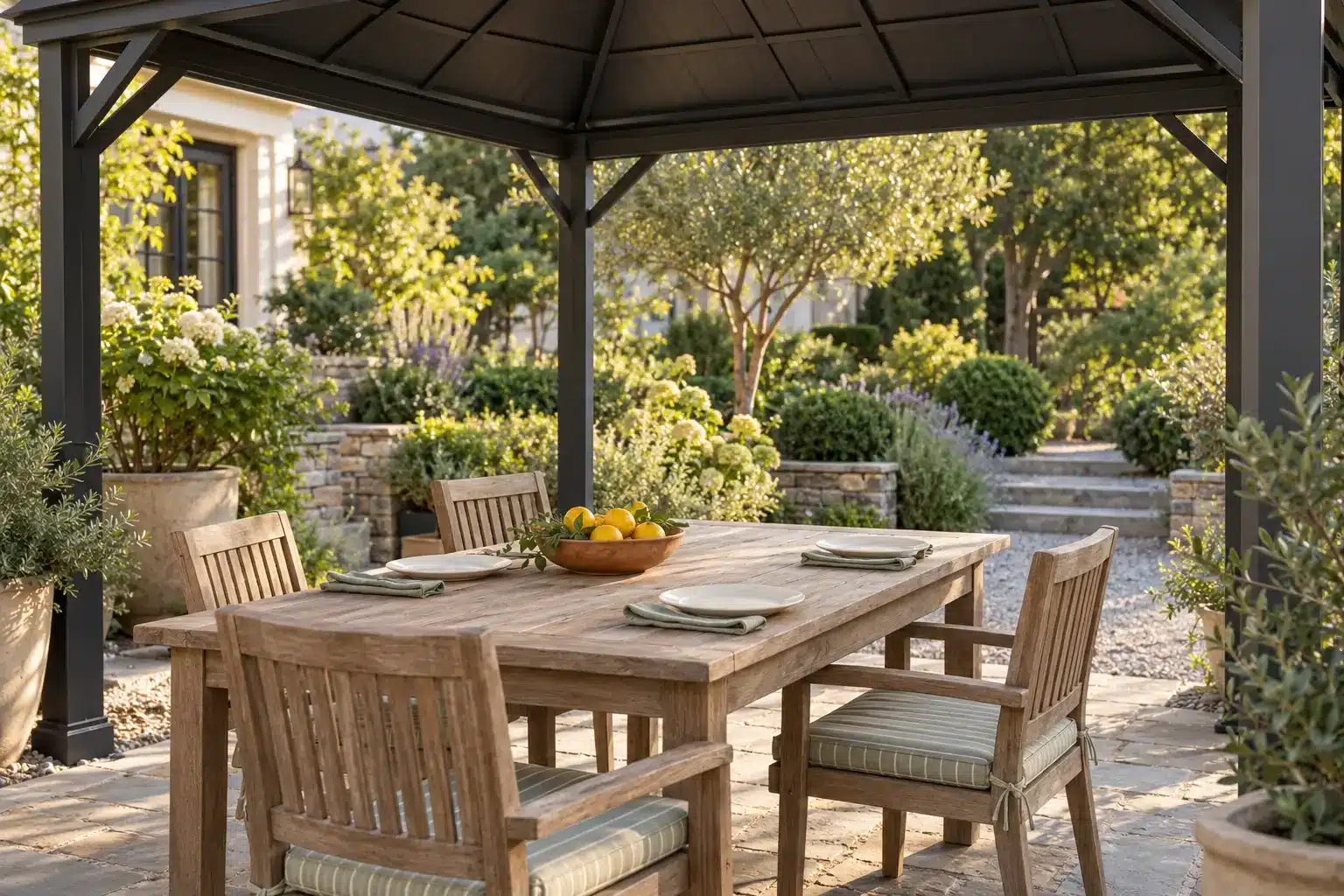
The most useful gazebo decorating ideas make an ordinary meal outdoors feel inviting without creating a long setup routine. Start with a table and chairs that work, choose a small group of colours, and add a few accessories you can easily clear away. Leave enough room for dinner itself.
Let the gazebo and furniture guide the palette
Begin with the finishes already in view: the frame, roof, tabletop, paving and nearby planting. These are your starting colours. You do not need to match every one, but choosing accessories alongside them is easier than buying individual pieces and hoping they work together.
A charcoal frame and a wooden table, for example, could suit cream tableware with a little green or terracotta. A pale table could take blue stripes and simple clear glasses. These are styling suggestions, not rules. Place two or three items together outside before buying a complete set, and see whether you like them against the actual furniture.
If you are still comparing gazebo designs, imagine each structure with the table you intend to use. Consider the view through its openings as well as its finish. The garden beyond is part of the setting; you may prefer to leave it visible instead of adding decoration to every side.
For an existing gazebo, try rearranging what you own first. Move a plant into view, remove a tired runner or bring out the plates you usually save for guests. A more coherent setting does not always require a new furniture set.
Give the table one decorative focal point
A low bowl, a small vase or a compact plant can be enough to make the table feel ready for a meal. Choose something that leaves people able to see and speak to one another. Then put the serving dishes on the table before deciding whether another decorative object belongs there.
This is especially useful with a compact dining set. An oversized arrangement may look generous when the table is empty, then compete with every plate and glass once people sit down. If the centrepiece has to move before the food arrives, give it a nearby resting place or choose a smaller one.
A tray can help gather a few small items, provided it fits comfortably on the table and is easy to carry. It also makes the change from decorated table to clear surface straightforward. There is no need to fill the tray simply because it has room.
Try three looks with the same basic setup
Imagine an existing wooden table, four chairs and plain white plates beneath an open gazebo. The following combinations are hypothetical styling examples. Each changes a few removable details while keeping the furniture and tableware in place.
Soft green for a relaxed lunch
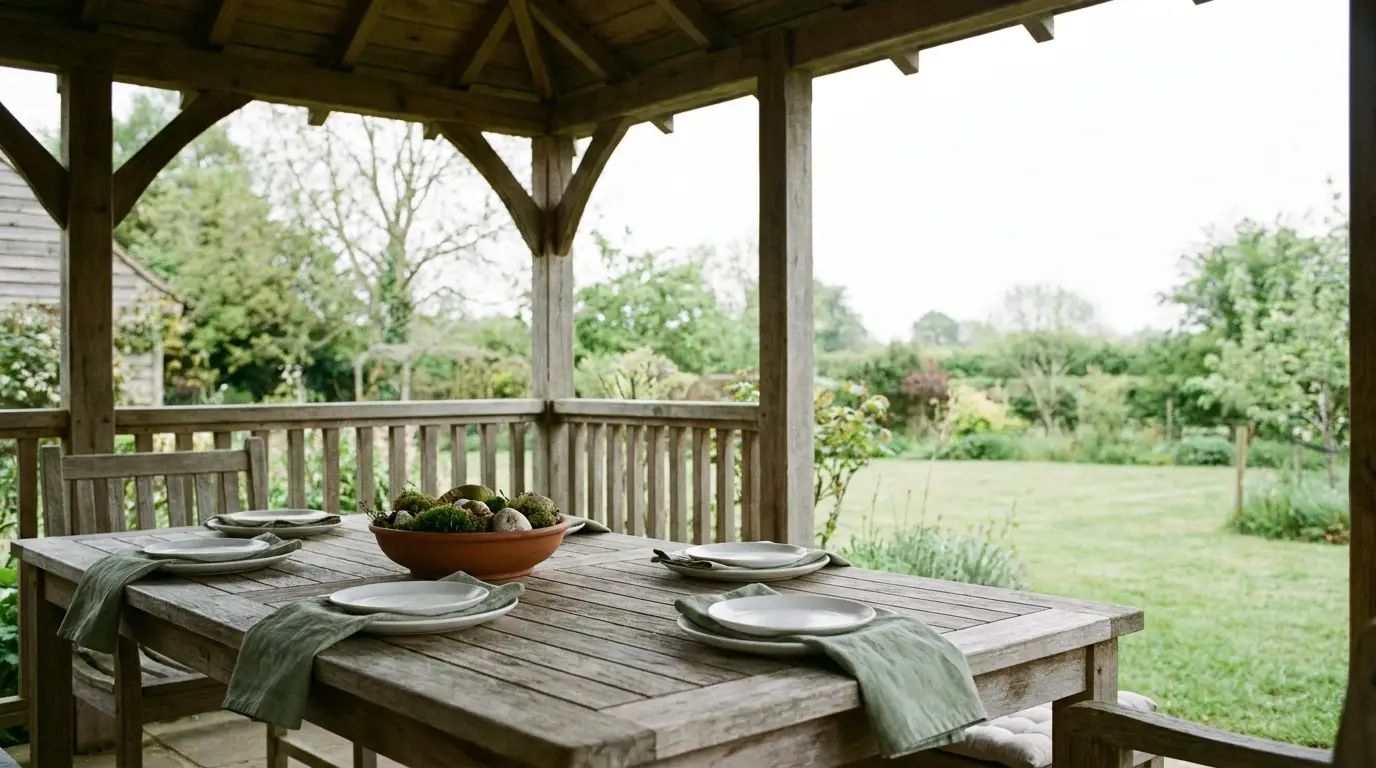
Use sage napkins, a low terracotta bowl and a pair of striped outdoor seat cushions. Let nearby foliage provide the rest of the colour. Keep the table mostly bare so the wood remains visible and there is space to share dishes.
Blue and white for a brighter table
Swap the sage napkins for blue ones and use a simple white serving bowl. If you already own patterned plates, bring out a few rather than buying an entirely coordinated collection. Keep other accessories quiet so the pattern is easy to enjoy.
Try the arrangement without a tablecloth first. You may find that the blue and white pieces are enough. If you prefer a cloth, choose one that suits the table and the conditions, with no loose fabric trailing into a walkway.
Warm terracotta for an informal supper
Keep the white plates and add rust-coloured napkins with one low ceramic pot or bowl. Repeating that warm tone in just one other item, such as a cushion, can connect the table to the seating.
For meals after sunset, use lighting intended for its actual outdoor location and follow its instructions. A suitable portable table light may be simpler than adding suspended decorations. Its placement still needs to leave diners comfortable and the table usable.
Choose soft furnishings you can realistically care for
Cushions can make a chair more welcoming, but more cushions also mean more pieces to clean and put away. Start with what improves the seat rather than piling on decorative extras. Sit down and eat at the table before deciding that it needs another layer.
Read care instructions for the finished cushion, including its filling and cover. A zip does not automatically mean the cover should be machine washed. Sunbrella’s upholstery guidance, for example, advises consulting the furniture manufacturer before removing a casing because cushion construction varies. That instruction applies to the products it covers, not every outdoor textile.
A gazebo roof is not a reason to ignore the care requirements of items beneath it. Follow the manufacturer’s directions for cleaning, drying and storage. Treat indoor throws or table linens brought outside for a meal as items to take back in afterwards unless their product guidance says otherwise.
Decide where the removable pieces will go
Before adding another accessory, give it a place to live when it is not in use. A shelf indoors may be enough for napkins, a small centrepiece and a portable light. Cushions may need a different arrangement based on their care instructions and the space available.
Put the collection away once as a trial. Can you carry it comfortably? Does it fit without moving half the cupboard? If the answer is no, reduce the collection before buying more storage. The setting should be simple enough to use on a weeknight.
If you are already considering enclosing a carport to create a larger storage area, treat that as a separate building project. Its suitability, ventilation, moisture conditions and local requirements need assessment; adding walls does not by itself establish appropriate storage for textiles. A few dining accessories are better planned around storage you know is suitable than around an unconfirmed conversion.
Do a dinner test before calling it finished
Set the table for an ordinary meal, including the serving dishes, water and anything else you regularly use. Then assess the arrangement from a chair, rather than only from the garden path.
- Can everyone see across the table without moving the centrepiece?
- Is there room to pass food without rearranging the decoration?
- Do cushions support a comfortable seat at the table?
- Can people pull out their chairs and leave easily?
- Is there an obvious place for each removable item afterwards?
Remove whatever gets in the way and try the simpler version. Keep the details that make the meal more enjoyable.
Frequently asked questions
How can I decorate a gazebo without buying new furniture?
Work with the table and chairs first, then change a few removable details such as napkins, a low centrepiece or suitable seat cushions. Use colours that work with the existing finishes. Try the arrangement with a real meal before purchasing more pieces.
Does a gazebo dining area need a rug?
No. A rug is optional, and a bare patio can look complete. If you want one, choose a product suited to the surface and exposure, follow its care guidance, and make sure chair movement and walking routes remain comfortable.
Should the cushions and table linen match exactly?
They do not have to. You can repeat one colour or combine a simple pattern with plain pieces. Testing items together in the actual space is more useful than relying on separate product photographs.
Make it easy to sit down and stay
A well-styled gazebo dining area leaves room for people, food and the garden around it. Start with one palette and one focal point, then add only what makes the seating or meal more enjoyable. Keep the clearing-away routine part of the design.
For your next meal outdoors, use the furniture and tableware you already own and try one small change. Eat there, clear it away and notice what you would keep. That gives you a practical starting point for a setting you will use regularly, not just dress for a special occasion.