Two windows cut into the same wall, at the same size, can leave a room feeling noticeably different. One feels bright and open. The other feels flat, or glaring at four in the afternoon. The glass area is identical. What changed is the style of the window and the color of the frame around it.
Most guidance treats both as decorating choices. They are not only that. Each one changes how much daylight reaches the room and how your eye handles the brightness once it arrives. Here is what actually happens, and how to choose with that in mind.
Style Decides How Much of the Opening Is Glass
Every window gives up part of its opening to frame, sash, and hardware. How much it gives up depends on the style.
A double hung window has two sashes that slide past each other, and where they meet there is a horizontal check rail. Even with the window closed, that rail sits across the middle of the glass. Building Advisor lists the obstructed view as one of the standard trade-offs of the style, alongside roughly half the ventilation of a casement.
A casement window is hinged at the side and opens as one panel. No middle rail means the glass is a single continuous pane. The extra glass area is the reason casements are usually recommended where you want light and a clear view, such as over a kitchen counter or in a stairwell. Some manufacturers go further and offer a hinge set closer to the frame so that even the hardware intrudes less.
Picture windows give up the least, because nothing opens. In practice, the widest uninterrupted glass in a wall comes from a casement, picture, casement combination: three units with no check rails between them.
None of this makes double hung the wrong choice. On a 1920s house, swapping the double hung for casements will fight the architecture, and the vertical operation is genuinely easier to live with where a deck, a walkway, or a planter sits directly outside. It is a trade, and it is worth making on purpose rather than by default.
The Number on the Sticker That Tells You How Bright the Room Will Be
Glass is not simply transparent. The figure that matters is visible transmittance, usually written as VT: the fraction of visible daylight the whole window assembly passes, given as a decimal between 0 and 1. A VT of 0.60 means sixty per cent of the visible light gets through.
Clear single pane glass sits around 0.80 to 0.90. Modern double-glazed units with a low-emissivity coating generally land between 0.40 and 0.70, depending on how many coatings they have. Tinted and solar control glass can drop below 0.40.
Published figures for a double pane casement show the pattern clearly. With one low emissivity coating, VT comes in around 0.53. Add a second coating and the same window drops to roughly 0.42. A triple pane unit with two coatings can read as low as 0.36. Each coating does useful work on heat and energy bills, but it also takes light out of the room.
This is the practical consequence: a south-facing window in a recently renovated room can pass less daylight than an older, worse-insulated window in the same wall did. The room is warmer and cheaper to run. It is also dimmer, and nobody warned the owner. VT appears on the NFRC label, so you can ask for it before you order rather than discover it afterward.
Frame Color Inside the Room: The Part the Design Press Gets Backward
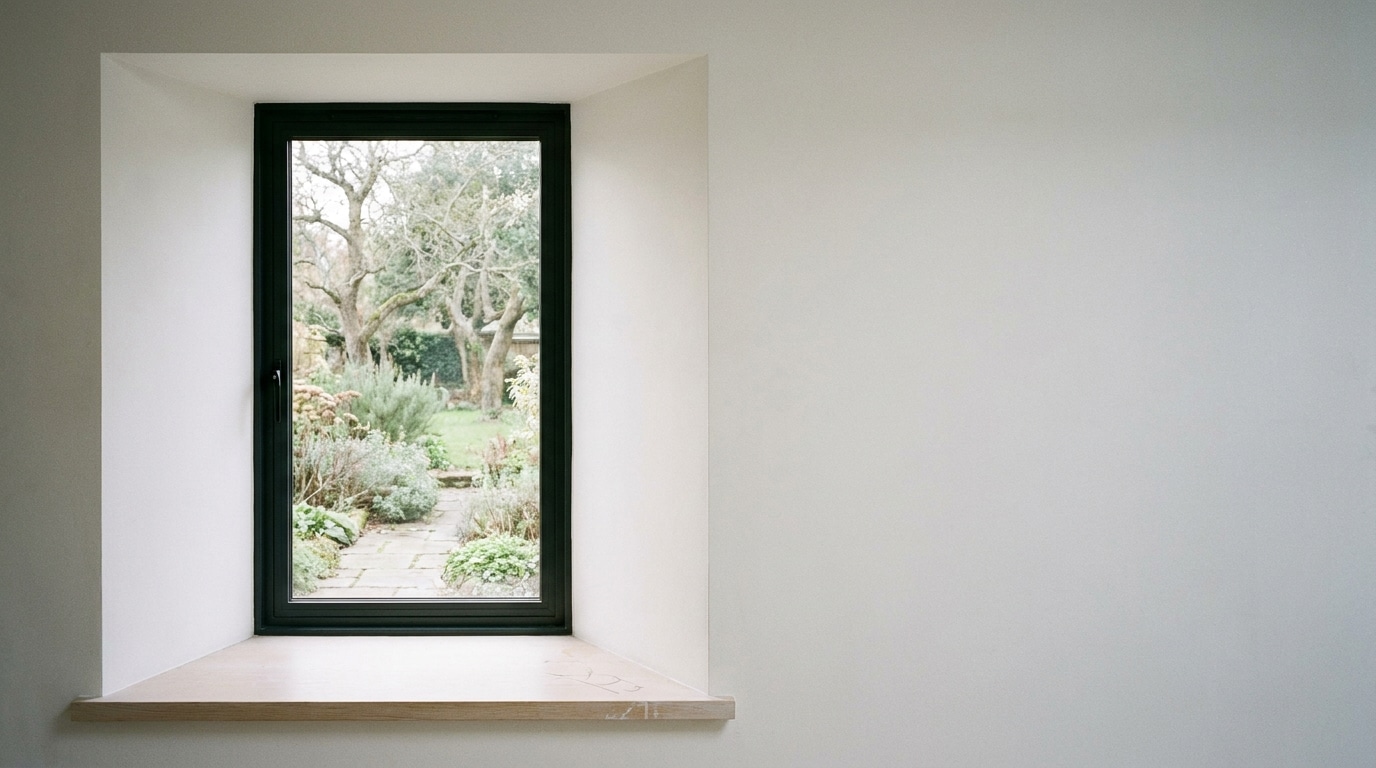
Black frames photograph beautifully. The dark line draws the eye straight to the view and makes the glass read as a crisp rectangle rather than a vague bright patch. That effect is real, and it is why the look has lasted.
Daylighting guidance, though, points the other way. Work published through Lawrence Berkeley National Laboratory on daylighting with windows advises against large areas of dark color near a window, because dark surfaces absorb light instead of bouncing it further into the room, and because they create glare when seen beside a bright surface. The same guidance recommends keeping sills and revealing surfaces light, to spread daylight and soften the contrast at the edge of the window.
The mechanism is contrast. Glare is less about absolute brightness than about the gap between a bright source and everything around it. Daylighting work puts comfortable luminance variation at roughly 10:1, with discomfort setting in somewhere past 20:1. A dark frame against bright sky widens that gap at exactly the point your eye keeps crossing.
The resolution is narrower than the trend suggests. A slim dark frame on a large window is a thin line and causes nobody any trouble. Wide dark frames, dark reveals, and a dark wall around the window are a different proposition, particularly in a north-facing room with little light to spare. If you want the dark frame, keep the reveal, the sill and the wall around it light, and the frame reads as a graphic line rather than a dark border eating the daylight.
What Dark Frames Do on the Outside
Color on the exterior is a performance question before it is a style question, and it is the part most homeowners never hear about.
Dark profiles absorb far more solar energy than white ones. Writing in Window + Door, Travis Arthur of Cornerstone Building Brands notes that dark profiles can reach surface temperatures 50 to 60°F above the surrounding air, and that the resulting heat build-up stresses the material and affects its dimensional stability over time. Vinyl is a thermoplastic. Heat it enough, and it softens, bows, and pulls at the seals.
That is why serious manufacturers do not simply paint vinyl dark. Two processes handle it properly. Lamination bonds an acrylic film over a standard extrusion, giving color plus a scratch- and UV-resistant barrier. Coextrusion fuses a coloured outer layer to a white substrate as the profile leaves the die, using pigments formulated to reflect heat, so the color is part of the section and cannot chip or peel. Both are validated by heat build-up testing under ASTM D4803 and full unit thermal cycling under AAMA 1506, which checks that a complete window holds its shape under infrared heat.
Several points follow from this, and they are worth raising with whoever quotes your job. A company fitting replacement windows in Toronto, where a 30°C July and a minus 20°C January land in the same year, should have an answer to all four without checking.
- Painting an existing white vinyl frame a dark color is the one route to avoid. The paint was not engineered for the heat load, and it generally voids the frame warranty.
- Ask whether the dark finish is factory applied, and by which process. Laminated and coextruded finishes behave very differently from field-applied paint.
- Ask what the warranty says about dark colors specifically. Some manufacturers limit exterior colors by light reflectance value, and dark shades fall below the threshold.
- Aluminum and aluminum-clad wood windows sidestep the question, because neither cladding softens the way PVC does.
Two Tone Frames, and Why They Became the Standard Answer
The common solution is to run a dark color outside and white inside. It is now a stock configuration rather than a custom order: major manufacturers list black exterior with white interior as a standard product across single hung and slider ranges.
It works for reasons beyond keeping options open. Outside, the dark frame gives the contrast and the modern line. Inside, a light frame continues the reveal and the wall, keeps daylight bouncing into the room, and keeps the contrast at the window edge low. You get the look you want from the street and the daylight performance you need where you live.
The cost is flexibility later. Repainting a laminated or coextruded frame isn’t really an option, so the pairing you choose is the pairing you keep.
If you are weighing two-tone, look at a finished corner sample of both colors in daylight before you sign, ideally from a manufacturer that builds its own frames, such as Delco Windows and Doors.
Designers who work with the trend regularly make the same point: black frames read as both timeless and of the moment, which means the rest of the room has to carry them rather than lean on them. Homeowners who have lived with them tend to report two things: that dark frames show dust and water marks the way a dark car does, and that cheaper dark finishes scratch back to white.
Choosing by Room, Not by Trend
Work through the decision in this order, and the answer usually falls out.
- Start with the aspect. North-facing rooms get even, indirect light and never have a surplus. Prioritize glass area and VT: a casement or picture unit, a light interior frame, light reveals. South- and west-facing rooms have light to spare and a glare problem instead, so a lower VT and a darker interior frame are easier to live with.
- Then the room’s job. Anywhere you read, work at a screen, or cook facing a window, contrast at the window edge matters more than the frame color does. Keep the surround light.
- Then the style. Match the architecture first. If the house asks for double hung, use double hung and accept the check rail, or get the glass area back elsewhere in the same wall.
- Then the color, inside and out separately. They are two decisions, not one.
- Ask for the VT figure on the quote. It is on the label and rarely volunteered. Two quotes that look identical can differ by fifteen points of visible light.
Small rooms deserve one extra note. In a small north-facing room, the difference between a 0.36 VT triple-glazed unit with a wide dark interior frame and a 0.53 VT casement with a white one is not subtle. It is the difference between a room you use in the afternoon and one where you reach for the light switch at two o’clock.
Sources
- Tips for Daylighting with Windows, Lawrence Berkeley National Laboratory
- Behind Black and Bronze Vinyl Windows, Window + Door, April 2026
- Daylighting quality, VELUX knowledge base
- Window Visible Transmittance: A Complete Guide
- Casement vs. Double-Hung Windows, Building Advisor
- Are Black Windows Worth the Risk? Insights from Designers and Homeowners