For restorative sleep, your core body temperature needs to drop. A mattress that holds heat works against that process, which is why people who sleep warm tend to notice the difference between one mattress and another more sharply than anyone else.
If you’re shopping with temperature in mind, the construction matters more than the marketing. Here’s what to look at, in the order it’s worth looking at it.
Start With What Sits Under The Comfort Layer
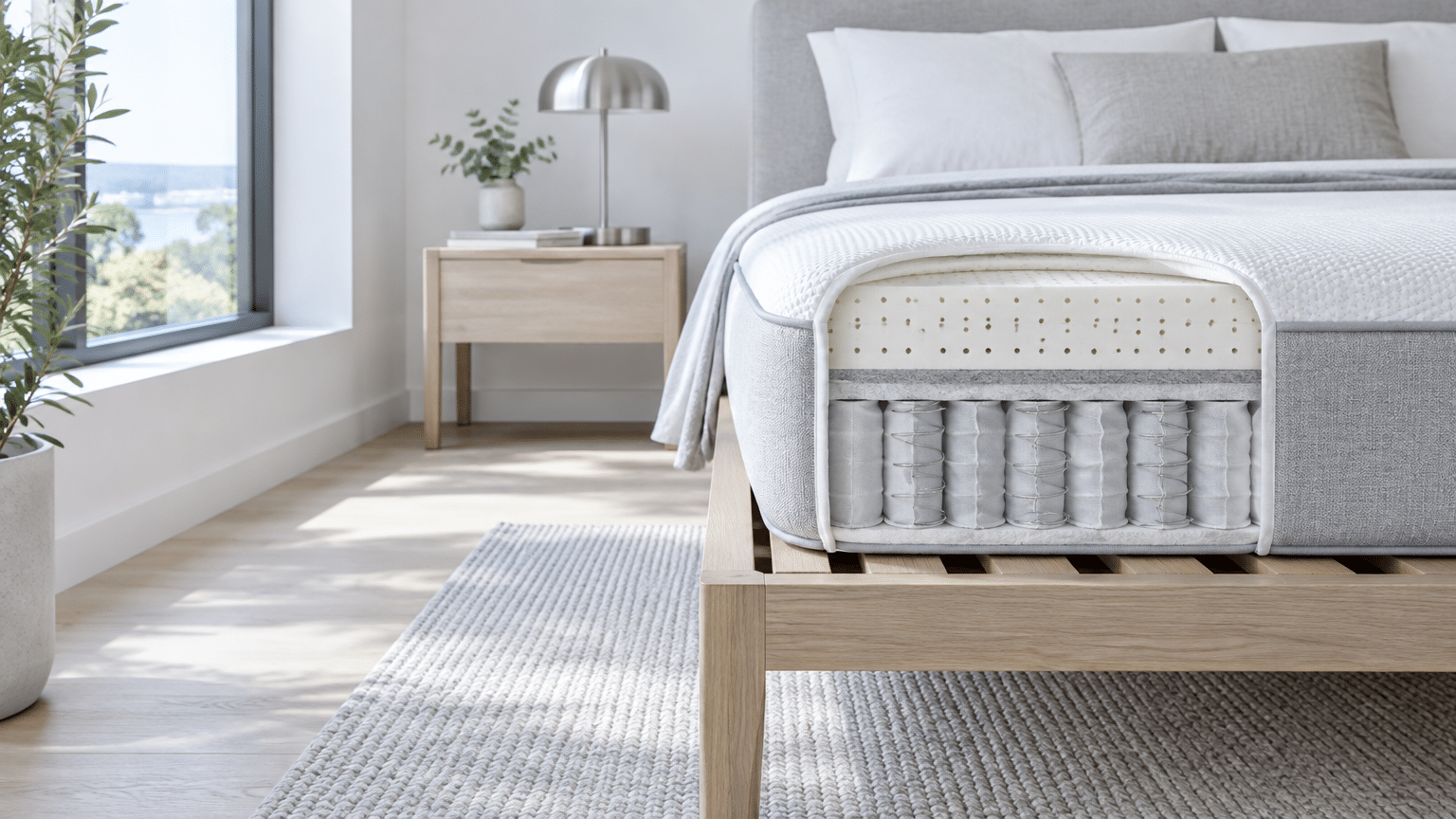
The support layer decides how much air can move through the mattress at all. An all-foam mattress can be a solid block. Air moves through it slowly, and body heat has nowhere obvious to go. A spring unit is mostly empty space, so warm air can move sideways and out through the sides of the mattress as you shift position, and cold air can be compressed upwards.
This is the single biggest structural factor for a hot sleeper, and it’s why hybrid mattresses dominate the market for people who overheat. Sleep brand Simba places its patented Aerocoil® pocketed microsprings right near the sleep surface, specifically to push warm air out and circulate cooler air every time you move.
Check What The Comfort Layer Is Made Of
Foam sits above the springs on most hybrids, and not all foam behaves the same way. Dense, slow-recovery foams hold their shape by holding onto heat. Open-structure foams are built with more air in them and release heat more readily.
Things worth asking about any foam layer:
- Is it open-structure or closed-cell?
- Does it offer any cooling properties?
- Is it perforated, channelled or otherwise ventilated?
- How thick is it, since a deep foam layer traps more heat than a shallow one.
- Does it sit above or below the spring layer?
Look At The Cover And Any Cooling Finish
The cover is the part your body actually touches, so its finish changes the first ten minutes of the night more than anything underneath.
Cool-touch treatments are designed to help regulate temperature at the sleep surface, and Simba’s cooling Stratos® technology can keep sheets up to 3°C cooler* than non-treated fabric. Additionally, the brand’s HeatRelease™ technology – engineered graphite strips that continuously pull excess warmth away – can be added as an upgrade for their Hybrid® Pro and Luxe mattresses, and is included as standard on the top-tier Hybrid® Ultra.
*Temperature testing carried out by HeiQ in November, 2020 on Stratos®-treated vs untreated fabric to measure immediate and continuous cooling.
Fix The Bedding At The Same Time

A cooling mattress underneath a heavy winter duvet won’t help you much. Tog rating is the simplest lever you have, and a lighter tog duvet for warm sleepers is often the most affordable swap you can make.
Simba’s own guidance splits it like this: 4.5 tog for warm summer months or people who sleep hot year-round, 7 tog for spring and autumn, and 10.5 tog for year-round use or people who feel the cold. Their duvets also pair breathable Simba Renew Bio™ fibers with Stratos® cool-touch covers, ensuring the duvet works with the mattress rather than insulating against it
Check The Room Before You Blame The Mattress
Some overheating has nothing to do with what you’re sleeping on.
- A bed pushed against an external wall or above a radiator runs warmer.
- A solid divan base can restrict airflow underneath the mattress compared with a slatted frame.
- Bedroom temperature around 16 to 18 degrees suits most sleepers.
- Blackout blinds keep daytime heat out of a south-facing room.
Working through these costs nothing and rules out the cheap explanations first.
What To Check On The Product Page
Most of what matters is published, if you know what you’re reading. Spring count tells you how finely the support layer is divided, and a higher count usually means the load is spread across more individual springs. Total depth tells you how much material sits between you and the base.
Layer descriptions are worth reading closely too. A mattress described as having springs and foam could have either one on top, and the order changes how quickly heat leaves the surface.
The Short Version
Run through this before you order:
- A spring support layer, not a solid foam core.
- Comfort foam that’s open-structure, perforated or otherwise ventilated.
- A removable, washable cover.
- A duvet tog that matches how warm you sleep.
- A slatted base, where the frame allows it.
- A trial period long enough to cover a change in season.
Temperature is the one thing you can only judge properly after a few weeks of real sleep, which makes the trial terms as important as the specification.
FAQs
Do hybrid mattresses sleep cooler than foam ones?
Generally yes. The spring layer leaves air space inside the mattress, so warmth can disperse as you move. The size of the difference depends on how much foam sits above the springs and how that foam is made.
Is a firmer mattress cooler?
Not necessarily. Mattress firmness does not directly determine how cool a mattress sleeps. Temperature regulation depends more on the materials used, the amount of airflow through the mattress and how well the construction allows heat to dissipate. Choose firmness based on comfort and support rather than temperature.
Should hot sleepers avoid mattress toppers?
Not necessarily, though a topper adds a layer between you and the ventilated part of the mattress. If you want one for comfort, look for the same properties you’d want in a mattress comfort layer, which means open-structure foam with some ventilation built into it.
How long should I test a mattress for temperature?
Long enough to cover a change in weather. A mattress bought in October may feel entirely different in July, which is an argument for buying from somewhere with a trial period measured in months.